
Three’s Company! The Moon, Venus, and Mercury Meet in Tonight’s Sky
Quick Summary
Tonight is a great night to look at the sky! Right after sunset, three bright objects will appear close together in the western sky: the thin crescent Moon, brilliant Venus, and the planet Mercury. Tonight is actually the very best night of the year to spot Mercury.
What Happened?
Every once in a while, the planets line up in ways that make for a beautiful view from Earth. Tonight, October 12, is one of those special nights.
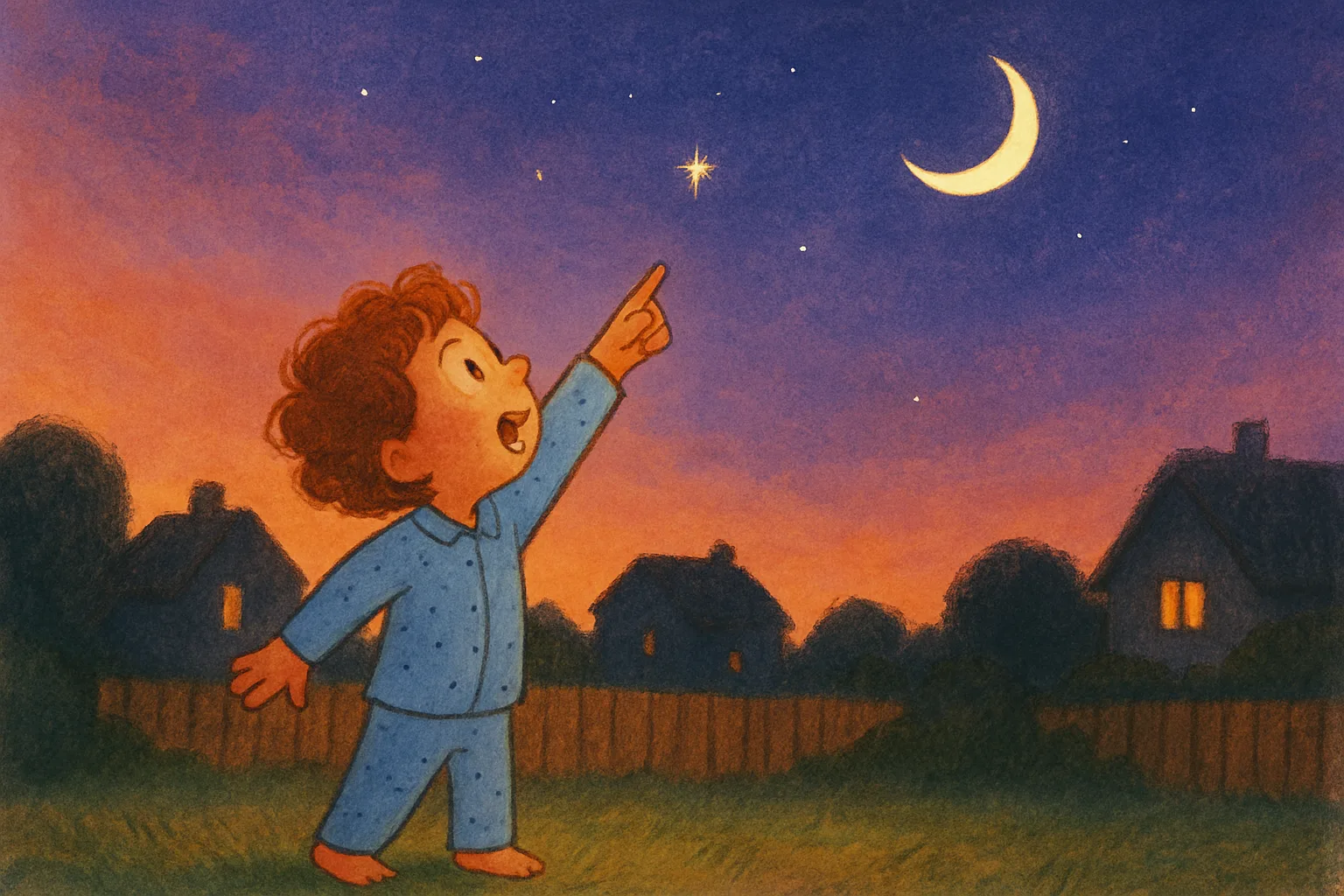
Here’s what you’ll see: Just after the Sun goes down, turn and look toward the western horizon — the direction where the Sun just set. You will see a very thin, curved crescent Moon, almost like a glowing fingernail clipping in the sky.
Nearby, shining like the brightest star you’ve ever seen, will be Venus. Venus is covered in thick clouds that reflect sunlight powerfully. Even though it is millions of miles away, it often outshines everything else in the sky except the Moon.
And near Venus, look carefully for a third dot of light — Mercury. Mercury is the smallest planet and the closest to the Sun. Most of the time it is impossible to see because it stays so close to the Sun’s glare. But tonight is Mercury’s greatest eastern elongation, which means it has swung as far from the Sun as it will get for this cycle. Tonight, Mercury sits about 25 degrees from the Sun — roughly the width of two outstretched fists held side by side.
That little gap of sky between Mercury and the Sun is what makes tonight so special. It is the best chance to spot Mercury with your naked eye in all of 2026.
Why Does It Matter?
Mercury is notoriously tricky to see. The ancient astronomer Copernicus reportedly never saw it with his own eyes! So if you spot it tonight, you’re in very good company with sky-watchers through history.
Seeing three solar system objects gathered in the same patch of sky — the Moon, Venus, and Mercury — is a rare treat. You don’t need a telescope or binoculars. Just step outside just after the Sun sets and look west. Act fast, though: they will only be visible for about 30 to 45 minutes before they sink below the horizon.
From the Southern Hemisphere, skywatchers have an even better view than those in the Northern Hemisphere, where Mercury sits quite low. Either way, it is worth stepping outside!
Big Words
- Crescent Moon — the Moon phase when only a thin, curved sliver of the Moon is lit up by sunlight, shaped like the letter C
- Greatest eastern elongation — the moment when Mercury (or Venus) appears farthest from the Sun in the evening sky, making it easiest to spot
- Western horizon — the edge of the sky in the direction where the Sun sets each evening
- Naked eye — seeing something with just your eyes, without a telescope or binoculars
- Planet — a large, round body that orbits the Sun; our solar system has eight planets, and Mercury is the smallest and closest to the Sun
Fun Fact
Mercury travels around the Sun faster than any other planet — it completes one full orbit in just 88 Earth days! That means Mercury has already lapped Earth almost three times since the start of 2026.
Think About It
If you could visit any planet in our solar system, which one would you choose, and why?
Sources
- Star Walk — October Astronomical Events: What to See in the Night Sky This Month
- Star Walk / Space news — Night Sky Tonight: What to See This Week (October 11–17, 2026)