
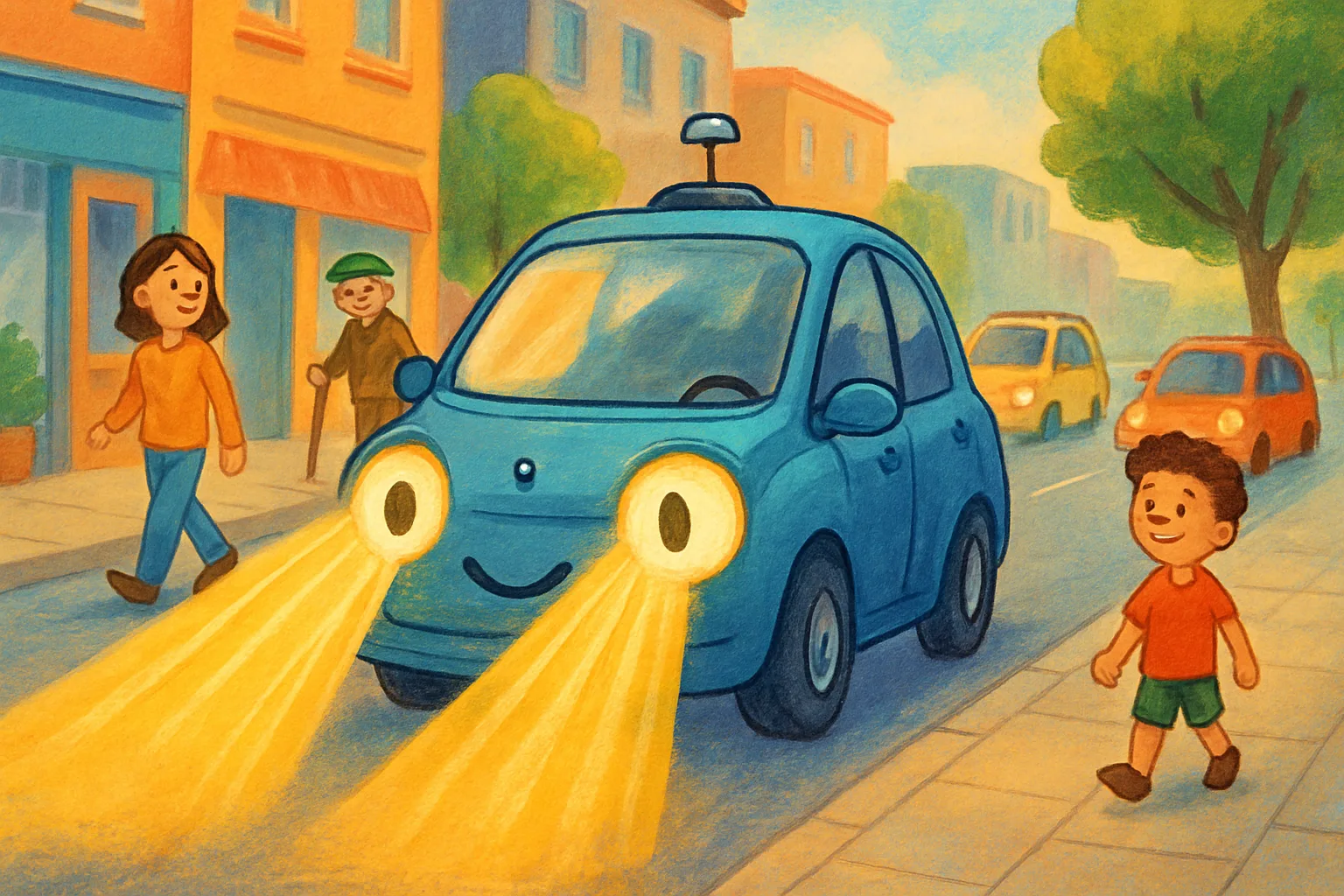
Self-Driving Cars Are About to Get Much Better Eyes!
Quick Summary
Engineers at MIT built a tiny new chip that could give self-driving cars a much wider and clearer view of the world around them. The chip uses light instead of moving parts to “see.” This solves a problem that has puzzled researchers for years.
What Happened?
Self-driving cars need to know exactly what is around them at all times. They need to spot other cars, pedestrians, bikes, and even a ball rolling into the street. To do this, they use a technology called lidar.
Lidar works a lot like bat echolocation — but with light instead of sound. The system shoots out invisible pulses of infrared light in all directions. When the light bounces back off nearby objects, the car’s computer measures how long it took. From that, it builds a detailed 3D map of everything nearby, updated many times per second.
Older lidar systems use spinning or moving parts to send light in different directions. But moving parts can break over time — imagine a spinning fan that starts to wobble after a few years. That makes them expensive and unreliable.
A newer approach puts the whole lidar system onto a tiny chip, called a silicon-photonics chip. This chip uses light instead of electricity to process information. Think of it like swapping out a big, heavy flashlight for a tiny, powerful laser on your fingernail. No moving parts means nothing to break!
But there was still a big problem. Chip-based lidar had tunnel vision. It could see clearly in the center but struggled to spot things at the edges — like wearing horse blinders. The antennas on the chip were too close together and kept scrambling each other’s signals, like two radio stations playing at the same time.
MIT engineers solved this by designing specially shaped antennas that can sit side by side without interfering with each other. In tests, the new chip steered a single, sharp beam of light across a wide area while keeping its signal clean and clear. The team published their results in the scientific journal Nature Communications.
Why Does It Matter?
Better lidar means safer self-driving cars. With a wider, clearer view, a self-driving car can spot a child running into the street from the corner of its “eye” — just like a careful human driver would. This technology could also be used in drones mapping disaster zones, robots working in warehouses, and even tools that help build skyscrapers more safely.
Big Words
- Lidar — A system that uses pulses of light to measure distances and create 3D maps of the surroundings, similar to how bats use sound.
- Silicon-photonics chip — A tiny computer chip that controls and uses light instead of electrical signals to process information.
- Infrared light — A type of light that humans cannot see with their eyes but that cameras and sensors can detect.
- Antenna — A device that sends or receives signals, like radio waves or light pulses.
- Field of view — The total area that a sensor or camera can see at one time; a wider field of view means seeing more of the world at once.
Fun Fact
Lidar was first used by scientists in the 1960s to measure the distance from Earth to the Moon! Today, it fits on a chip smaller than your thumbnail.
Think About It
If you were designing a self-driving car, what other kinds of sensors besides lidar would you want it to have? Why might more than one type of sensor make the car safer?
Sources
- ScienceDaily — MIT’s New Lidar Chip Could Give Self-Driving Cars a Wider View (July 22, 2026)
- Interesting Engineering — Silicon-photonics lidar chip widens autonomous vehicle vision range
- SciTechDaily — MIT Engineers Solve a Major Lidar Problem That Has Stumped Researchers for Years
- Nature Communications (2026) — Reduced-crosstalk antennas for grating-lobe-free and wide-field-of-view integrated optical phased arrays