
Moon Dirt From Mars! Japan Launches a Spacecraft to Grab Samples From a Tiny Moon
Quick Summary
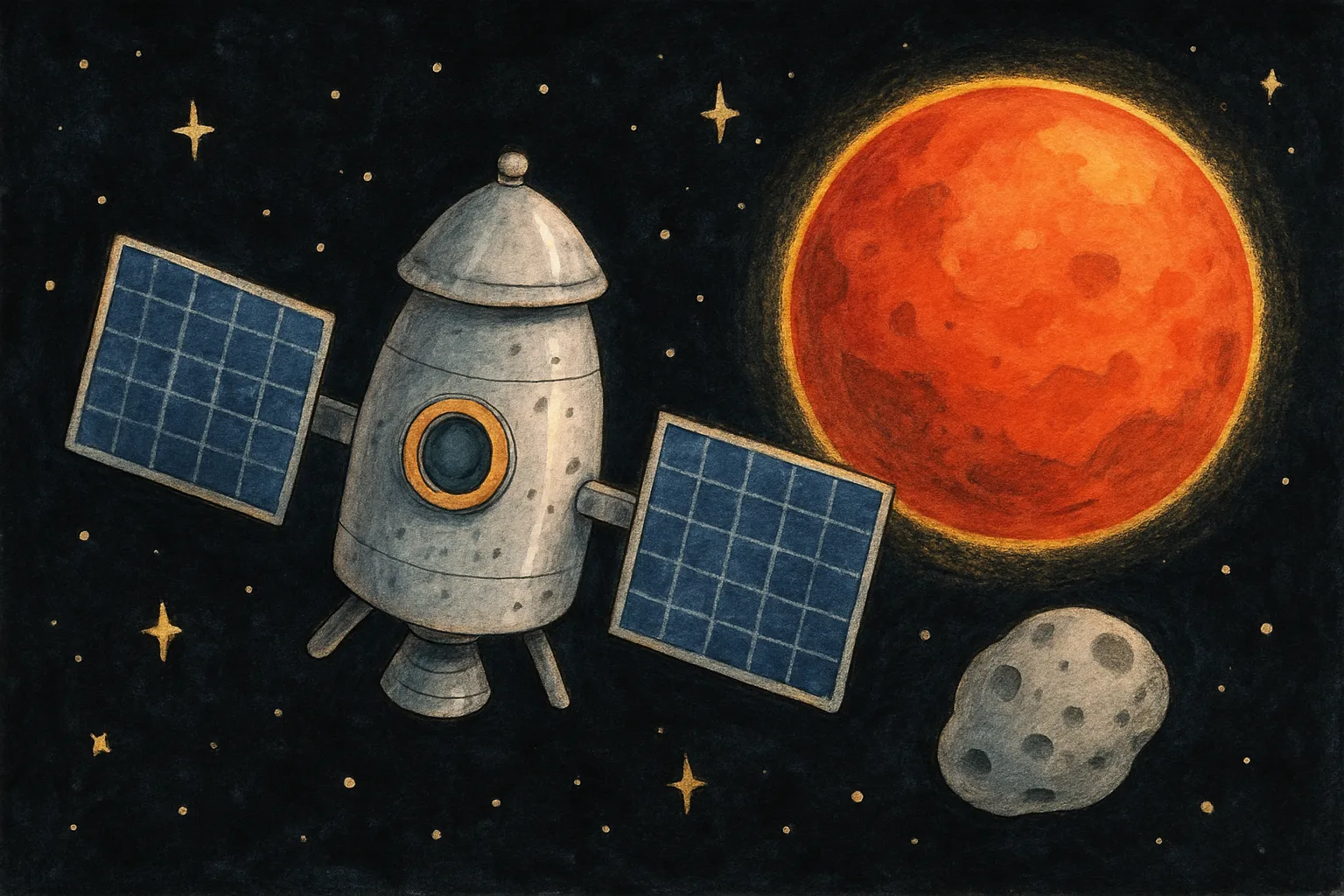
Japan launched a spacecraft today called MMX on a five-year journey to the moons of Mars. Its big goal is to scoop up a tiny handful of soil from Phobos — one of Mars’s two moons — and bring it all the way back to Earth. Scientists hope those grains of soil will solve a mystery that has puzzled them for years.
What Happened?
Today, a rocket blasted off from Tanegashima Space Center in Japan carrying a spacecraft called MMX. Those three letters stand for Martian Moons eXploration. The rocket is Japan’s powerful H3, and it sent MMX racing toward Mars at incredible speed.
MMX is a team effort. Japan’s space agency, JAXA, built and leads the mission. NASA added two science instruments to help with the investigation. The European Space Agency, ESA, is helping the spacecraft communicate across hundreds of millions of miles. France and Germany together built a small rover — named Idefix — that is riding along inside.
After about ten months of travel, MMX will reach Mars. That’s roughly as long as a whole school year. Once there, the little Idefix rover will hop off and explore the surface of Phobos on its own.
Phobos is very small. If you could hold it, it would be about the size of a city — roughly 14 miles from one side to the other. It is covered in craters and ancient dust.
The main MMX spacecraft will then carefully land on Phobos and collect at least ten grams of soil. That is about the same weight as two teaspoons of sugar. Then it will fly all the way back to Earth, dropping the precious sample capsule into Australia in 2031.
Why Does It Matter?
Scientists are not sure where Phobos actually came from. Two main ideas compete. One idea says it is an old asteroid that got pulled in by Mars’s gravity long ago. The other idea says it was created when a space rock smashed into Mars billions of years ago, sending chunks into orbit that clumped together.
The soil samples will help scientists figure out which story is true. The samples may also carry clues about what our solar system was like before life began on Earth.
This will be the first time any mission has ever brought material back from the region of Mars. It is a historic moment for space exploration!
Big Words
- Spacecraft — a vehicle built to travel through outer space
- Sample return — a mission that travels to another world, collects material, and brings it back to Earth for study
- Rover — a small robotic vehicle that drives around on the surface of another world to explore and gather information
- Gravity — the invisible pulling force that keeps planets, moons, and everything else in orbit around larger objects
- Orbit — the curved path one object takes as it circles around another object in space
Fun Fact
Phobos is so close to Mars and moves so fast that if you stood on Mars, you would see Phobos rise in the west and set in the east — the opposite direction from the Sun!
Think About It
If you were a scientist and you could send a robot to collect soil from any place in the solar system, where would you send it and why?
Sources
- EarthSky — The MMX mission launches to Mars’ moons on Monday
- The Planetary Society — MMX, Japan’s Martian Moons eXploration mission
- NASA Science — NASA to Help Unlock Mysteries of Mars’ Moons in Upcoming Mission
- SpacePolicyOnline — JAXA’s MMX Mars Mission Readies for Launch with Two NASA Instruments
- ESA / Digg — JAXA’s MMX mission is set to launch October 19, 2026, for a Phobos sample-return attempt