
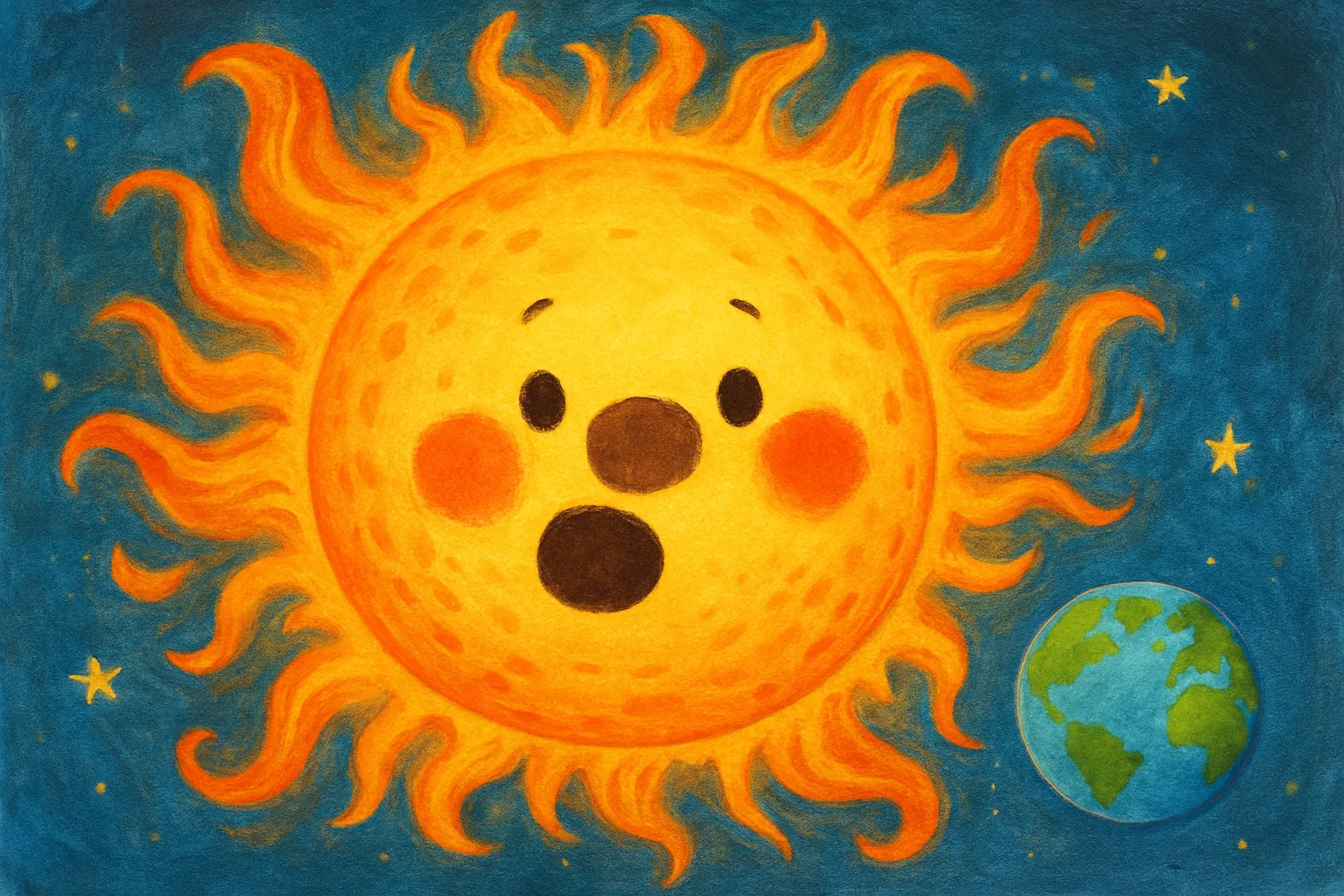
Sun Surprise! A Monster Sunspot Is Staring Right at Earth
Quick Summary
A giant sunspot called AR4551 has appeared on the sun and is now pointing straight at Earth. Scientists say it has the strongest magnetic setup a sunspot can have. Everyone is watching to see if it fires off a big solar flare.
What Happened?
Sunspots are dark patches on the sun’s surface. They form where powerful magnetic forces tangle and twist, blocking some of the sun’s heat from escaping. Think of them like enormous knots in a garden hose — the pressure builds up and up.
This week, a sunspot region called AR4551 caught scientists’ attention. It grew quickly over just a few days. Now it has what experts call a beta-gamma-delta magnetic field. That is the strongest and most tangled type of magnetic setup a sunspot can reach. It is as if that garden hose knot grew tight enough to burst.
Right now, AR4551 is sitting in the middle of the side of the sun that faces Earth. Scientists call this being “geoeffective.” In plain language, it means any explosion from this sunspot would head straight toward our planet.
So far, AR4551 has mostly fired smaller flares called C-class flares — the everyday kind. But scientists say it has enough magnetic energy to launch a much bigger M- or X-class flare. Solar flares get rated like report card grades: C is common, M is moderate, and X is the biggest and most powerful.
On October 15, AR4551 fired its strongest blast yet — a C4.9 flare. That is still in the smaller range. Experts are keeping a close eye on it as it slowly moves across the sun’s face.
Why Does It Matter?
If a very powerful flare goes off and points toward Earth, it can cause something called a coronal mass ejection, or CME. That is a giant cloud of charged particles shooting out from the sun at millions of kilometers per hour.
When those particles reach Earth, they can light up the sky with beautiful auroras — the northern and southern lights. That is the amazing part! They can also briefly mess with radio signals and GPS systems that people use every day.
Scientists at NOAA’s Space Weather Prediction Center track sunspots around the clock. They help protect satellites, power grids, and communication systems by giving early warnings before any big blast arrives.
The last four years have been especially active for sunspots. Our sun goes through an 11-year cycle of activity, and right now we are near the most active part of that cycle — called solar maximum.
Big Words
- Sunspot — a dark patch on the sun’s surface caused by strong magnetic forces
- Solar flare — a powerful burst of energy and light from the sun
- Geoeffective — pointed toward Earth, so any explosion could reach our planet
- Coronal mass ejection (CME) — a giant cloud of charged particles blasted from the sun into space
- Aurora — colorful lights in the night sky caused by particles from the sun hitting Earth’s atmosphere
Fun Fact
Sunspot AR4551 is enormous — sunspots can grow to be many times wider than the entire planet Earth. If Earth sat next to this sunspot, it would look like a marble next to a basketball.
Think About It
If you could design a “space weather alert app” for your school, what information would you want it to show kids every day?
Sources
- EarthSky — Sun news: Meet monster sunspot region AR4551 (Oct 16, 2026)
- SpaceWeather.com / NOAA — A Potentially Dangerous Sunspot: Big sunspot 4551 (Oct 16, 2026)
- ARRL Solar Update — Sunspot Region 4551 fueling increased activity (Oct 2026)