
Speed Demons of the Deep! Scientists Unlock How Sea Giants Hunted Prey
Quick Summary
While dinosaurs ruled the land, giant reptiles called mosasaurs ruled the seas. A new study used fossil bones and math to figure out how fast they could attack. The answer? Blazing fast — and sneaky.
What Happened?
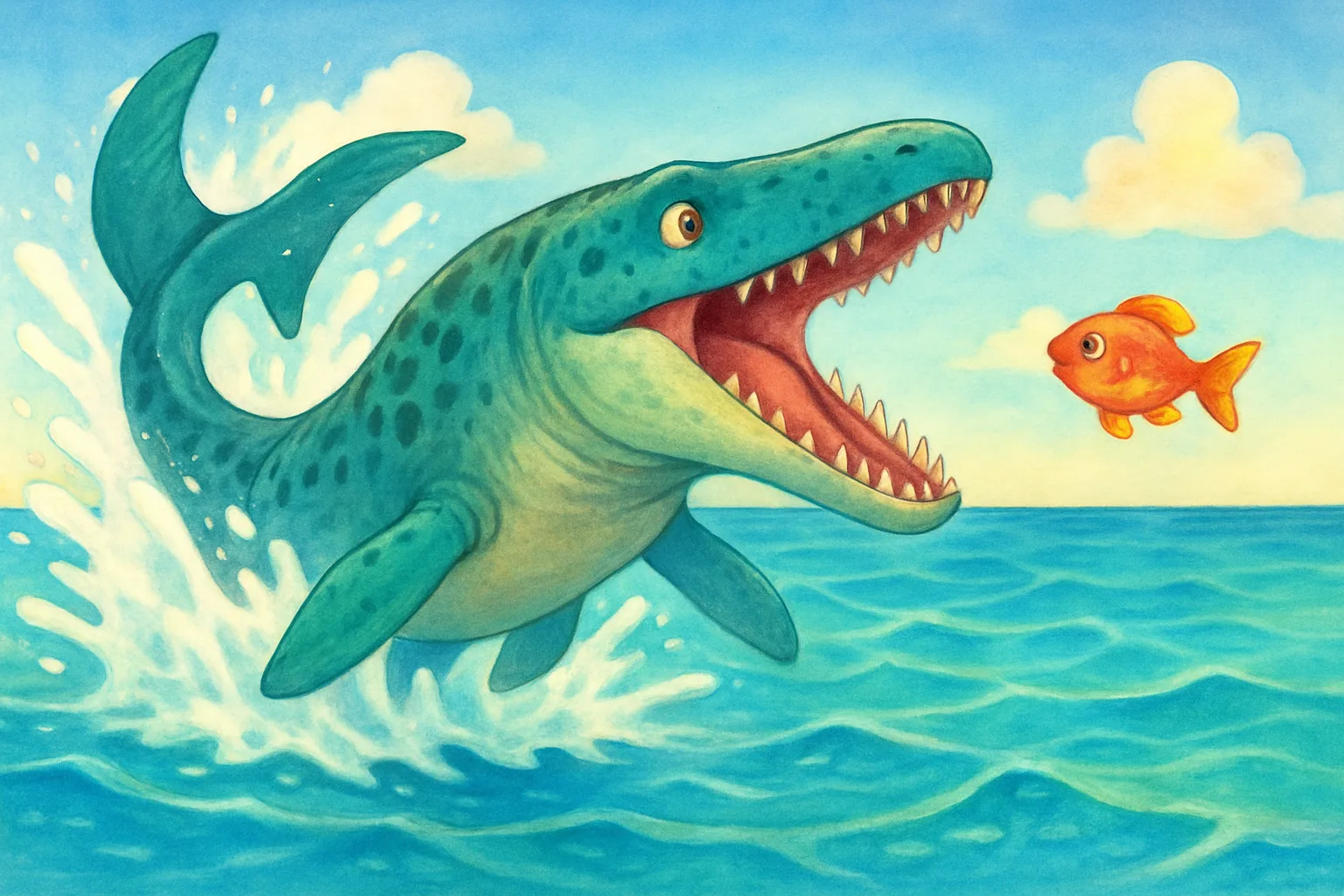
Scientists at Rutgers University studied the tails of four types of mosasaurs. Mosasaurs were huge marine reptiles that lived about 66 to 100 million years ago, at the same time as T. rex. The biggest ones grew as long as 56 feet — roughly as long as three school buses parked end to end.
Researchers used fossil skeletons and computer models to calculate how hard each creature could push through the water with one big sweep of its tail. They called this burst of speed a “slam-start.” Think of it like a swimmer launching off a pool wall, but the wall is the animal’s own tail.
The results were published in the journal Current Biology. One large type called Tylosaurus could reach about 15 miles per hour in a single tail stroke. That’s way faster than the fastest human swimmer, who tops out around 5 miles per hour.
Not all mosasaurs hunted the same way, though. Some, like Tylosaurus, had long, flexible tails built for explosive surprise attacks — a lot like a crocodile ambushing prey near the shore. Others had shorter, stiffer tails better suited to cruising steadily through open water, more like a tuna chasing fish over long distances.
“At the same time dinosaurs like T. rex were ruling the land, mosasaurs were ruling the seas,” said lead researcher Kiersten Formoso of Rutgers University.
Why Does It Matter?
Fossils usually only preserve bones — not muscles or skin. This study showed that scientists can use the shape of those bones, plus the laws of physics, to work out how an extinct animal moved. It’s like figuring out how fast a car could go just by studying its engine parts.
Understanding how mosasaurs hunted helps scientists piece together what ancient ocean ecosystems looked like. It also opens the door to studying the movement of other extinct creatures the same way.
Big Words
- Mosasaur — a large, extinct marine reptile that ruled Earth’s oceans during the age of the dinosaurs
- Fossil — the preserved remains or shape of a living thing that died long ago, turned to rock over millions of years
- Biomechanics — the science of how living bodies move, using the rules of physics
- Ambush predator — a hunter that hides and waits quietly, then strikes with a sudden burst of speed
- Slam-start — the scientists’ nickname for a mosasaur’s explosive one-tail-stroke lunge at prey
Fun Fact
Mosasaurs were not actually dinosaurs — they were more closely related to today’s monitor lizards and snakes! A Komodo dragon is one of their living relatives.
Think About It
If you could only look at an animal’s skeleton and never see it alive, what clues would you use to figure out how it moved and hunted?
Sources
- Current Biology (Formoso et al.) — Mosasaur tail morphology reveals burst swimming performance and ecological diversity
- EurekAlert / Rutgers University — Some of those ancient sea predators were built for surprise attacks
- NPR Short Wave — The terrifying physics of prehistoric sea monsters
- phys.org — Flexible tails could boost ancient sea predators’ ambush speeds, fossil-based models suggest
- Nautilus — Mosasaurs Were Capable of Explosive Speed