
Stormy Skies, Better Warnings! Europe’s Smartest Weather Satellite Launches Tonight
Quick Summary
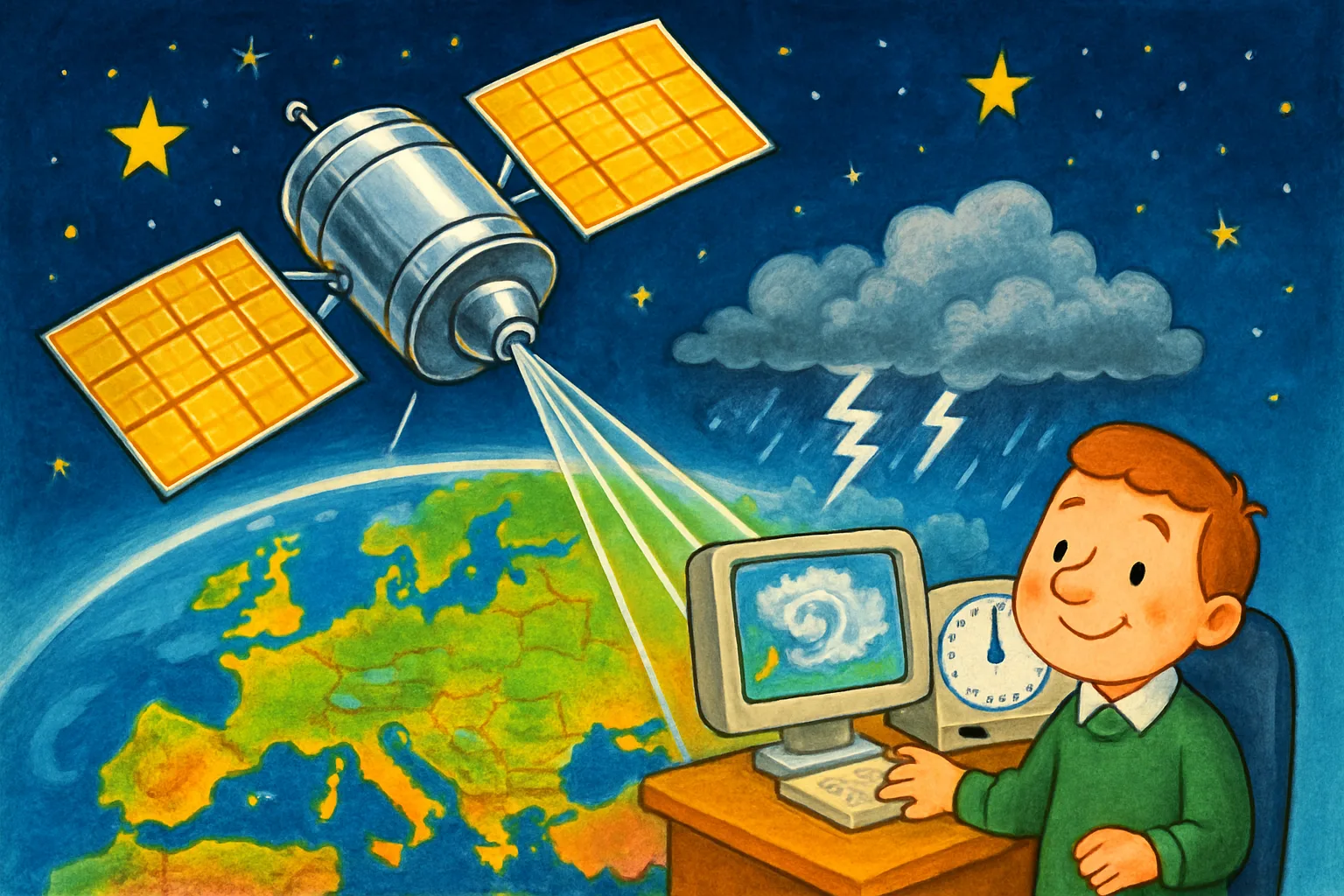
A powerful new European weather satellite called MTG-I2 is launching into space tonight. It will watch over Europe and Africa from high above, snapping pictures of storms every two and a half minutes. This completes Europe’s most advanced storm-tracking system ever built.
What Happened?
Tonight, August 27, an Ariane 6 rocket will roar off the launchpad at Europe’s Spaceport in Kourou, French Guiana, carrying a very special passenger: a satellite named MTG-I2.
MTG stands for Meteosat Third Generation. Think of it like a brand-new model of a smartphone — much sharper, much faster, and far smarter than the old version. MTG-I2 is the second imaging satellite in a team of three satellites that will work together to give weather forecasters an extraordinary view of storms over Europe and Africa.
Once in its place, MTG-I2 will orbit 36,000 kilometers above Earth. That is so high that if you stacked about 4,500 Eiffel Towers on top of each other, they still would not reach it. From that dizzying height, the satellite will photograph the same patch of sky every two and a half minutes. That is more than five times faster than the older satellites it replaces.
MTG-I2 carries two special cameras. One captures detailed images of clouds and rainfall in 16 different color channels — more than twice as many as before. The other is a Lightning Imager, which detects lightning flashes across a huge area. Together, they can spot a dangerous thunderstorm building from space — before it becomes truly dangerous on the ground.
The satellite will also see storms in much sharper detail. Its visible-light camera now captures features as small as 500 meters across — about the length of five football fields. The older satellites could only see things 1,000 meters across, or larger.
Liftoff is scheduled for 10:10 p.m. local time in French Guiana. The whole mission from launch to satellite release takes about 36 minutes.
Why Does It Matter?
Accurate weather warnings save lives. When forecasters can see a violent thunderstorm forming earlier, they can warn pilots to reroute planes, warn farmers to protect crops, and alert communities to take shelter. This is especially important for fast-moving severe storms that can grow from nothing to dangerous in just an hour.
MTG-I2 completes Europe’s first full family of next-generation weather satellites. Together, EUMETSAT — the organization that operates Europe’s weather satellites — says the system will be able to track an entire storm’s life cycle from space for the very first time.
Big Words
- Satellite — a spacecraft that orbits a planet, often used to collect information and send it back to Earth
- Geostationary orbit — a special orbit 36,000 km above Earth where a satellite travels at exactly the right speed to stay above the same spot on the ground at all times
- Nowcasting — very short-range weather forecasting, predicting what will happen in the next hour or two rather than days ahead
- Lightning Imager — a camera on MTG-I2 designed to detect lightning flashes over a wide area from space
- Imager — a type of satellite instrument that takes pictures of Earth’s surface, clouds, and weather
Fun Fact
The MTG-I2 satellite weighs 3.8 metric tons at launch — about as heavy as three large pickup trucks. Yet once in orbit, it can detect a lightning bolt flickering for just a fraction of a second, from 36,000 kilometers away!
Think About It
If you were designing a satellite to help people, what would you want it to look for — and how would you use the information it sent back?
Sources
- ESA — “MTG-I2 ready for launch” (esa.int)
- EUMETSAT — “Launch of Meteosat Third Generation Imager 2 (MTG-I2)” (eumetsat.int)
- Arianespace Newsroom — “Arianespace to launch weather satellite MTG-I2 on Ariane 6’s first mission to geostationary orbit on August 27, 2026”
- Meteorological Technology International — “MTG-I2 launch to bring new era of rapid weather monitoring from space”