
Secret Tunnel on the Moon? NASA Is Sending a Mission to Find Out!
Quick Summary
NASA has chosen a special mission called GIMLI to visit a mysterious dark hole on the Moon. Scientists think that hole might be the opening to a giant underground cave or tunnel made of ancient lava. If they are right, it could be one of the most exciting discoveries in lunar science in decades.
What Happened?
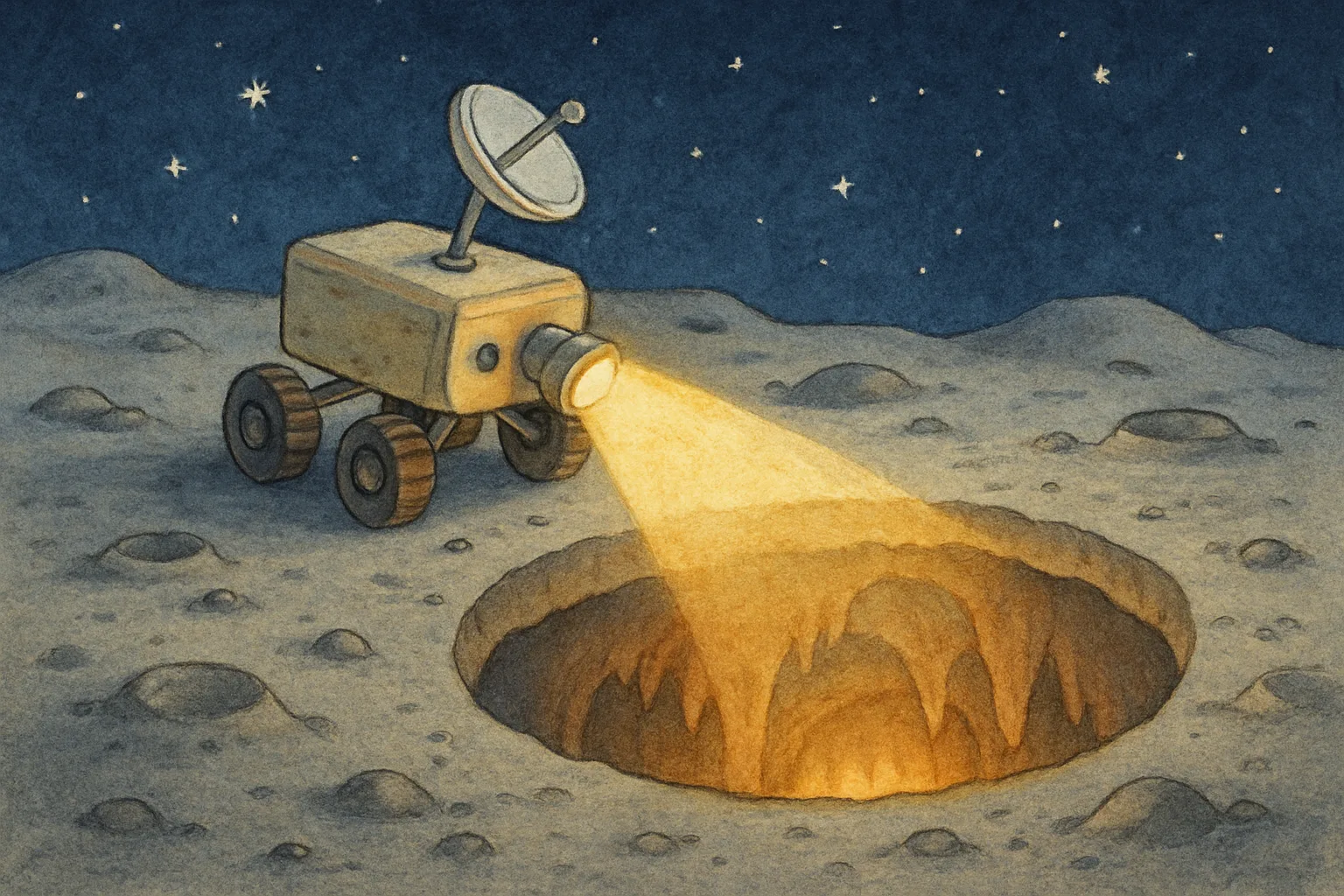
On the Moon’s surface, in a bumpy volcanic region called the Marius Hills, there is a dark round pit. It is about 65 meters wide — roughly the same as the length of an Olympic swimming pool. Scientists first spotted it in 2009, when Japan’s Kaguya spacecraft photographed it from orbit. Ever since, researchers have wondered: does that pit go straight down into solid rock? Or does it open into something much bigger — a huge underground cavern?
NASA has now selected a project called GIMLI — short for Geophysical Instruments for Marius Lunar pit Investigation — to go find out. Scientists from the Planetary Science Institute in Tucson, Arizona are leading the mission. They will build special instruments that will ride to the Moon on a lander and a rover.
GIMLI will not jump down into the hole right away. Instead, it will study the pit from the outside, like a doctor using an X-ray to look inside a patient without making a cut. The tools include:
- Ground-penetrating radar — sends radio waves into the ground and listens for echoes from below, the way sonar detects fish underwater
- Seismic sensors — measure tiny vibrations in the ground to figure out what is solid rock and what might be empty space
- A gravimeter — a super-sensitive scale that measures tiny changes in gravity, which can reveal where rock is missing underground
The Norwegian Space Agency will supply the radar equipment. Honeybee Robotics will build the instruments. This will be the first intentional seismic survey on the Moon since Apollo 17 in 1972 — more than 50 years ago.
If GIMLI finds a giant lava tube cave beneath the pit, it would be an enormous discovery. Lava tubes form when liquid rock — called lava — flows through the ground and the outside crust cools and hardens while the inside keeps draining away, leaving a hollow tunnel behind. On Earth, lava tubes can stretch for many kilometers. On the Moon, they could be even bigger — because the Moon’s lower gravity means the rock ceiling can hold up over a much wider space.
Why Does It Matter?
A confirmed lava tube cave on the Moon would be exciting for two big reasons. First, it would tell scientists a lot about the Moon’s volcanic past. Second — and here is where it gets really cool — caves could be perfect shelters for future astronauts. On the Moon’s surface, temperatures swing from scorching hot to freezing cold, and dangerous radiation from the Sun beats down constantly. Underground caves would stay at a steady temperature and block that radiation. Future moon explorers could set up a base inside one — like living in a natural underground house!
Big Words
- Lava tube — a hollow tunnel left behind when flowing lava drains out and the outer crust hardens
- Ground-penetrating radar — a tool that sends radio waves into the ground to find what is hidden below the surface
- Seismic sensor — an instrument that detects vibrations moving through the ground
- Gravimeter — a super-sensitive instrument that measures tiny changes in gravity to find empty spaces underground
- PRISM — NASA’s program that sends science instruments to the Moon aboard commercial spacecraft
Fun Fact
Lava tubes on Earth can be walked through like long dark hallways. One in Hawaii called Thurston Lava Tube is so large and smooth inside that tourists visit it every year — and Moon lava tubes could be hundreds of times bigger!
Think About It
If scientists confirm there is a giant cave on the Moon, what would you put inside it to make a cozy home for astronauts?
Sources
- Planetary Science Institute — PSI-led team selected for NASA PRISM program to explore potential lunar cave
- Phys.org — Team selected for NASA program to explore potential lunar cave
- ScienceDaily — This mysterious hole on the Moon may open into a giant cave
- TechTimes — NASA Picks Lunar Lava Tube Hunt: First Surface Seismic Survey Since Apollo
- Above the Norm News — NASA Will Investigate Whether a Hole in the Moon Opens Into a Giant Cave (citing NASA official announcement)