
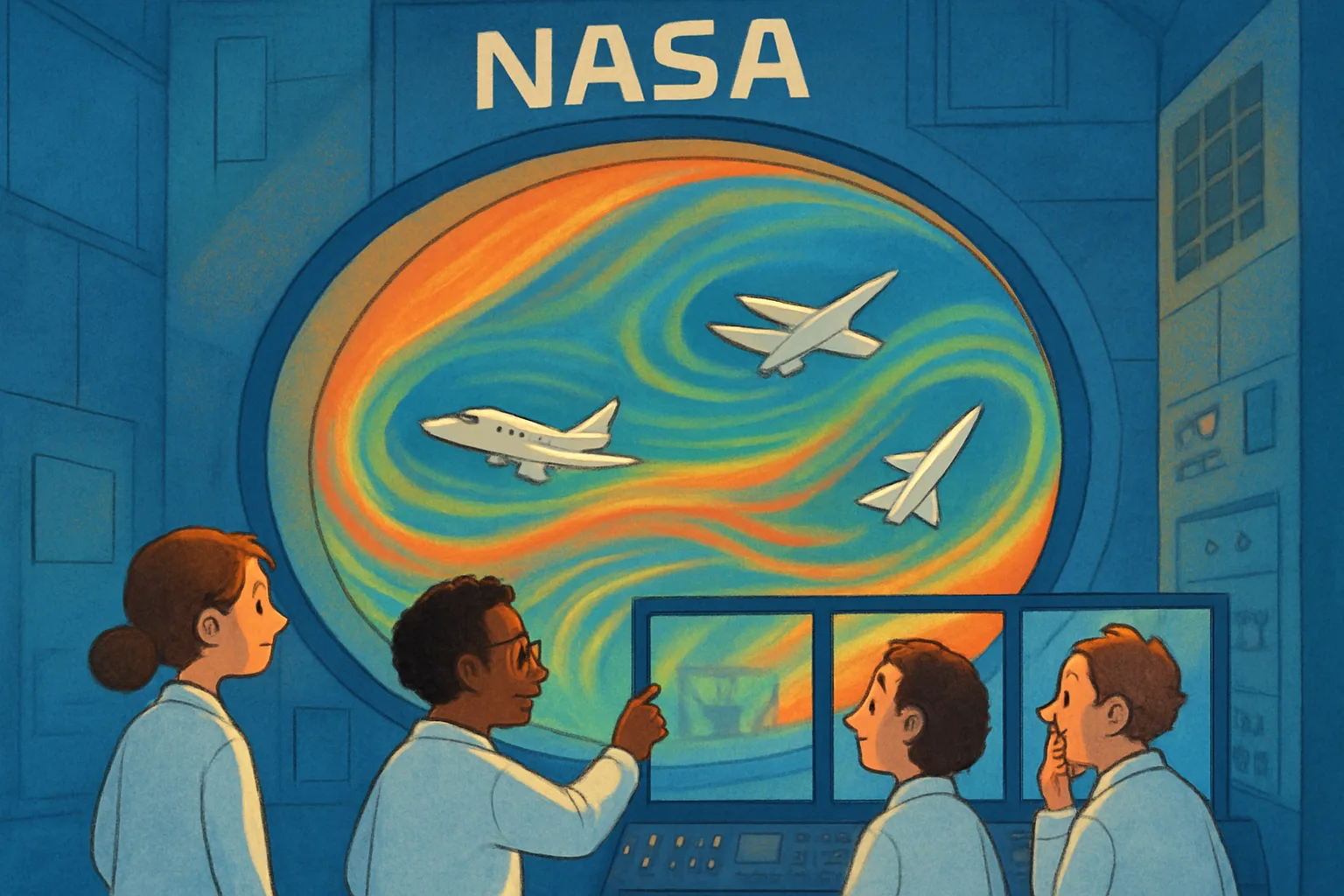
NASA Just Cut the Ribbon on Its First New Wind Tunnel in Over 40 Years!
Quick Summary
Today, NASA officially opened a brand-new wind tunnel at its Langley Research Center in Virginia. It’s called the Flight Dynamics Research Facility, and it’s the first major new wind tunnel NASA has built in more than 40 years. Engineers plan to use it to test future airplanes, drones, and even spacecraft headed to the Moon.
What Happened?
NASA held a ribbon-cutting ceremony this morning at Langley Research Center in Hampton, Virginia. NASA Administrator Jared Isaacman was there to celebrate the opening. The new facility has been under construction since 2022, and today it was finally ready for the world to see.
So what exactly is a wind tunnel? Picture a giant tube with a powerful fan at one end. The fan blows air through the tube at very high speed. Engineers place a small model of an airplane — or a drone, or a spacecraft — inside. As the air rushes past the model, scientists can see exactly how it flies. It’s like holding your hand out a car window and feeling the wind push against it — but much more precise and scientific.
NASA’s new tunnel is called a vertical wind tunnel. Instead of blowing air sideways, it blows air straight up. That’s important for testing how aircraft spin, tumble, and recover. Think of it like a skydiver in a wind tube at a skydiving center — but for experimental spacecraft and planes.
The Flight Dynamics Research Facility is enormous. It stands 131 feet tall — that’s about as tall as a 13-story building. Its test chamber is 20 feet across and 24 feet high. Engineers will use it to test drones, experimental aircraft called X-planes, and technology for landing spacecraft safely on the Moon and Mars.
This new tunnel replaces two older tunnels at Langley that have been running since the 1930s and 1940s. Those historic tunnels helped design nearly every U.S. military aircraft built since World War II. Now, after more than 40 years without a major new tunnel, NASA is ready for the next chapter.
Why Does It Matter?
Airplanes and spacecraft need to be tested before real people fly in them. Wind tunnels let engineers find problems — and fix them — before anything leaves the ground. NASA’s new tunnel can test things the older tunnels couldn’t. It will help make future planes quieter, safer, and greener. It will also support the Artemis program, which is working to send astronauts back to the Moon. Getting a spacecraft to land safely takes a lot of practice — and that practice can start right here on Earth, inside a wind tunnel.
Big Words
- Wind tunnel — a tube where fast-moving air is blown past a model so engineers can study how it flies
- Aeronautics — the science of designing and flying aircraft
- Vertical — pointing straight up and down, like a flagpole
- X-plane — an experimental aircraft built to test new technologies, often with unusual shapes
- Artemis — NASA’s program to return astronauts to the Moon
Fun Fact
NASA’s Langley Research Center has been testing flying machines for over 100 years! Some of the earliest research done there helped the Wright Brothers’ successors figure out how to build better planes in the early 1900s.
Think About It
Engineers test models in wind tunnels before building the real thing. Can you think of other jobs where people practice on a small model or copy before making the full-size version?
Sources
- NASA.gov — NASA to Showcase Agency’s Newest Wind Tunnel in Virginia (July 22, 2026)
- Aero-News Network — NASA Opens New Wind Tunnel (July 2026)
- NASA.gov — NASA’s Newest Wind Tunnel Builds on Legacy of Innovation
- NASA.gov — Flight Dynamics Research Facility Characteristics