
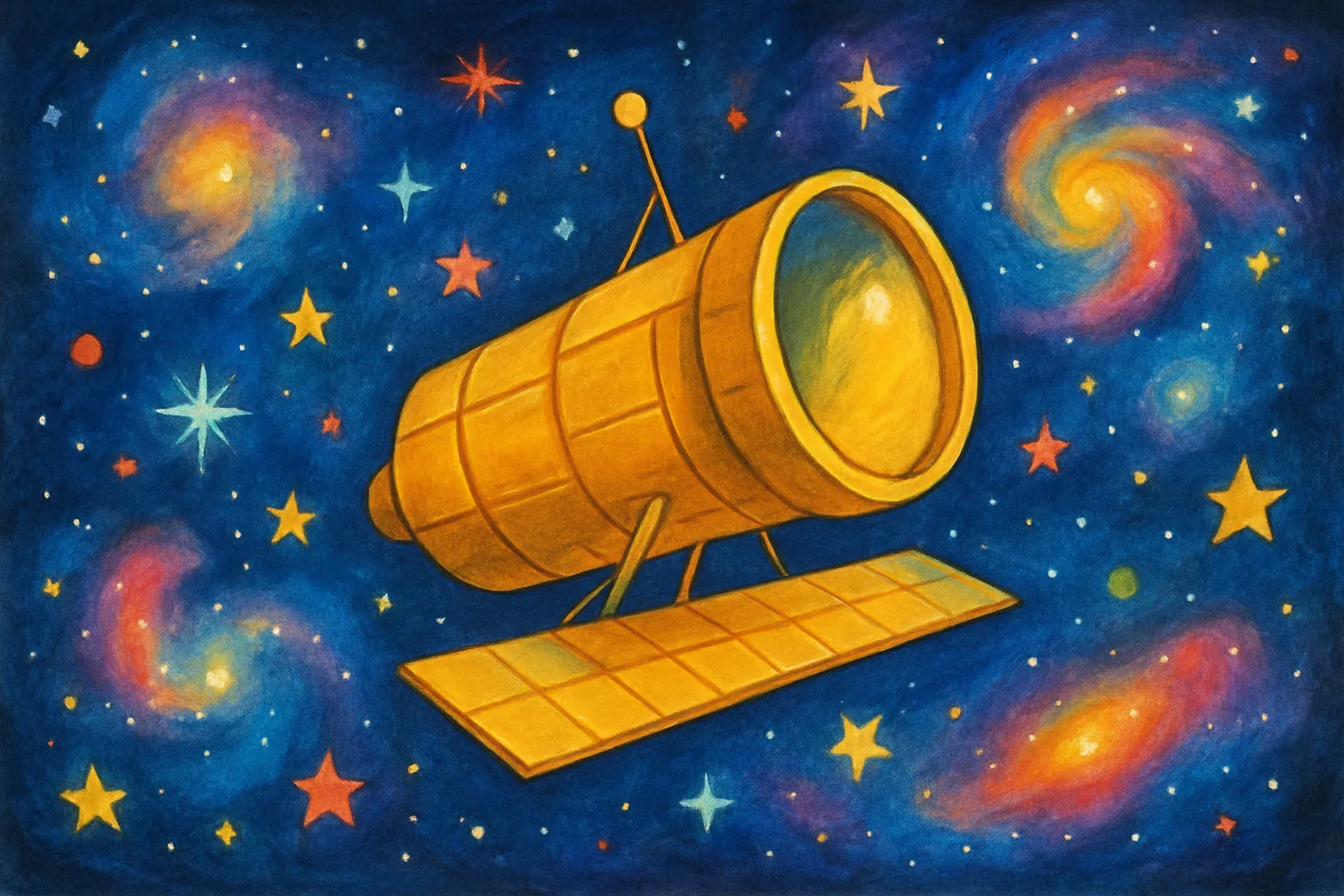
Brand-New Telescope! NASA Just Picked Its Next Great Eye on the Universe
Quick Summary
NASA has officially chosen a powerful new space telescope called PRIMA. It will study the universe using a special kind of light that human eyes cannot see. Scientists hope it will answer some of the biggest questions about how stars, planets, and even water on Earth got here.
What Happened?
On Wednesday, September 23, NASA announced that a mission called PRIMA is moving forward. PRIMA stands for PRobe far-Infrared Mission for Astrophysics. That is a long name for an amazing idea.
PRIMA will look at the universe using far-infrared light. Infrared is a kind of energy, just like regular light — but it is invisible to our eyes. It is the same kind of warmth you feel from the Sun on your skin. Far-infrared is an even lower-energy version of that. Cold, dusty clouds of gas in space glow in far-infrared, making it perfect for seeing places where stars and planets are being born.
Think of it this way: regular cameras photograph a party by capturing the lights and colors. But far-infrared cameras can also see the heat from the food! PRIMA will catch light from the universe that every other telescope misses.
NASA says PRIMA is designed to bridge the gap between the famous James Webb Space Telescope and powerful radio telescopes here on Earth. It will study how galaxies, black holes, and planets formed and changed over billions of years. Scientists are also excited that PRIMA could help explain how water arrived on Earth in the first place.
PRIMA has a 5.9-foot-wide telescope mirror and has a budget capped at about 1.2 billion dollars. It is the first telescope ever chosen in NASA’s brand-new Probe Explorers program. The plan is to launch it around the year 2033.
Why Does It Matter?
Every major space telescope has taught us something amazing. PRIMA is designed to open a whole new window that has never been fully explored. It could help answer questions like: Where did Earth’s water come from? How do black holes grow? Why does the universe look the way it does today?
Big Words
- Far-infrared — a type of invisible energy given off by cold objects in space; far-infrared telescopes can see dusty clouds where stars are forming
- Galaxy — a massive system of billions of stars, gas, and dust held together by gravity; our home galaxy is called the Milky Way
- Black hole — a region in space where gravity is so strong that nothing, not even light, can escape
- Astrophysics — the branch of science that uses physics and chemistry to understand how stars, planets, and the universe work
- Phase B — a step in NASA’s process for building a new spacecraft, when engineers start working on detailed designs and technology
Fun Fact
The James Webb Space Telescope, launched in 2021, has already shown us some of the oldest galaxies ever seen. PRIMA will study many of those same galaxies in far-infrared light, revealing hidden details Webb could not see — like a second pair of glasses that shows colors your first pair missed!
Think About It
If PRIMA can help scientists figure out where Earth’s water came from, what else might we learn about how life on Earth got started?
Sources
- NASA.gov — NASA Selects Far-Infrared Telescope as First in New Mission Class
- JPL/Caltech — NASA Selects PRIMA Mission; Key Roles for Caltech, JPL, and IPAC
- The Print — NASA announces new $1.2 billion far-infrared telescope to uncover secrets of the universe
- The News Pakistan — NASA’s PRIMA telescope has one big mission: Decode cosmic evolution