
NASA’s July 4th Gift: The Universe Dressed in Red, White, and Blue!
Quick Summary
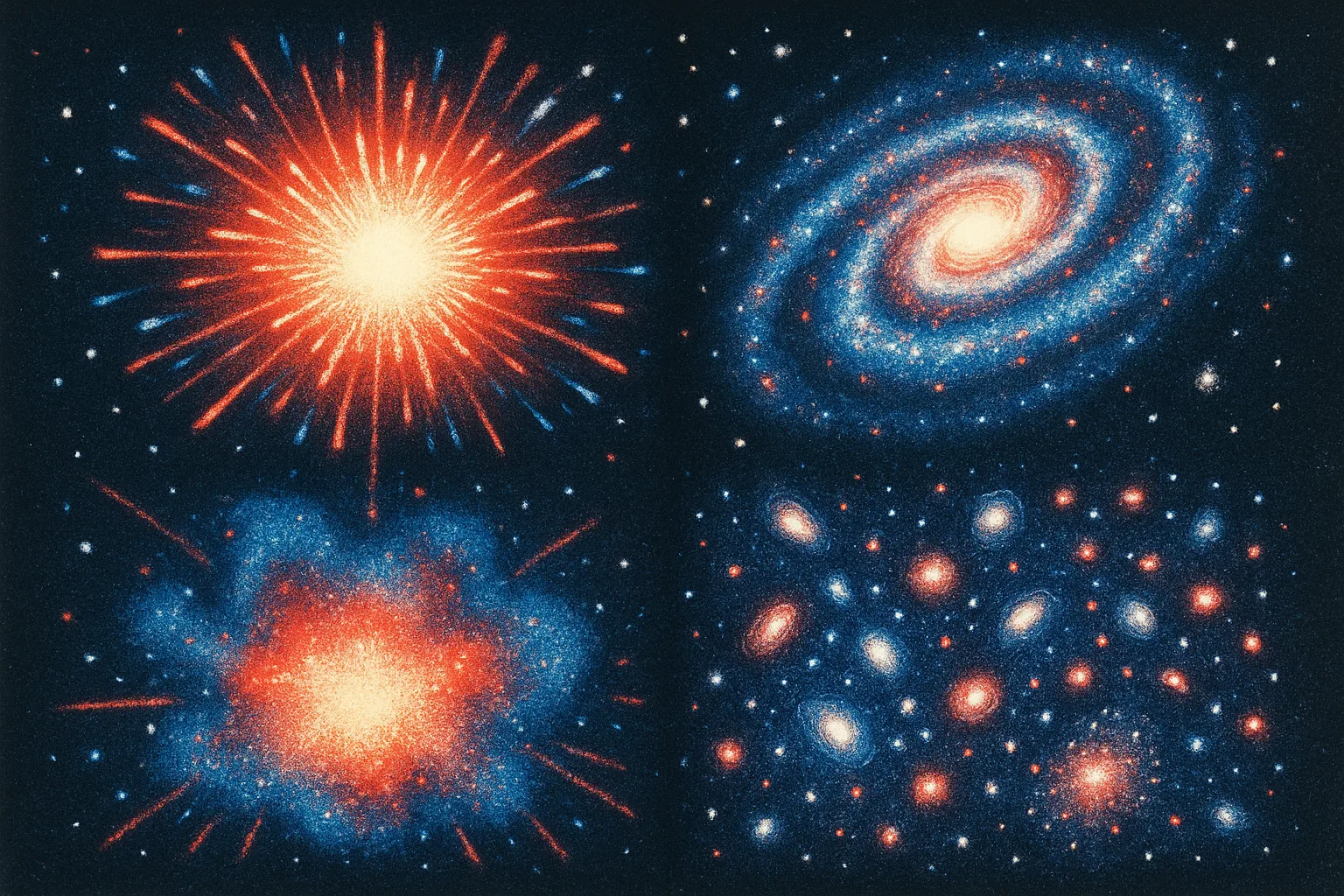
To celebrate America’s 250th birthday, NASA released four breathtaking space images — all colored in red, white, and blue. The pictures show everything from an exploded star to a cluster of thousands of galaxies. You can even listen to the universe make music!
What Happened?
Fireworks, parades, and … space pictures! NASA decided to join the Fourth of July celebration in the most out-of-this-world way possible.
Scientists used data from some of the most powerful telescopes ever built — including the Chandra X-ray Observatory, the Hubble Space Telescope, and the James Webb Space Telescope — to create four stunning images of deep-space objects. Then they colored every picture in America’s patriotic colors: red, white, and blue.
Here is what each picture shows:
Cassiopeia A — The glowing leftovers of a massive star that exploded in a giant blast called a supernova. It spreads across space like a beautiful cosmic firework. It contains iron, calcium, and oxygen scattered across the debris.
NGC 3603 — A giant cloud of gas and dust where brand-new stars are being born right now. It sits 20,000 light-years away from us inside our own Milky Way galaxy. One light-year is about 6 trillion miles — so this star nursery is almost impossibly far away.
Messier 94 — A spiral galaxy with a bright glowing ring of new stars forming around its center, like a spinning cosmic pinwheel.
ZwCl 0024+1652 — An enormous cluster of thousands of galaxies all held together by gravity. Scientists used this image to study something invisible called dark matter.
But NASA did not stop at pictures! The team also turned the images into music. They mapped the telescope data to different sounds and instruments — a process called sonification. So you can not only see these objects, you can actually hear them as music.
Why Does It Matter?
NASA’s celebration is a reminder that exploring space is one of America’s greatest adventures. The Chandra X-ray Observatory has been flying in orbit since 1999 — 27 years of looking at the most extreme events in the universe.
The sonification project is especially cool because it helps people who are blind or have low vision experience space in a whole new way. Sound can take you places that images alone cannot.
Looking at these four images, it is easy to see why humans have always looked up at the sky in wonder. The universe is full of beauty, waiting to be discovered.
Big Words
- Supernova — a massive explosion that happens when a large star runs out of fuel and collapses; it can be brighter than an entire galaxy for a short time
- Nebula — a giant cloud of gas and dust in space, often where new stars are born
- Sonification — turning data (like telescope measurements) into sound or music so people can hear what the universe looks like
- Dark matter — a mysterious invisible substance that scientists believe makes up much of the universe’s mass, but which no one has directly seen yet
- X-ray — a type of high-energy light that can pass through many materials; NASA’s Chandra telescope sees X-rays from the hottest, most violent events in space
Fun Fact
The Chandra X-ray Observatory orbits Earth at a distance of up to 86,500 miles — about one-third of the way to the Moon! That high orbit keeps it above the X-rays that are blocked by Earth’s atmosphere.
Think About It
If you could turn one thing from your everyday life into music using sonification — the way NASA turns starlight into sound — what would you choose and what do you think it might sound like?
Sources
- NASA.gov — ‘NASA Celebrates America’s 250th Birthday’
- Scientific American — ‘For July 4, NASA unveils an astronomical fireworks show, complete with sound effects’
- Space.com — ‘Stunning new NASA space telescope images reveal the universe in red, white and blue for America 250’
- Popular Science — ‘NASA celebrates Fourth of July with some cosmic fireworks’