
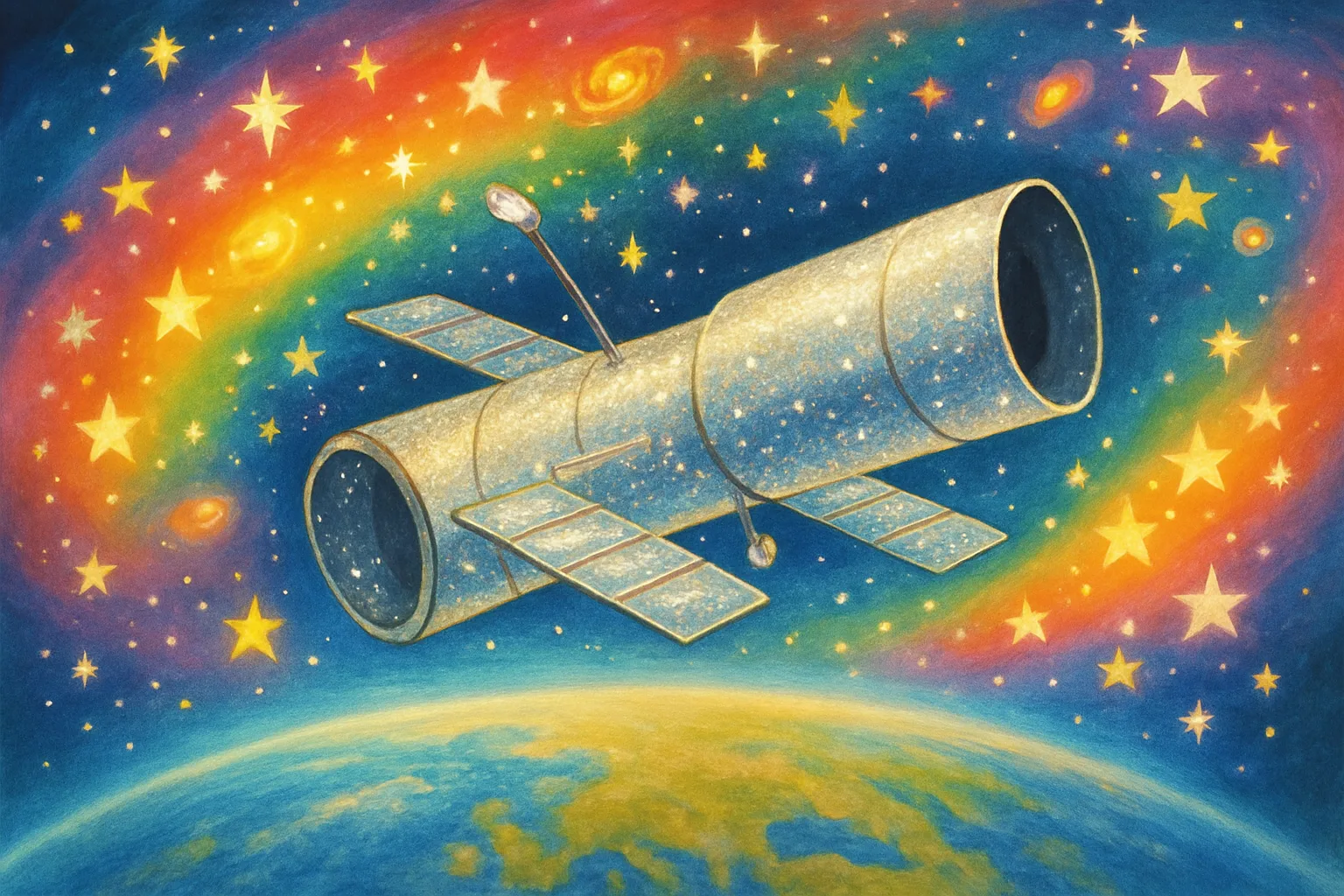
Fueled and Ready! NASA’s Newest Space Telescope Is Almost Set to Fly
Quick Summary
NASA just loaded fuel into its brand-new Roman Space Telescope. It is getting ready to blast off on August 30. When it reaches space, it will show us more of the universe than any telescope ever has.
What Happened?
Last week, a team of engineers in Florida did something very careful. They loaded 290 gallons of rocket fuel into NASA’s Nancy Grace Roman Space Telescope. That is about the same amount of liquid that would fill a small swimming pool. With that step done, the telescope is almost ready to launch.
The Roman Space Telescope is sitting at Kennedy Space Center in Florida right now. On August 30, it will ride a powerful SpaceX Falcon Heavy rocket into space. That is the same launchpad where many famous missions have lifted off.
Once in space, Roman will travel about one million miles from Earth. That is four times the distance to the Moon. It will settle into a special spot called Lagrange Point 2, or L2. At L2, gravity from the Sun and Earth balance perfectly. This lets the telescope stay in a very steady spot — perfect for looking at faint, faraway objects.
Why Does It Matter?
The Roman Space Telescope is going to see the universe in a way we never have before. Think of the Hubble Space Telescope taking one photo of the sky. Roman can take the same photo, but show 100 times more sky in one single picture. It is like switching from a peephole to a giant bay window.
In just five years, scientists think Roman will spot around 100,000 new planets beyond our solar system. That is more planets than all telescopes in history have ever found — combined.
Roman is named after Dr. Nancy Grace Roman. She was NASA’s first female chief astronomer and was a champion for the Hubble Space Telescope long before it was ever built. Because of her work, she is sometimes called the “Mother of Hubble.”
The launch was originally planned for May 2027. Scientists worked so hard and so well that it is now happening nine months early. NASA will hold a special news conference on July 29 to tell the world all about it.
Big Words
- Lagrange Point — a special spot in space where the gravity of two large bodies, like the Sun and Earth, perfectly balance, letting a spacecraft stay in one place easily
- Propellant — the fuel a spacecraft uses to fire its small engines and steer itself once it is in space
- Field of view — how much of the sky a telescope can see in one look; Roman’s is 100 times wider than Hubble’s
- Exoplanet — a planet that orbits a star other than our Sun
- Flagship mission — NASA’s biggest, most important kind of space mission, which takes many years and many scientists to build
Fun Fact
The Roman Space Telescope has a mirror the exact same size as Hubble’s — 2.4 meters across, about as wide as a car. But its camera can photograph 100 times more sky in one shot because of a special, extra-wide detector behind that mirror.
Think About It
If Roman can find 100,000 new planets in just five years, do you think any of them might be places where life could exist? What would scientists need to look for to find out?
Sources
- NASA Science Blog — ‘NASA Fuels Roman Space Telescope for Late August Launch’ (July 27, 2026)
- NASA.gov — ‘Roman Space Telescope Mission’ official page
- TechTimes — ‘NASA Moves Roman Space Telescope Launch Up To August 30’
- The Planetary Society — ‘The Nancy Grace Roman Space Telescope launch: what to expect’
- SpacePolicyOnline — ‘NASA Sets Launch Date for Roman Space Telescope’