
Look Out Tonight! The Farthest Planet Is at Its Best Right Now
Quick Summary
Tonight is a special night for planet watchers. Neptune — the most distant planet in our solar system — is at its closest and brightest point of the whole year. It’s called opposition, and it only happens once a year!
What Happened?
Every year, Earth laps Neptune in the race around the Sun. Think of it like a fast runner on an inside track passing a slow runner on the outside. When Earth zooms between the Sun and Neptune, that moment is called opposition. At that exact moment, Neptune is as close to us as it gets all year.
This year, Neptune hits opposition on the evening of September 25. Astronomers say it reaches its best position at 10 p.m. Eastern Time. That’s when it rises highest in the southern sky, right around midnight local time.
Neptune sits in the constellation Pisces, the Fishes. It hangs to the lower right of Saturn, which is easy to spot with the naked eye. The nearly full Harvest Moon is also glowing brightly nearby. That makes Neptune a little trickier to find — but certainly not impossible!
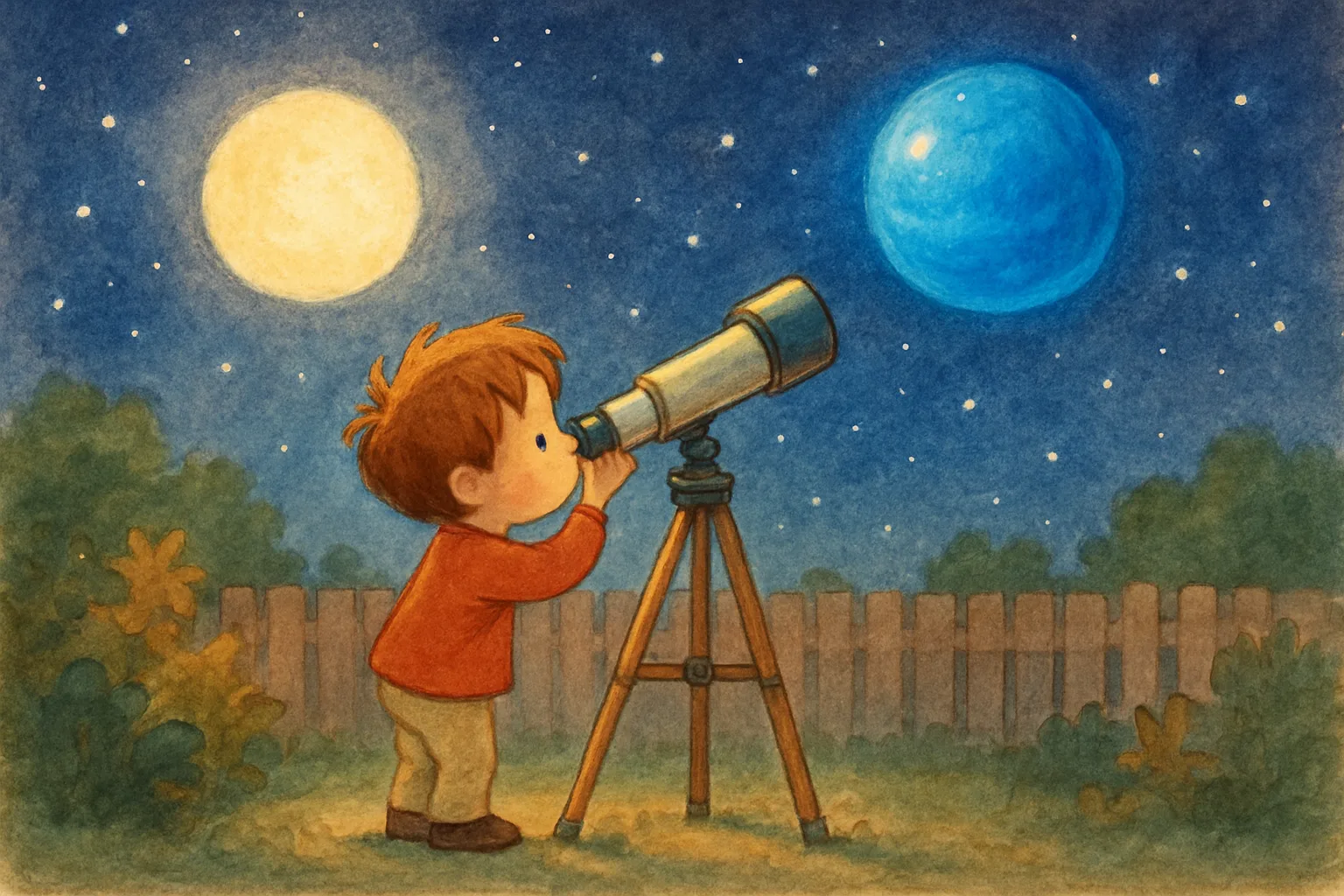
Here is the catch: Neptune is so far away that you cannot see it with just your eyes. You need binoculars or a telescope. Even in a telescope, it looks like a tiny blue-gray dot. But that tiny dot is a giant world. About 58 planet Earths could fit inside Neptune. It orbits the Sun more than 4 billion kilometers away — that is so far that light takes over four hours to travel from Neptune to us!
Neptune moves through the sky very slowly. It takes 165 years to complete one trip around the Sun. That means one Neptune year is longer than all of recorded American history.
Why Does It Matter?
Opposition nights are the best chance of the year to see Neptune for yourself. If you have never found it, now is the time to try! Scientists study Neptune to learn about how giant planets form and how the outer solar system works. Voyager 2 is the only spacecraft that has ever visited Neptune — that was back in 1989 — so every peek through a telescope adds to what we know.
Big Words
- Opposition — the moment when Earth passes between the Sun and an outer planet, placing that planet at its closest and brightest for the year
- Constellation — a group of stars that form a pattern in the sky, often named after animals or mythological figures
- Ice giant — a type of large planet made mostly of icy materials like water and ammonia; Neptune and Uranus are the two ice giants in our solar system
- Orbit — the curved path that a planet or moon follows as it travels around the Sun or another large body
Fun Fact
Neptune was discovered using math, not a telescope! In 1845, French astronomer Urbain Le Verrier noticed that Uranus was not moving exactly as expected. He calculated that another planet must be pulling on it — and he was right. Astronomers aimed their telescopes at the spot he predicted, and there was Neptune!
Think About It
If one Neptune year lasts 165 Earth years, how many Neptune years old would someone who lives to be 90 Earth years be?
Sources
- Astronomy.com — The Sky Today on Friday, September 25: Neptune at opposition
- EarthSky — Neptune at opposition on September 26, 2026
- Universe Today — Following Neptune Through Opposition 2026
- Star Walk Space — Neptune Opposition 2026