
Ghost Particles! A Scientist Wins the Nobel Prize for Catching Messengers From Deep Space
Quick Summary
A physicist named Francis Halzen just won science’s biggest award — the Nobel Prize. He built a giant detector buried deep under Antarctic ice. It catches mysterious particles called neutrinos that travel all the way from outer space.
What Happened?
Every year, scientists around the world wait to hear who wins the Nobel Prize in Physics. It is one of the highest honors a scientist can receive. This year, the prize went to Francis Halzen, a Belgian-American physicist at the University of Wisconsin-Madison.
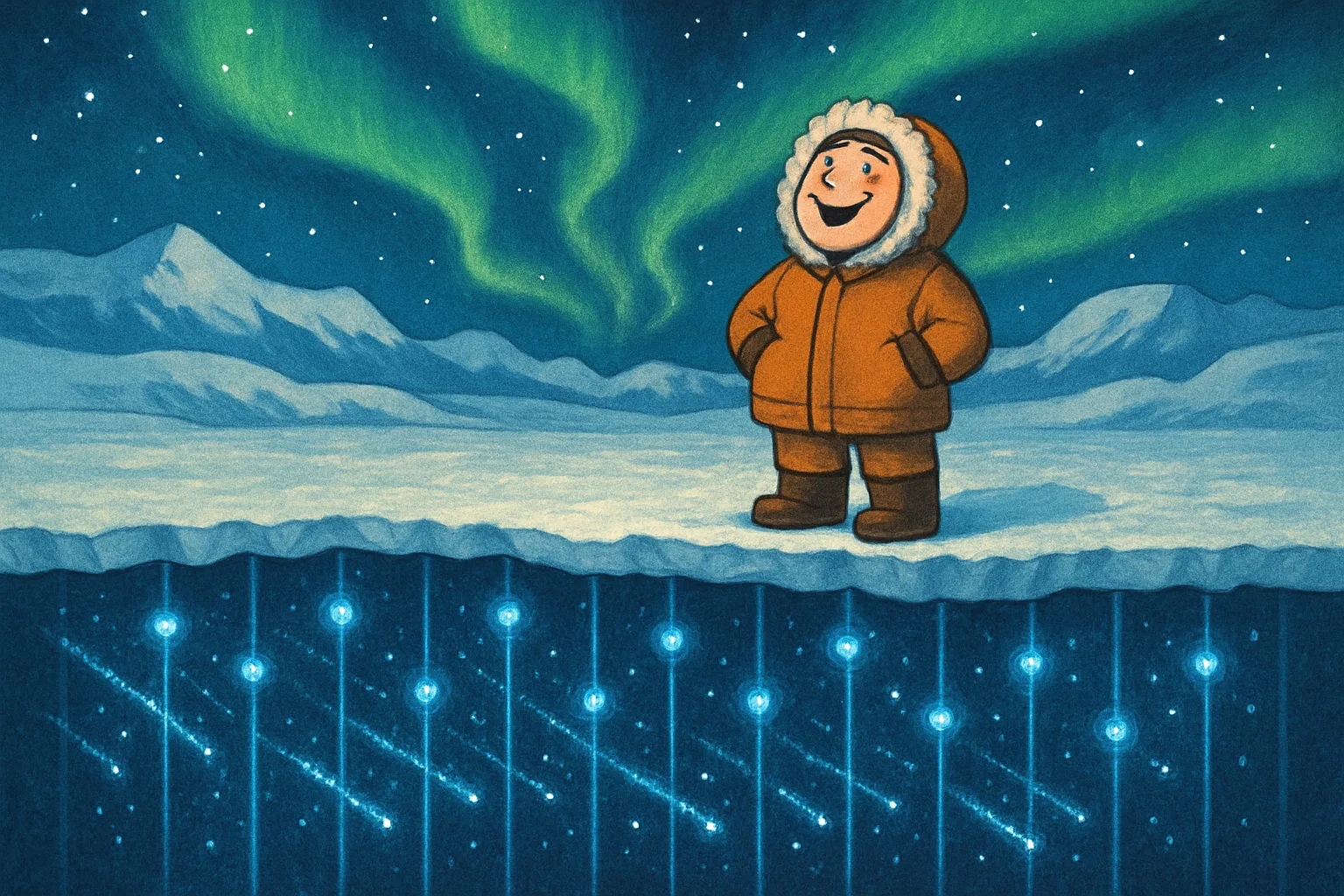
Halzen won for building something extraordinary. It is called the IceCube Neutrino Observatory. The detector sits beneath the South Pole, buried two kilometers down inside the Antarctic ice. That is about as deep as 20 football fields stacked on top of each other.
IceCube is made up of thousands of tiny light sensors arranged in a three-dimensional grid. Scientists drilled down into the ice using a powerful hot-water drill, then lowered strings of sensors inside. When a neutrino zips through the ice and bumps into something, it gives off a tiny flash of blue light. The sensors catch that flash.
But what is a neutrino? Think of it as a ghost particle. Trillions of neutrinos pass right through your body every single second without you feeling a thing. They fly through walls, through the Earth, and through almost everything else as if none of it were there. Catching one is incredibly hard.
That is exactly what makes IceCube so special. Halzen realized back in 1988 that the thick, clear ice at the South Pole was the perfect material for a neutrino catcher. It took more than 20 years to build, but IceCube became fully operational in 2011. Since then, it has detected neutrinos arriving from distant galaxies, exploding stars, and other powerful cosmic events.
The Nobel Committee said Halzen made “decisive contributions” to this discovery. His work opened a brand-new kind of astronomy. Instead of using telescopes to collect light, scientists can now study the universe using neutrinos. It is like gaining a whole new sense.
Why Does It Matter?
Neutrinos carry information about some of the most powerful events in the universe — things so far away and so energetic that their light never reaches us. By studying neutrinos, scientists can learn things about the cosmos that no other tool could reveal.
IceCube has already helped scientists map where neutrinos come from in the sky. Some arrive from the center of the Milky Way. Others come from galaxies billions of light-years away. Every neutrino is like a message in a bottle, sent from across the universe — and IceCube is learning to read them.
Big Words
- Neutrino — a tiny, nearly invisible particle that can travel through almost anything without stopping, like a ghost flying through walls
- Nobel Prize — one of the world’s greatest awards, given each year to scientists, writers, and peacemakers who make discoveries that change the world
- Observatory — a place or tool built to watch and study things in space or nature
- Detector — a device designed to sense and measure something, like light, heat, or particles
- Decibel — just kidding — Astrophysics — the study of stars, galaxies, and everything else in space, using the laws of physics
Fun Fact
IceCube catches roughly one neutrino from outer space every single day — even though trillions of the particles pass through it every second. It is like trying to catch one specific raindrop in an entire ocean of rain.
Think About It
If you could build a detector anywhere on Earth to study something invisible, where would you put it, and what would you try to detect?
Sources
- Nature — Nobel physics prize awarded for detection of cosmic neutrinos
- Al Jazeera — Francis Halzen wins Nobel Prize in Physics for work on ‘ghost particles’
- The Conversation — Nobel physics prize awarded for discovery of ‘ghostly messengers’ from the cosmos
- Scienceline — Francis Halzen awarded 2026 Nobel Prize for detecting neutrinos with Antarctic ice