
🔎 This story is still developing. We will update it as we learn more!
The Sun Is Sending a Light Show Just in Time for the Fourth of July!
Quick Summary
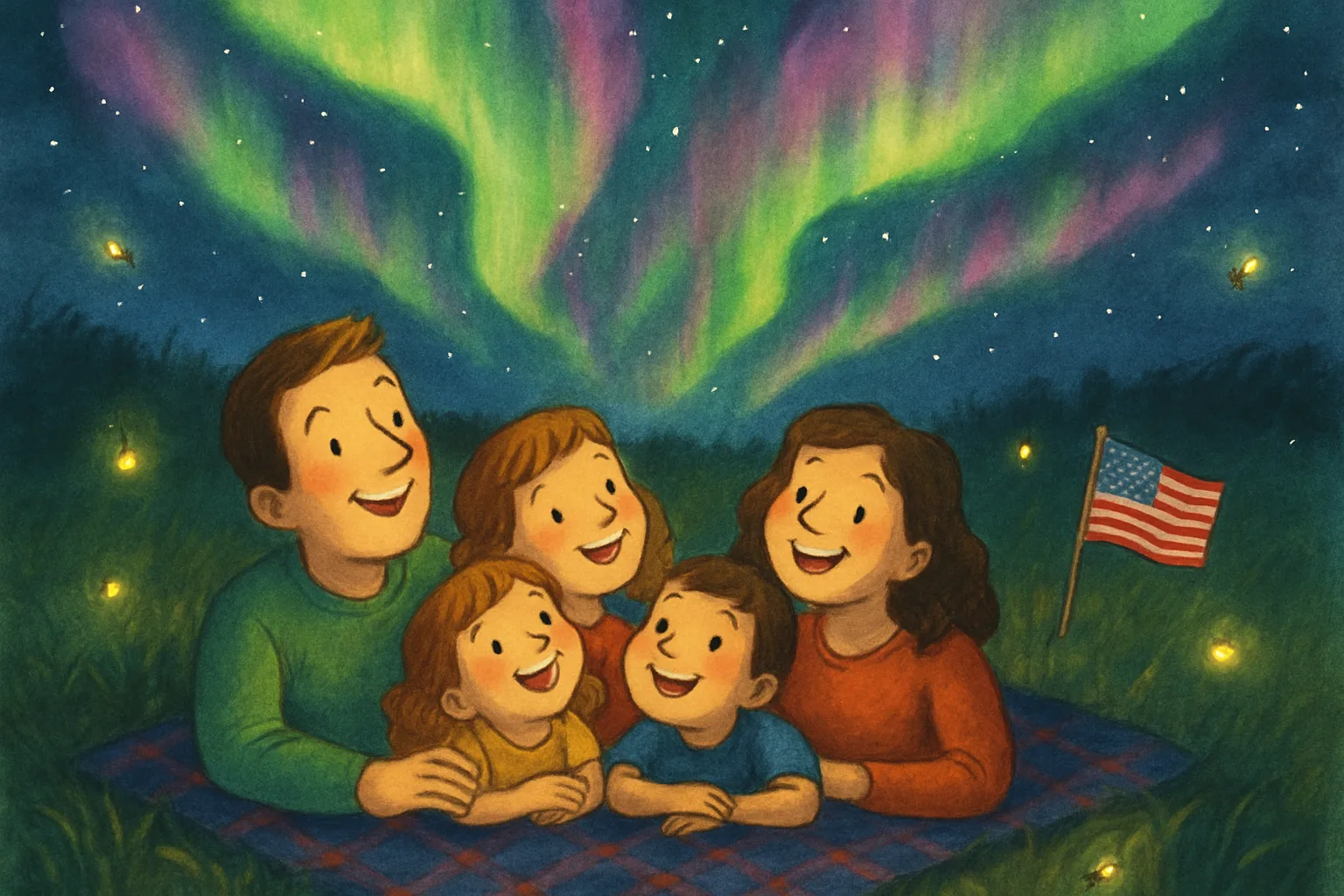
The sun blasted a huge burst of energy toward Earth this week, and it could light up the night sky with colorful Northern Lights on July 3rd and 4th. Scientists from NOAA — the U.S. government’s weather agency — say the glowing lights might be visible across as many as 26 states. It’s like the sun is giving America its own natural fireworks show!
What Happened?
Our sun goes through active and quiet phases. Right now, it is in a very active phase called the solar maximum — the peak of its 11-year cycle. This week, a giant sunspot called AR4479 released a powerful burst of energy known as an X-class solar flare — the most powerful type of solar flare that exists.
Along with the flare, the sun launched a huge cloud of charged particles called a coronal mass ejection, or CME. That cloud is speeding through space toward Earth at incredible speeds. Radio wave data showed it left the sun traveling at around 1,500 kilometers per second — that’s over 3.3 million miles per hour!
When that cloud of particles hits Earth’s magnetic field, it causes a geomagnetic storm. That storm energizes gas high up in our atmosphere, making it glow in beautiful colors — green, pink, and purple. That’s the aurora borealis, or Northern Lights!
NOAA’s Space Weather Prediction Center has forecast storm conditions as strong as G3 (“strong”) on a scale that goes up to G5. The northern lights are expected to be visible overnight from July 3rd through July 4th, potentially across up to 26 U.S. states. States closest to Canada — like Montana, Minnesota, North Dakota, and Wisconsin — have the best chances, but the lights could dip as far south as Kansas or Maryland if the storm is strong enough.
If you want to look for them, scientists suggest going somewhere away from city lights around midnight and looking north. Even a phone camera can help you catch colors your eyes might miss!
Why Does It Matter?
The Northern Lights are one of the most breathtaking sights on Earth, but most people only get to see them in very northern places like Alaska, Canada, or Norway. When the sun sends a powerful storm our way, the lights can spread much farther south, giving millions of people a rare and magical treat. This one arrives just as people across the United States are celebrating Independence Day — meaning the sky could put on its own colorful display alongside the fireworks!
Space weather scientists also study these events because strong geomagnetic storms can sometimes affect GPS signals, power grids, and satellites. Tracking them helps keep our technology safe.
Big Words
- Solar flare — A sudden, powerful explosion of energy from the sun’s surface, released when twisted magnetic fields snap and reconnect.
- Coronal mass ejection (CME) — A giant cloud of charged particles and magnetic field that blasts away from the sun and travels through space.
- Geomagnetic storm — A disturbance in Earth’s magnetic field caused when a CME crashes into it; it can create beautiful auroras.
- Aurora borealis — The scientific name for the Northern Lights; colorful glowing lights caused when particles from the sun excite gases in Earth’s upper atmosphere.
- Solar maximum — The most active period in the sun’s roughly 11-year cycle, when sunspots and solar flares are most frequent.
Fun Fact
The Northern Lights aren’t just green! Depending on which gas is excited and how high up in the atmosphere it is, auroras can appear green, pink, red, purple, or even blue. Green is the most common color and comes from oxygen about 60 miles above the ground.
Think About It
If you could name a solar flare the way scientists name storms, what name would you give this one — and why?
Sources
- Forbes — ‘Strong’ Northern Lights Alert: 26 States May See Aurora On July 4
- Space.com — Sun fires off 10 solar flares in 24 hours as multiple Earth-bound CMEs raise northern lights hopes for July 4 weekend
- EarthSky — Sun news: Confirmed! X flare sun-stuff on its way to Earth
- The Hill — Northern lights could dazzle to start July 4 weekend
- Fox Weather — Northern Lights could dazzle the sky in these states due to solar storm ahead of Fourth of July