
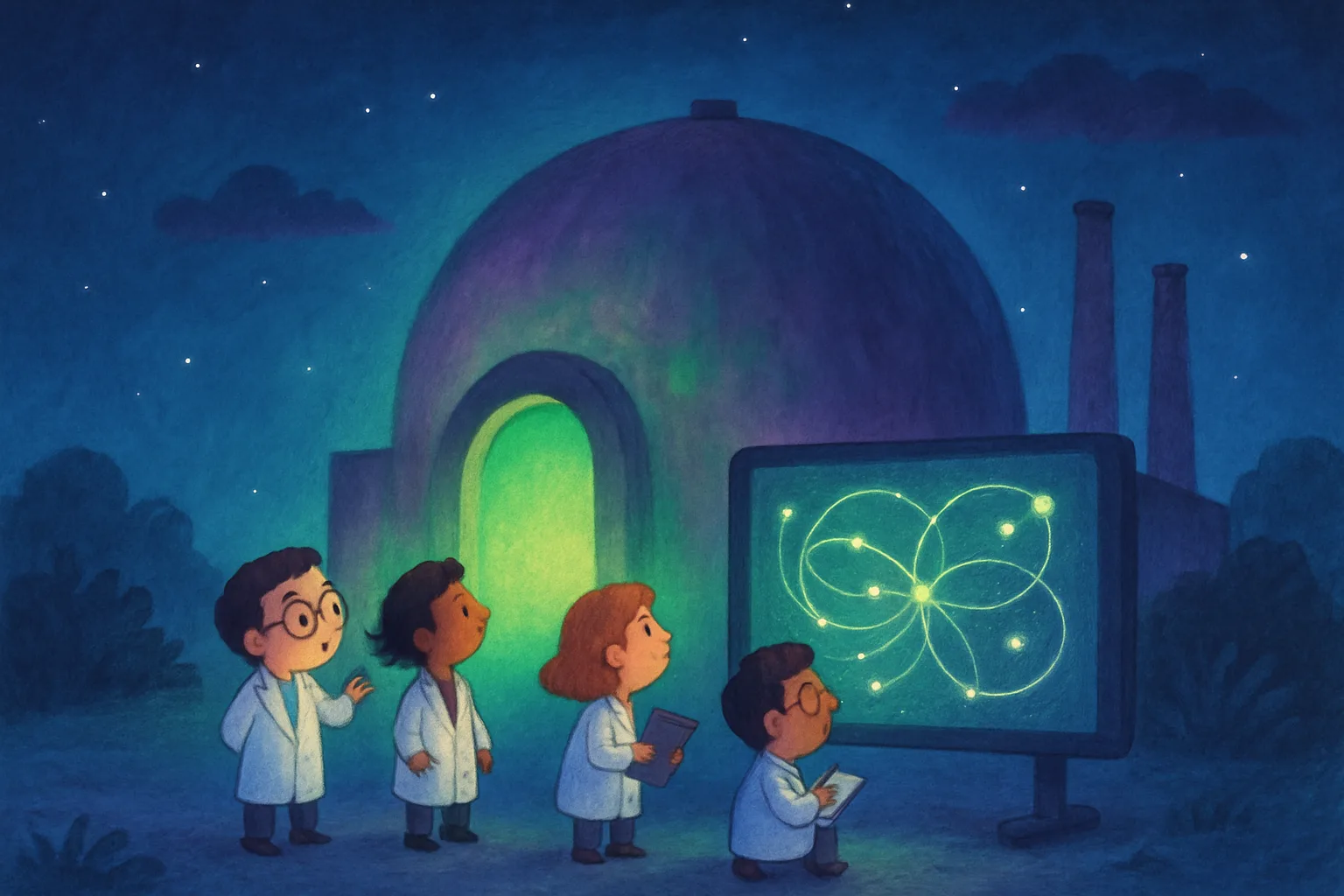
Ghost Glow! Scientists Catch a Reactor’s Secret Signal for the Very First Time
Quick Summary
Even after a nuclear reactor is switched completely off, it keeps sending out a tiny invisible signal. Scientists have now detected that signal for the very first time. The discovery is like finding a ghost that was always there but never noticed before.
What Happened?
Nuclear power plants generate electricity using a process called fission — splitting atoms to release energy. When a reactor is turned off, you might think everything inside stops. But that is not quite true.
The radioactive material inside the reactor keeps slowly breaking apart for months — or even years — after shutdown. This ongoing process releases tiny, almost invisible particles called antineutrinos.
Antineutrinos are remarkable. They are among the lightest things in the universe. They are so tiny and fast that they fly straight through the reactor walls, through the ground, and through your whole body without hitting a single atom. Billions of them pass through you every second without you feeling a thing.
This “ghost glow” of antineutrinos was always predicted by scientists, but no one had ever actually measured it directly from a shut-down reactor — until now.
A team of scientists working at a nuclear plant in northern France, using a detector experiment called Double Chooz, carefully observed the reactor after it was switched off. They spent more than 17 days collecting data with nobody in the reactor generating power. And they found it: the faint, lingering glow of antineutrinos, still quietly leaking out from the leftover fuel.
The measured signal matched almost perfectly with what scientists had predicted using math. That is exciting, because it means their models of nuclear reactors are very accurate.
Why Does It Matter?
This discovery is useful in a very practical way. Antineutrino detectors could one day be used to watch nuclear power plants even when they are offline — like having a security camera that works through walls. That could help make sure nuclear sites are being used safely and peacefully.
It also teaches scientists something deeper about the universe’s tiniest particles. Antineutrinos are everywhere, streaming through everything — and now we have a whole new way to study them.
Big Words
- Nuclear reactor — a machine that releases energy by splitting atoms; that energy is used to generate electricity.
- Fission — the process of splitting a heavy atom (like uranium) into smaller pieces, releasing a huge amount of energy.
- Antineutrino — a tiny, almost massless particle released during radioactive decay; it travels at close to the speed of light and passes through almost everything.
- Radioactive decay — the slow breakdown of unstable atoms over time, releasing energy and particles as they change into more stable forms.
- Double Chooz — the name of the scientific experiment in France that made this measurement; “chooz” comes from the name of the nearby village.
Fun Fact
Right now, billions of antineutrinos from the Sun and from the Earth’s own interior are passing through your entire body every single second — and you can’t feel any of them at all!
Think About It
Scientists found a signal that was always there but nobody had ever measured before. What other invisible things in the world around you do you think might be discovered someday?
Sources
- ScienceDaily — Scientists detect a nuclear reactor’s ghostly afterglow for the first time (Aug. 14, 2026)
- Phys.org — First measurement of antineutrinos from spent nuclear fuel confirms emissions persist after reactor shutdown
- EurekAlert — First measurement of antineutrinos from spent nuclear fuel
- Physical Review Letters — First measurement of neutrino emissions from spent nuclear fuel by the Double Chooz experiment (Aug. 4, 2026)