
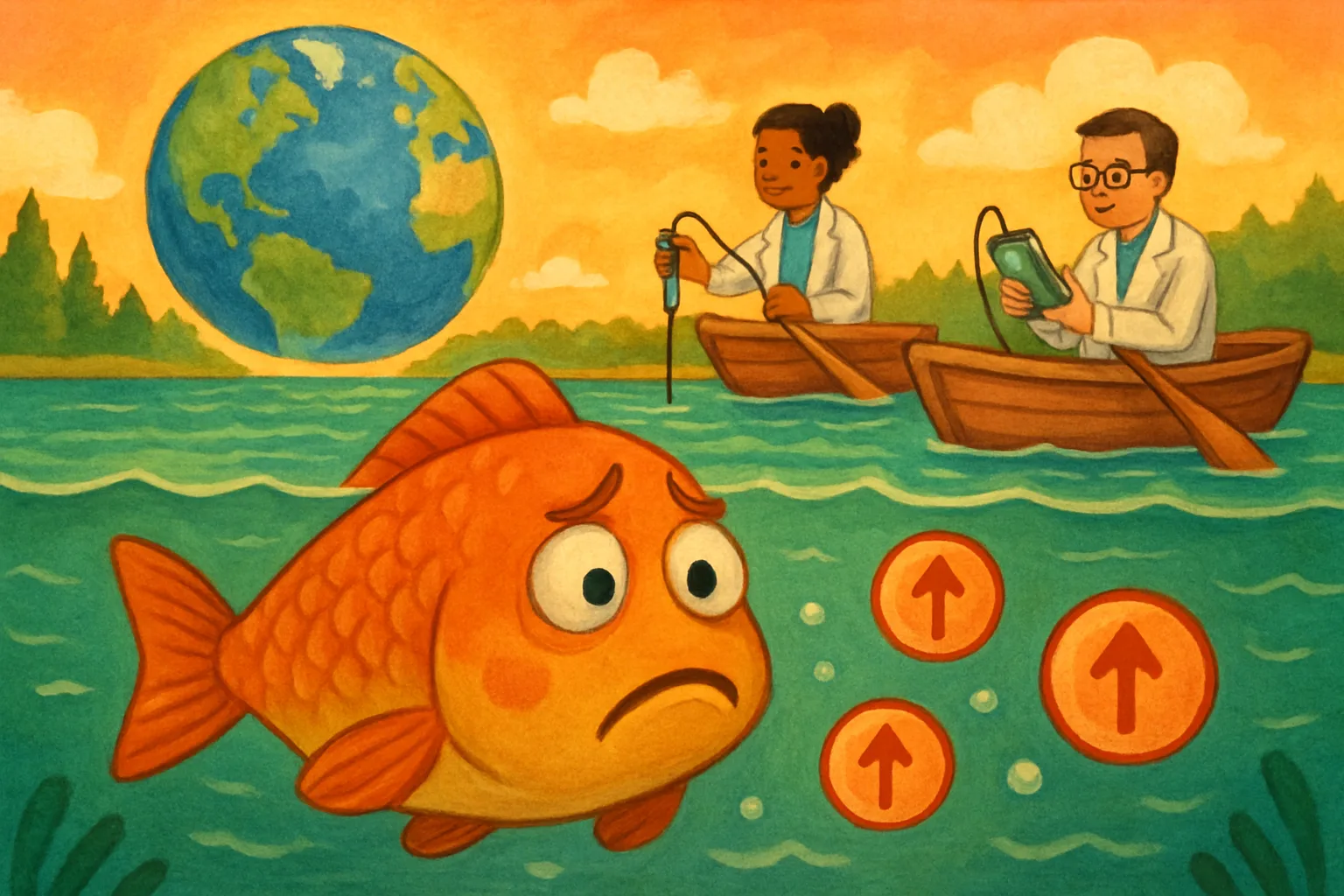
The Water Is Running Low on Oxygen — and Fish Are Feeling It
Quick Summary
Scientists at UC San Diego have released an important warning: the world’s oceans, lakes, and rivers are slowly losing oxygen. Fish and other water creatures need dissolved oxygen in water to breathe — just like we need oxygen in air. Researchers say this is a serious problem that needs global attention, and they have ideas about how to help.
What Happened?
You probably know that animals breathe oxygen from the air. But did you know that fish, crabs, whales, and tiny microorganisms also “breathe” oxygen — dissolved right inside the water where they live?
Water holds oxygen the same way soda holds bubbles. And just like a warm soda loses its fizz, warm water holds less oxygen. As our planet heats up because of climate change, the world’s water is warming — and losing its “fizz.”
Scientists led by researchers at the Scripps Institution of Oceanography at UC San Diego reviewed decades of data on water oxygen levels. They looked at oceans, rivers, lakes, coastal waters, and streams all around the world.
What they found was worrying. Oxygen is disappearing from water nearly everywhere. The global ocean has lost about 2 percent of its dissolved oxygen over the past 50 years. That might sound small, but in an ocean the size of Earth’s, 2 percent is an enormous amount of missing oxygen.
Warming temperatures are one big cause. Another is nutrient pollution — when fertilizers from farms wash into rivers and lakes. The extra nutrients cause algae to grow explosively. When those algae die, bacteria break them down — and that process uses up even more oxygen.
The study was published in the scientific journal Limnology and Oceanography. The researchers are asking global leaders to treat this as a serious environmental risk — as serious as climate change or biodiversity loss.
The good news is that scientists understand the causes, which means there are real things people can do. Cutting carbon emissions, reducing fertilizer pollution, and protecting wetlands can all help slow the loss.
Why Does It Matter?
Earth’s water is like a giant living system. Millions of species — from tiny shrimp to giant whales — depend on oxygen dissolved in that water. When oxygen levels drop, fish suffocate, dead zones appear, and entire food chains can collapse.
But it affects humans too. Billions of people around the world depend on fish and seafood for food. Many fishing communities depend on healthy oceans and rivers for their livelihoods.
By alerting the world now, scientists hope people, governments, and businesses will take action before the problem gets much worse. Understanding a problem is always the first step toward fixing it.
Big Words
- Dissolved oxygen — oxygen gas that is mixed into water, which fish and other aquatic creatures breathe to survive
- Deoxygenation — the process of oxygen being removed from or leaving a body of water
- Algae — tiny plant-like organisms that grow in water; too much algae, caused by pollution, can harm oxygen levels
- Planetary Boundaries — a scientific framework that identifies nine key ways human activity can push Earth toward dangerous instability
- Scripps Institution of Oceanography — a world-famous ocean research center that is part of UC San Diego in California
Fun Fact
A single teaspoon of healthy ocean water can contain millions of microscopic creatures — many of which depend on dissolved oxygen to survive. When oxygen drops, entire invisible communities disappear first, long before larger fish are affected.
Think About It
If you could make one change to help restore oxygen in the world’s water — whether it is something you do at home, at school, or something you’d ask leaders to do — what would it be and why?
Sources
- UC San Diego / Scripps Institution of Oceanography — Underwater Oxygen Loss Threatens Earth’s Stability (July 2026)
- ScienceDaily — Earth’s waters are quietly running out of oxygen, scientists warn (July 19, 2026)
- Gizmodo — Earth’s Oceans Are Rapidly Losing Oxygen. It Could Destabilize the Planet (July 20, 2026)
- Phys.org — Underwater oxygen loss threatens earth’s stability, researchers warn (July 2026)
- Limnology and Oceanography (journal) — Ferrer et al., published June 30, 2026