
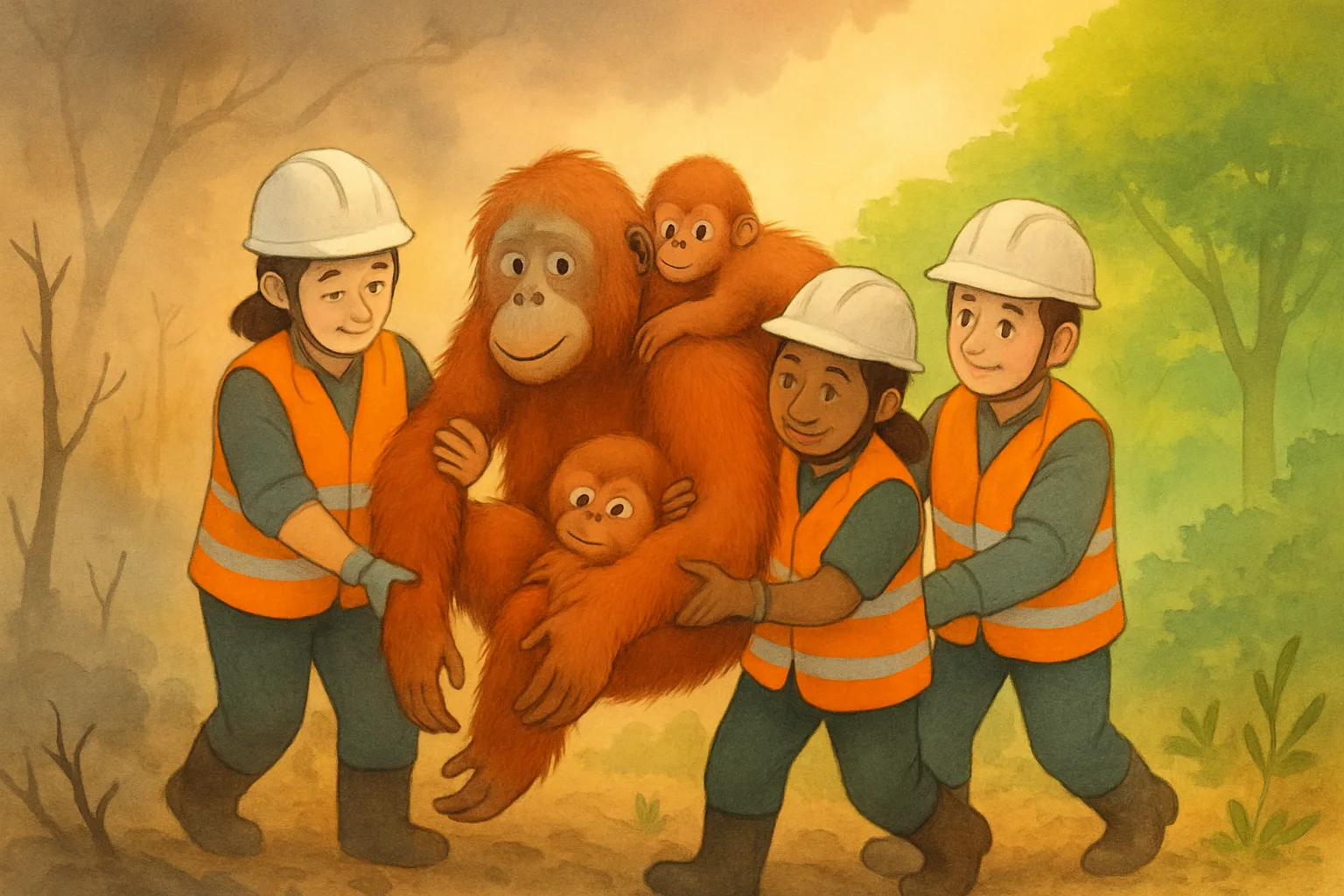
Safe Arms! Rescue Teams Save Dozens of Orangutans From Indonesia’s Wildfires
Quick Summary
Wildfires have been burning through the forests of Indonesia, putting one of our closest animal relatives in terrible danger. But brave rescue teams have been working hard — and they have already saved dozens of critically endangered orangutans and moved them to safety.
What Happened?
On the island of Borneo in Indonesia, wildfires have been ripping through forests for months. These are the same forests where wild orangutans live, eat, sleep, and raise their babies. As the fires spread, the orangutans lost their food and their homes.
Conservation groups — including the Borneo Orangutan Survival Foundation, the World Wildlife Fund, and government wildlife teams — rushed in to help. Working together in dangerous, smoky conditions, rescue teams have saved dozens of the great apes and moved them to safer places.
In one province alone, called West Kalimantan, one team reported evacuating more than 51 orangutans between August and October. Other groups have rescued additional animals across different parts of Borneo and Sumatra. Some of the rescued animals include mothers carrying their tiny babies and young adolescents who were alone and frightened.
The rescued orangutans are being carefully checked by veterinarians. Some had breathing problems from the smoke. Healthy animals are being released into protected forests where the fires have not reached, giving them a real chance to rebuild their lives.
The fires have been made worse this year by an especially strong El Niño weather pattern. El Niño makes parts of Southeast Asia hotter and drier than usual, which helps wildfires start and spread more easily.
Why Does It Matter?
Orangutans are critically endangered. That means they are at serious risk of disappearing from Earth forever. Fewer than 130,000 remain in the wild, scattered across Borneo and Sumatra. A century ago, more than twice as many lived there.
These amazing animals share about 97% of their DNA with humans. They are incredibly intelligent — they use tools, solve puzzles, and teach their young how to find food. Losing them would be a tragedy for our planet.
The good news is that rescue teams are not giving up. Every single orangutan saved is a victory. And some rescued animals are already back in the trees, where they belong.
Big Words
- Critically endangered — a label scientists use for animals that face a very high risk of going extinct if nothing is done to protect them
- Conservation — the careful protection of animals, plants, and natural places so they can survive for the future
- El Niño — a natural weather pattern that warms the Pacific Ocean, often making parts of Asia drier and more fire-prone
- Evacuate — to move people or animals away from a dangerous place to somewhere safe
- Habitat — the natural environment where an animal lives, finds food, and raises its young
Fun Fact
Orangutans are the world’s largest tree-dwelling animals. An adult male can weigh as much as 220 pounds — about the same as a large black bear — yet he can still swing gracefully through the treetops!
Think About It
If you could design a safer forest home for orangutans that would be protected from wildfires, what would it look like?
Sources
- Malay Mail / AFP — Dozens of endangered orangutans rescued from Indonesia wildfires as haze chokes region, Oct 18 2026
- Yahoo News / AFP — Dozens of orangutans saved from Indonesia blazes, Oct 18 2026
- WGCU / NPR — Dozens of critically endangered orangutans rescued from Indonesian wildfires, Oct 17 2026
- ABC News / AP — Indonesia relocates 8 orangutans into protected forest after rescue from wildfires, Oct 13 2026
- Japan Times — Indonesia releases eight orangutans rescued from fires to protected forest, Oct 11 2026