
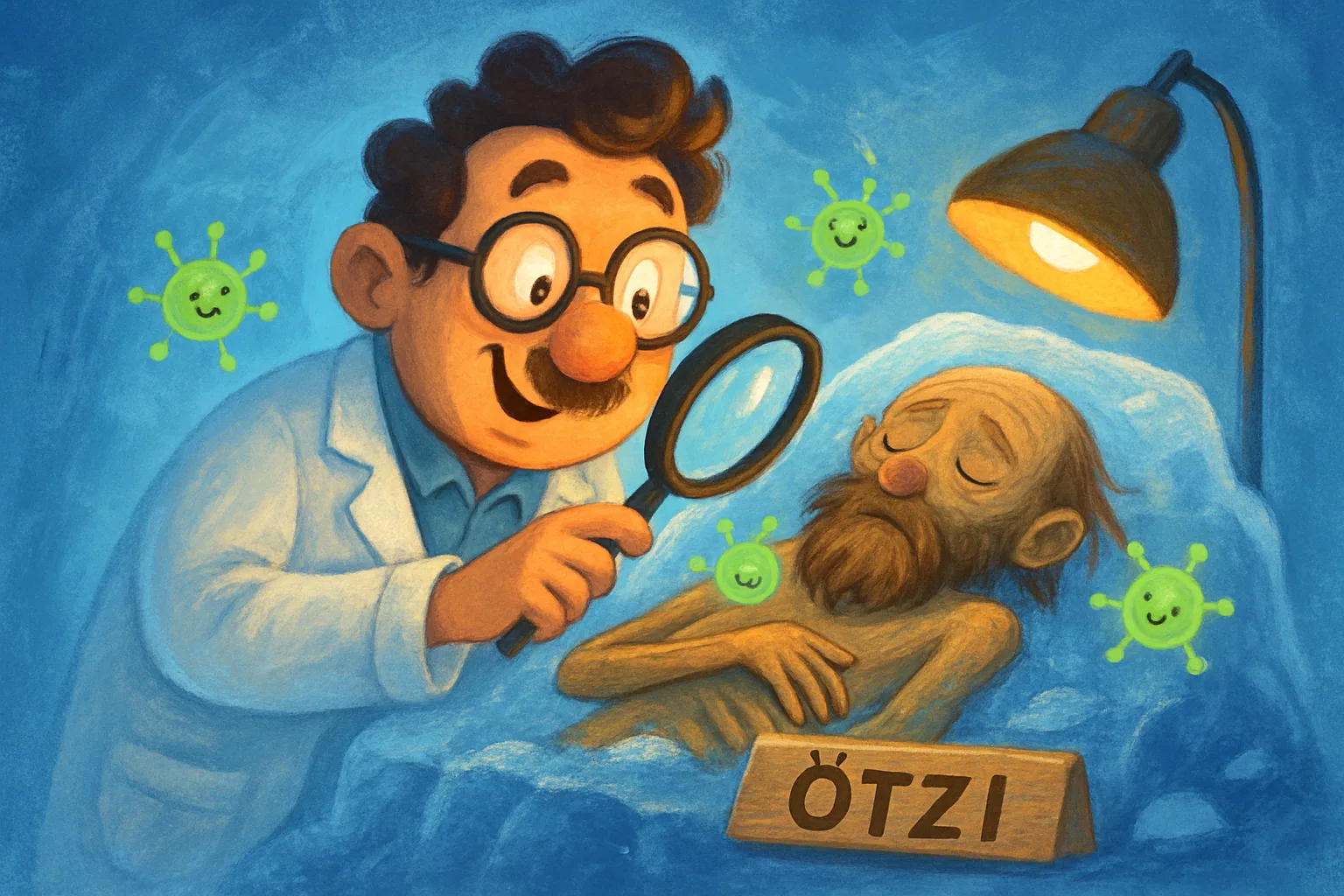
The Iceman’s Secret Passengers! Living Microbes Found on a 5,300-Year-Old Mummy
Quick Summary
Scientists have made a surprising discovery about Ötzi the Iceman, a famous 5,300-year-old frozen mummy found in the Alps. Tiny living microorganisms — including ancient gut bacteria and cold-loving yeasts — are still on his body today. The findings were published this week in the science journal Microbiome.
What Happened?
In 1991, hikers stumbled upon something extraordinary in the icy mountains on the border of Austria and Italy. Poking out of a melting glacier was a very old, very well-preserved mummy. Scientists later named him Ötzi the Iceman. He lived during the Copper Age — a period about 5,300 years ago when people were just starting to use metal tools.
Ötzi quickly became one of the most important archaeological discoveries in history. Scientists have studied his teeth, stomach contents, and even his DNA. But a new team of researchers from Eurac Research recently took a closer look at something even smaller: the microorganisms living on and inside his frozen body.
Microorganisms — or microbes — are living things so tiny you need a microscope to see them. Bacteria and yeasts are two kinds. Your own body right now is home to trillions of them!
The researchers collected samples from Ötzi’s internal tissues, stomach contents, and even the meltwater inside the mummy. Then they separated the microbes into groups: ones that were part of Ötzi’s body when he was alive, ones that arrived after his death while he lay in the glacier, and ones that got on him during museum storage.
What they found was remarkable. Ancient gut bacteria — the kind Ötzi would have carried in his intestines when he was alive — were still preserved in his tissues. These bacteria are rarely found in people today, but are still seen in communities that live traditional, non-industrialized lives.
Even more surprising, four species of cold-loving yeasts were found on the mummy’s surface. These yeasts are related to microbes found in extremely cold places like Antarctica. Scientists actually grew colonies of them in the lab — proving they were still alive after thousands of years!
Why Does It Matter?
Studying Ötzi’s ancient microbes is like opening a time capsule for tiny life forms. It gives scientists a glimpse of what lived inside human bodies thousands of years ago — before modern diets, medicines, and cities changed everything.
The cold-loving yeasts might even have practical uses one day. Scientists think microbes that thrive in freezing cold could help power energy-saving industrial processes, like low-temperature fermentation — the same process used to make bread or yogurt, but needing much less heat.
For now, scientists are also keeping a close eye on these yeasts. If they ever start growing actively on the mummy, they could damage it. Protecting Ötzi means understanding every tiny creature sharing his ancient body.
Big Words
- Microorganism — a living thing so small it can only be seen under a microscope; bacteria and yeasts are examples
- Mummy — a body that has been naturally or artificially preserved, often for thousands of years
- Microbiome — the full community of microorganisms living in or on a body, like a tiny city of living creatures inside you
- Yeast — a tiny, single-celled fungus; some yeasts help make bread and yogurt, while others live in cold environments
- Copper Age — a period of human history, roughly 3,500 to 5,000 years ago, when people began making tools from copper metal
Fun Fact
Ötzi’s last meal — eaten just hours before he died — included deer meat, wild grains, and plants. Scientists know this because his stomach contents were so well preserved in the ice!
Think About It
If scientists can study what microbes were in people’s bodies 5,300 years ago, what might that tell us about how the human body has changed over thousands of years of history?
Sources
- ScienceDaily — Scientists find unexpected life on Ötzi the Iceman’s 5,300-year-old body (Aug 7, 2026)
- Eurac Research / Springer Microbiome journal — The Iceman’s microbiome: unveiling millennia of microbial diversity and continuity (2026)
- CNN — Ötzi the Iceman: Ancient microbes are dormant but alive thousands of years after mummy’s death (June 8, 2026)
- La Brujula Verde — Some microbes found in Ötzi the Iceman are still alive after 5,000 years frozen in ice (June 2026)
- Science News Explores — Dormant microbes from Ötzi the Iceman’s body can grow in the lab