
Go Outside Tonight! Earth Is About to Take a Giant Bite Out of the Moon
Quick Summary
Tonight, Earth slides right between the Sun and the Moon, casting a huge shadow that will swallow 96% of the lunar surface. The Moon will turn deep red or copper-colored. This is one of the best lunar eclipses until 2028 — and you do not need any special equipment to see it!
What Happened?
There is a free, spectacular light show happening in the sky tonight — and the only ticket you need is a window or a backyard.
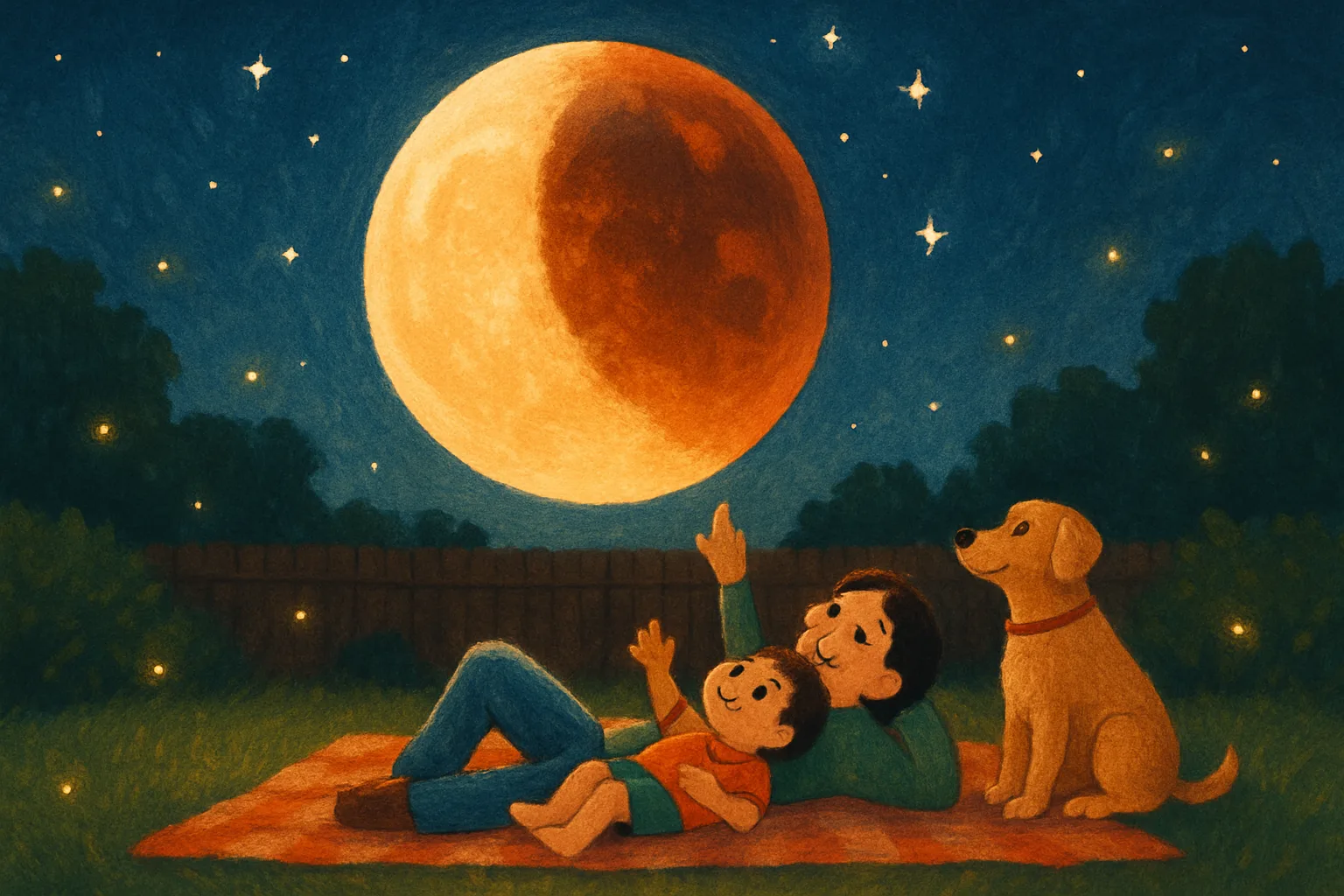
Beginning late tonight, the Moon will pass into Earth’s shadow in what scientists call a deep partial lunar eclipse. At its peak, 96.3% of the Moon’s face will be inside Earth’s darkest shadow — called the umbra. Only a tiny sliver of the Moon will stay lit by the Sun. The rest will transform into a glowing ball of deep red, orange, or copper.
Why does it turn red? Here is the cool part. When sunlight passes around the edges of Earth, our planet’s atmosphere bends and filters it — the same way the sky turns orange-red at sunset. All of Earth’s sunsets and sunrises are projected onto the Moon at once. Think of it as Earth putting on a red lampshade.
For people in the eastern United States, the eclipse will be most dramatic around midnight. On the West Coast, the peak comes around 9:12 p.m. local time. The whole event — from the first hint of shadow to the last — lasts more than five hours. The obvious red phase lasts about three hours and eighteen minutes, so there is plenty of time to step outside and look.
The best seats are across North and South America, where the complete eclipse will be visible. Much of Europe and western Africa can also catch the earlier and deepest stages before the Moon sets near dawn. You do not need a telescope or special glasses — just your eyes. Binoculars will make the colors look even richer.
NASA confirms the peak occurs at 4:13 a.m. Universal Time on August 28 — that is the moment when the shadow is deepest and the Moon glows most vividly.
Why Does It Matter?
Lunar eclipses are one of nature’s most reliable reminders that we live on a moving planet in a moving solar system. Every single thing you see during the eclipse — the shadow, the red color, the slow movement across the Moon — is caused by the motion of Earth, the Moon, and the Sun working together like a giant cosmic clock.
This eclipse is also extra-special because at 96%, it comes incredibly close to being a total eclipse. You will be able to see almost the entire Moon turn red — something that will not happen this dramatically again until New Year’s Eve 2028.
And approximately 3.3 billion people across the globe have a chance to watch it tonight, which makes it one of the most widely-viewable sky events of the year.
Big Words
- Lunar eclipse — when Earth moves between the Sun and the Moon, blocking sunlight and casting Earth’s shadow on the Moon
- Umbra — the darkest, innermost part of a shadow, where the light source is completely blocked
- Partial eclipse — an eclipse where only part of the object (here, the Moon) is covered by the shadow
- Atmosphere — the layer of gases surrounding a planet; Earth’s atmosphere bends sunlight during an eclipse, giving the Moon its red color
- Universal Time (UT) — a standard clock used by scientists worldwide, based on the time in Greenwich, England
Fun Fact
During a total or deep partial lunar eclipse, some animals get confused! Birds that normally sleep at night may start singing, and insects that come out at dusk may appear as the Moon darkens — because their bodies think night is falling twice.
Think About It
If you were standing on the Moon tonight looking back at Earth, what do you think you would see during a lunar eclipse?
Sources
- NASA Scientific Visualization Studio — “August 27-28, 2026 Deep Partial Lunar Eclipse” (svs.gsfc.nasa.gov)
- Space.com — “Partial lunar eclipse Aug. 27-28 live updates”
- EarthSky — “Deep partial lunar eclipse on August 27-28, 2026”
- Old Farmer’s Almanac — “August 2026 Lunar Eclipse: When and Where to See It”