
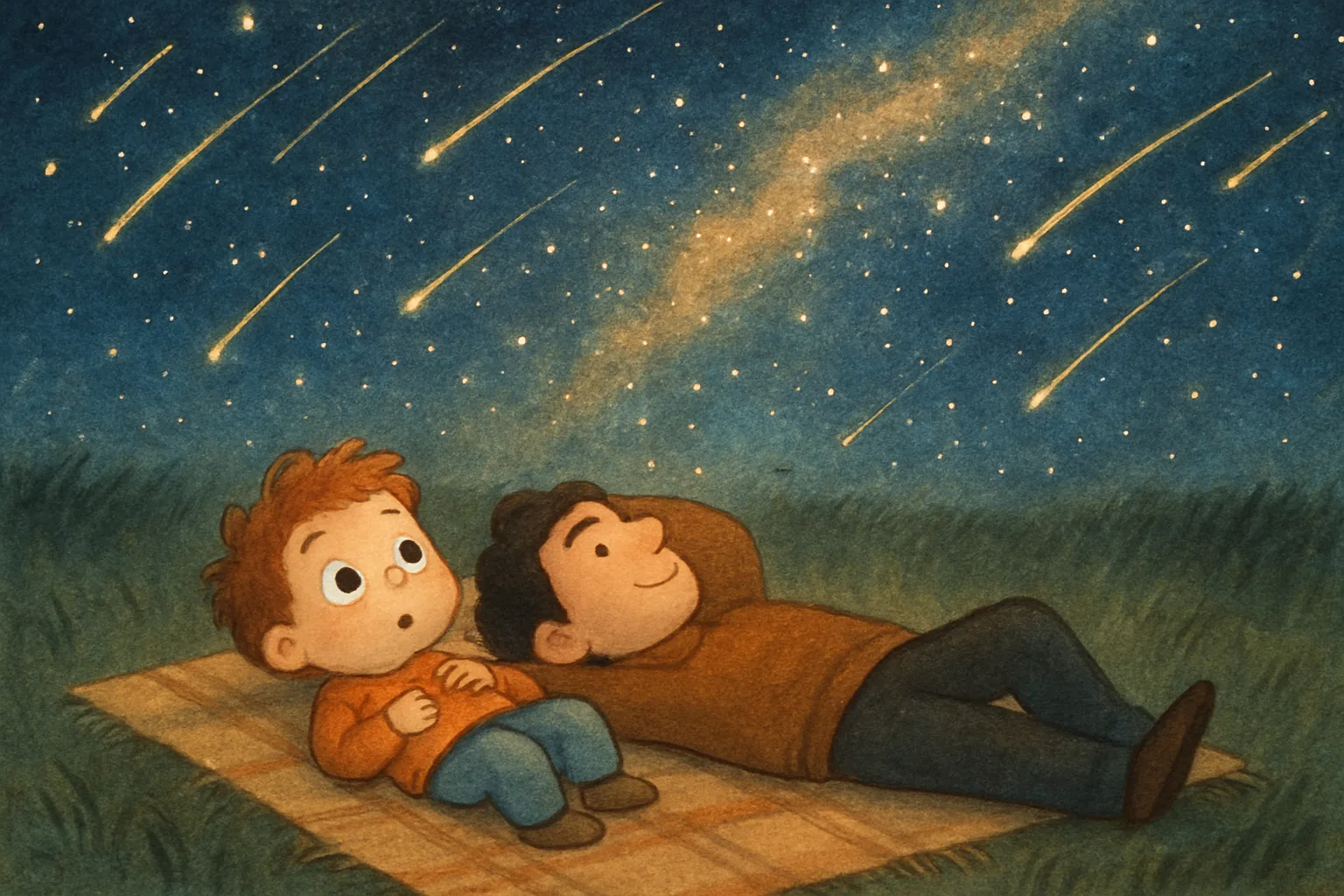
Shooting Stars All Night! The Perseid Meteor Shower Is Putting on Its Best Show of the Year
Quick Summary
Last night, the sky put on one of the best free shows of the year. The Perseid meteor shower reached its peak on the night of August 12 into the early hours of August 13. Lucky skywatchers with dark skies could spot dozens of shooting stars every hour!
What Happened?
Every August, Earth travels through a trail of dust and rock left behind by a comet called Swift-Tuttle. When those tiny bits of space debris hit our atmosphere, they burn up in a flash of light. That is what we call a shooting star — or, officially, a meteor.
This year’s Perseid peak was extra special. There was a new Moon in the sky, which meant no moonlight to wash out the view. The night was as dark as it gets. Scientists call this the ideal condition for watching meteors. Think of it like trying to see a candle flame in a dark room versus a bright room — the darkness makes all the difference.
At its best, the shower was producing up to 100 shooting stars per hour. That is nearly two every single minute! Even in less perfect spots, skywatchers could expect 30 to 75 meteors per hour.
The Perseids got their name from Perseus, a constellation in the northern sky. That is the direction the meteors appear to shoot from. But here is a fun trick — once you spot where they are coming from, look slightly away from it. You will see longer, more dramatic streaks.
The shower was visible all around the world. The best views came after midnight, when Perseus climbed higher into the sky.
Why Does It Matter?
The Perseid meteor shower happens every single year like clockwork. It is one of the most reliable sky shows on Earth. Scientists love it because the meteors carry tiny clues about what the early Solar System was made of.
Comet Swift-Tuttle, the comet whose trail makes the Perseids, is enormous — its center is about 16 miles (26 kilometers) wide. That is roughly the distance you might drive to visit a grandparent across town. Because the comet is so big, it leaves behind a thick, rich trail of debris. That is why the Perseids almost always produce bright fireballs — meteors as brilliant as the planets Jupiter or Venus.
If you missed peak night, do not worry. The shower stays active until August 24. Rates will be lower, but shooting stars can still be spotted on clear nights.
Big Words
- Meteor — a small piece of space rock or dust that burns up in Earth’s atmosphere, making a bright streak of light.
- Meteor shower — an event when Earth passes through a trail of debris left by a comet, causing many meteors to appear in a short time.
- Comet — a large, icy space object that travels around the Sun and leaves a trail of dust and gas behind it.
- New Moon — the phase when the Moon is between Earth and the Sun, so its lit side faces away from us and the night sky stays very dark.
- Radiant — the point in the sky where a meteor shower appears to come from; the Perseids’ radiant is in the constellation Perseus.
Fun Fact
Comet Swift-Tuttle takes about 133 years to complete one trip around the Sun. It last swung close to Earth in 1992, and it will not visit again until the year 2126 — long after every person alive today has grown old!
Think About It
If you could send a tiny robot probe to fly through the trail of comet dust that creates the Perseids, what do you think it would find? What questions would you want it to answer?
Sources
- The Planetary Society — ‘The Perseid meteor shower 2026: How to watch’
- timeanddate.com — ‘Perseid Meteor Shower 2026—When, Where, and How to See It’
- StarWalk Space — ‘Perseid Meteor Shower: Visibility Map & Guide for August’
- NASA JPL Night Sky — ‘August 12, 13 - Perseids Meteor Shower’