
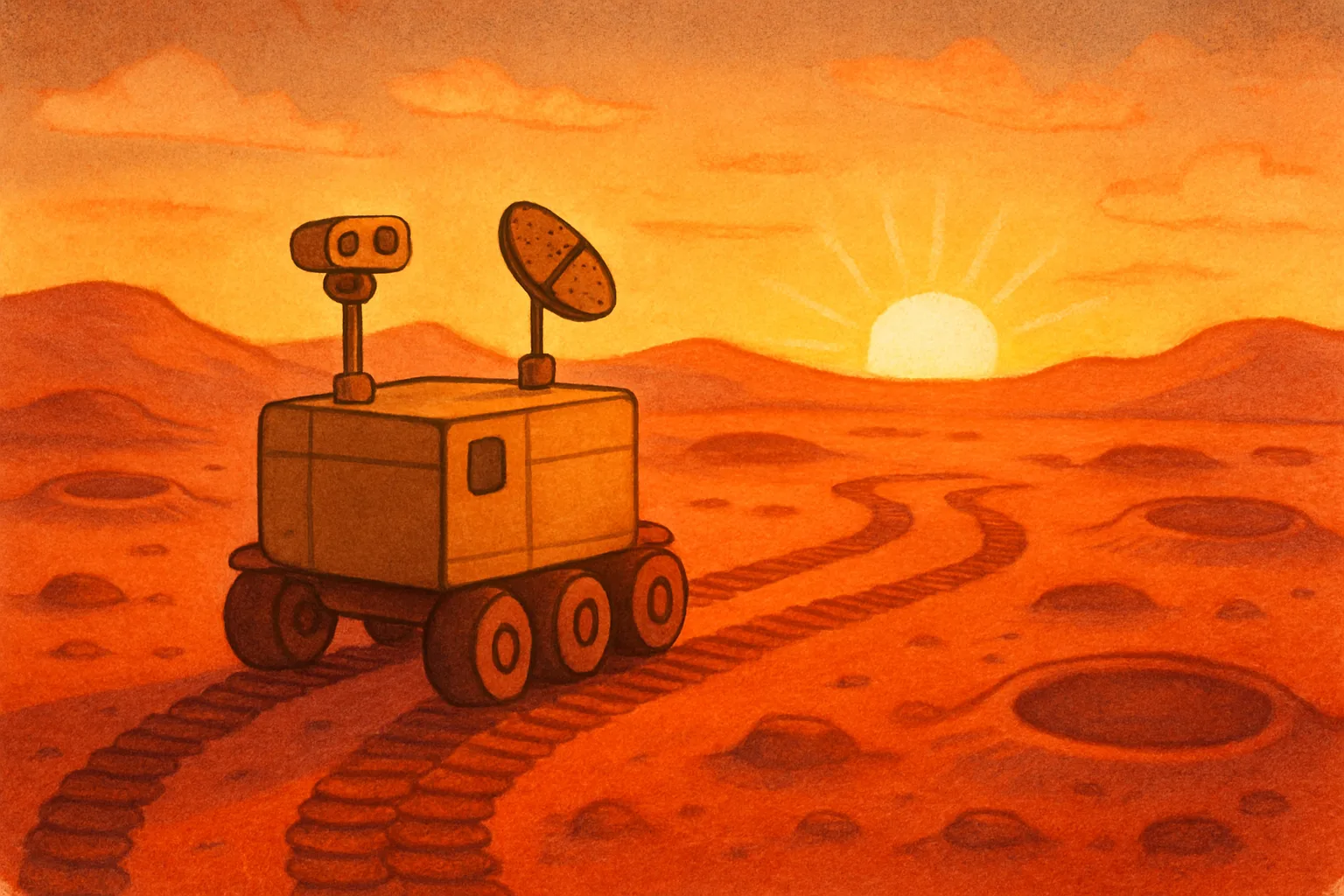
Road Trip Record! NASA’s Rover Has Driven Farther on Mars Than Any Machine Ever Has
Quick Summary
NASA’s Perseverance rover just made history on the red planet. On October 11, 2026, it drove farther than any vehicle has ever traveled on another world. It beat a record that had stood for years — and it did it in less than half the time!
What Happened?
Imagine taking a road trip across a completely different planet. That is exactly what NASA’s Perseverance rover has been doing since it landed on Mars in 2021.
On October 11, Perseverance rolled to a total distance of 28.10 miles (about 45 kilometers) across the Martian surface. That pushed it past the old record of 28.06 miles, which had been held by NASA’s Opportunity rover.
Opportunity was a remarkable machine. It spent nearly 15 years on Mars to rack up that distance. Perseverance beat it in just five and a half years — less than half the time. Think of it like running a race and finishing the same distance in half as many steps.
How did Perseverance go so fast? The secret is a smart system called AutoNav. This lets the rover plan its own path without waiting for instructions from Earth. Nine out of every ten drives, Perseverance chooses its own route, a bit like a self-driving car picking the best road.
The record-breaking moment happened near a place scientists call the “Lac de Charmes,” on the edge of a giant bowl-shaped crater called Jezero. Perseverance was heading toward an even older rocky area called Idubi. The rocks there are so ancient that nothing like them survives on Earth anymore.
NASA has already approved Perseverance to keep exploring until at least the end of 2028. So the rover will keep adding miles to its record — and there is no sign of stopping.
Why Does It Matter?
Perseverance is not just breaking records for fun. It is searching for signs of ancient life on Mars. The farther it travels, the more ground it can explore and the more samples it can collect.
Every drive teaches scientists more about what Mars was like billions of years ago, when the planet may have had rivers, lakes, and even tiny living things. Perseverance could one day help answer one of the biggest questions humans have ever asked: Are we alone in the universe?
The rover’s mission also shows how robots can work more and more on their own. That knowledge will help future missions — and maybe future astronauts — travel safely across other worlds.
Big Words
- Rover — a robotic vehicle built to drive across the surface of another planet and collect scientific information
- Odometer — a tool that measures how far a vehicle has traveled, like the distance counter in a car
- AutoNav — short for “autonomous navigation,” a system that lets Perseverance plan its own driving routes without waiting for commands from Earth
- Crater — a large bowl-shaped hole in the ground, usually made long ago by a space rock crashing into a planet
- Sol — one Martian day, which is about 24 hours and 37 minutes long — just a little longer than a day on Earth
Fun Fact
Perseverance’s original mission plan only called for it to drive about 12.4 miles. It has now driven more than double that — and it is still going strong!
Think About It
If you were designing a robot to explore Mars, what would you want it to look for, and why?
Sources
- NASA JPL — NASA’s Perseverance Sets Off-World Record for Total Distance Driven
- EarthSky — NASA’s Perseverance rover on Mars sets off-world driving record
- Guinness World Records — NASA’s Perseverance rover breaks the record for longest road trip on Mars
- PetaPixel — NASA Perseverance Mars Rover Sets New Record for Off-World Distance Driven