
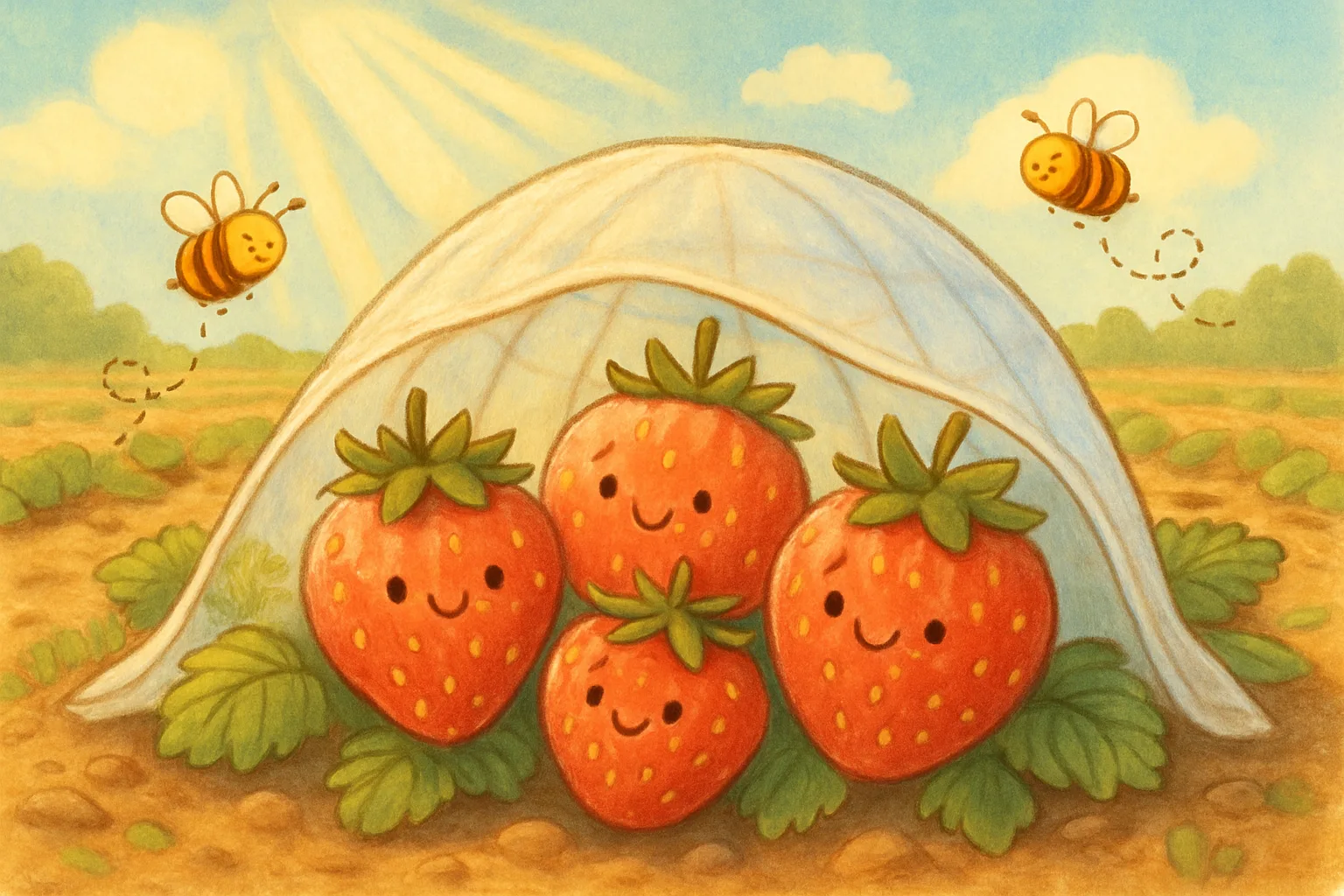
Super Suit for Strawberries! New Fabric Makes Farms Grow Way More Fruit
Quick Summary
Scientists at North Carolina State University invented a special fabric cover called Plant Armor. When draped over strawberry plants, it helped them grow more than three and a half times as much fruit. Best of all, it could help farmers use less water and fewer pesticides!
What Happened?
Researchers at NC State spent three growing seasons testing a new kind of textile — a fancy word for woven or knitted fabric. The material is called Plant Armor, and it is designed to be laid directly over strawberry plants like a cozy blanket.
The fabric has a clever three-dimensional, or 3D, structure. Picture a thick sponge made of threads — it has lots of open space inside it. That structure lets sunlight, rain, and fresh air pass right through to the plants below. But the gaps are too small and complex for insects to squeeze through. Bugs that normally eat or damage strawberry plants simply cannot get in.
In their tunnel field tests, strawberries covered by Plant Armor produced up to 3.56 times more fruit than plants without the cover. If you usually picked one basket of strawberries from a plant, Plant Armor could give you almost four baskets from the same spot!
The fabric also acts like a gentle greenhouse. It traps a little warmth around the plants, helping them reach the fruiting stage — the point where they start making berries — faster than usual.
Researchers were actually surprised by the results. They expected the fabric’s thick look would block too much sunlight and push the plants to grow more leaves instead of fruit. But measurements showed that light levels were not reduced at all.
Here is a fun detail: Plant Armor did not start out as a farm invention. It grew out of research on military clothing — scientists were trying to make uniforms that protected soldiers from mosquito bites while wearing body armor. That research turned into something that helps farmers instead!
Why Does It Matter?
Feeding the world’s growing population is one of the biggest challenges on Earth. If farmers can grow more food from the same patch of land — without using more chemicals or water — that is a huge win for people and for the planet. Pesticides, which are chemicals sprayed on crops to kill pests, can sometimes harm helpful insects like bees. Plant Armor blocks bugs physically, so there is less need for those sprays.
Researchers say the technology could work with other crops too, not just strawberries. More testing on different plants and in different climates is planned next.
Big Words
- Textile — a material made by weaving, knitting, or bonding threads together; fabric is a textile
- Pesticide — a chemical used to kill insects or other pests that damage crops
- Three-dimensional (3D) structure — a shape that has height, width, and depth, rather than being flat; like a cube compared to a square
- Fruiting stage — the part of a plant’s life when it produces fruit; plants need the right amount of warmth and light to reach this stage
- Tunnel field trial — a scientific test done on crops grown inside a long, low tunnel covered with plastic, protecting them from harsh outdoor weather
Fun Fact
Strawberries are actually not true berries in the botanical sense! Botanists — scientists who study plants — technically classify them as an accessory fruit. Meanwhile, bananas and avocados really are classified as berries. Nature loves surprises!
Think About It
If you could use a Plant Armor-style fabric to help grow any food in the world, which food would you choose, and why?
Sources
- ScienceDaily / NC State University — New ‘Plant Armor’ more than triples strawberry yields (Oct 1, 2026)
- Knitting Industry — Knitted fabric boosts strawberry yields (Sep 30, 2026)
- NC State University News — How a new textile fabric could triple production in strawberry plants (Sep 29, 2026)
- Textiles Resources — Plant Armor Knitted Textile Fabric Boosts Strawberry Yield (Oct 2, 2026)