
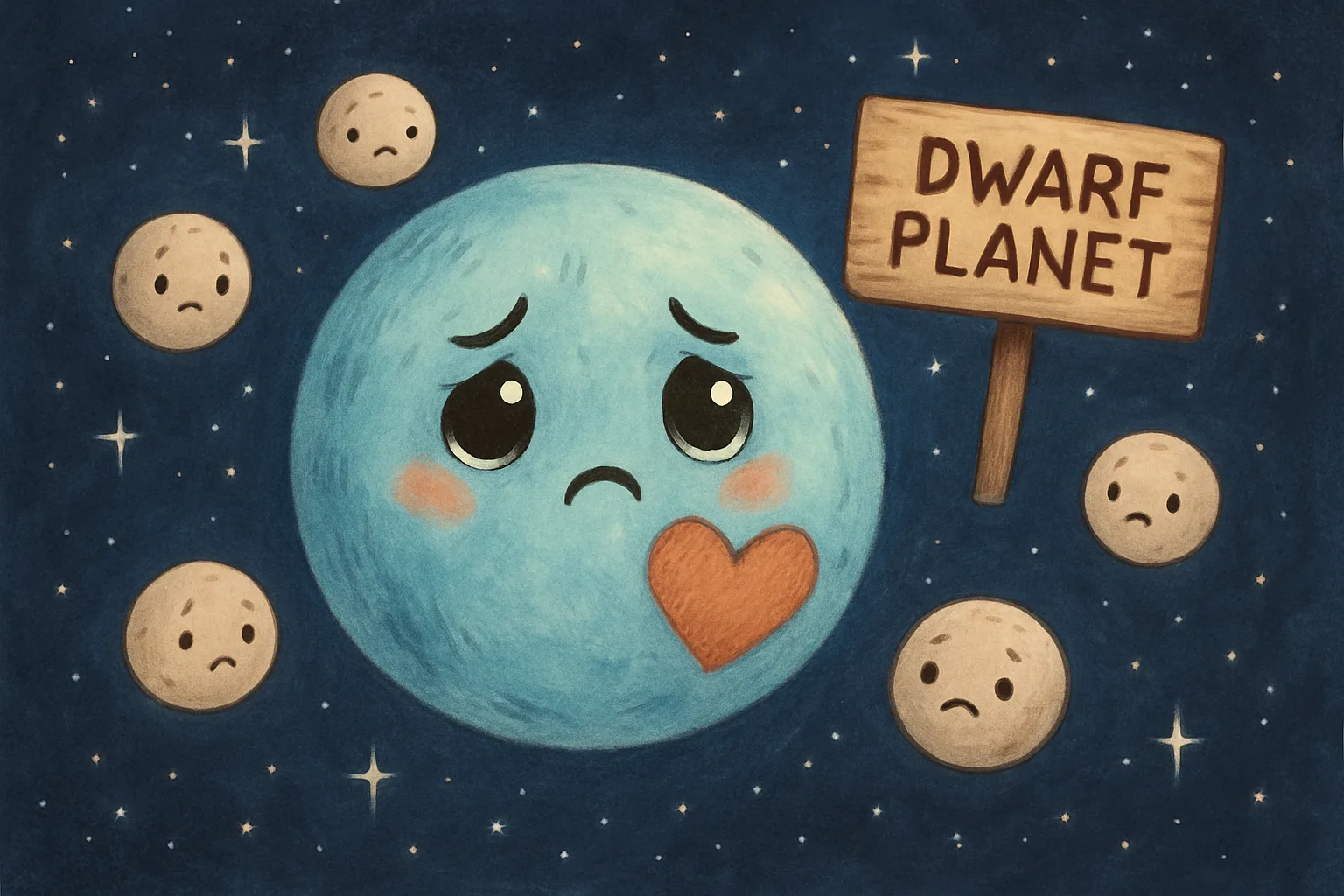
Happy Un-Birthday, Pluto! It’s Been 20 Years Since the Solar System Lost Its 9th Planet
Quick Summary
Exactly 20 years ago today — August 24, 2006 — scientists voted to remove Pluto from the list of official planets. Today the whole world is remembering the little world that lost its big title.
What Happened?
For 76 years, Pluto was the ninth planet in our solar system. Kids learned it. Teachers taught it. Textbooks printed it. Solar system models had nine little balls hanging on strings.
Then on this exact date in 2006, everything changed.
Scientists from around the world had gathered in Prague, Czech Republic, for a big astronomy meeting. They were part of a group called the International Astronomical Union, or IAU — a kind of rulebook committee for space. On August 24, 2006, they voted on a brand-new definition of what a planet actually is.
Under the new rules, a planet had to do three things. First, it had to orbit the Sun. Second, it had to be round — or nearly round — because of its own gravity. Third — and this is where Pluto ran into trouble — it had to have “cleared its neighborhood.” That means its gravity had to be strong enough to push away or gobble up other space objects near its path.
Pluto failed the third test. Its neighborhood in the outer solar system is crowded with thousands of other icy objects. Pluto is a bit like a student who has a tidy desk but a very messy bedroom — it just could not keep its orbital lane clean.
So the IAU voted, and Pluto was reclassified as a “dwarf planet.” Just like that, the solar system shrank from nine planets to eight.
Not everyone was happy. Only about 424 astronomers were in the room to vote that day. That is less than 5 percent of the world’s professional astronomers. Some scientists thought the vote was not fair. They still argue about it today. In fact, the scientist who led the New Horizons mission to Pluto — which flew past the tiny world in 2015 and sent back gorgeous photos — still believes Pluto deserves to be called a planet.
Why Does It Matter?
Pluto’s story teaches us something really important: science is not just about facts. It is also about definitions, and sometimes scientists disagree on where to draw the lines.
We now know five official dwarf planets: Pluto, Eris, Ceres, Makemake, and Haumea. Astronomers think there could be hundreds or even thousands more, hiding in the outer reaches of the solar system.
And Pluto is still amazing. The New Horizons spacecraft revealed that it has a giant heart-shaped plain of nitrogen ice, enormous mountains of water ice, and five moons — the biggest one called Charon. Pluto takes 248 years to orbit the Sun just once. It is so far away that sunlight takes over five hours to reach it. From Pluto’s surface, the Sun looks like just a bright star in the sky.
Dwarf planet or not, Pluto is a fascinating world — and it is still out there, quietly orbiting, no matter what humans decide to call it.
Big Words
- Dwarf planet — a round object that orbits the Sun but has NOT cleared away other objects from its orbital neighborhood
- International Astronomical Union (IAU) — the global scientific organization that officially names and classifies objects in outer space
- Orbit — the curved path one object takes around another in space, like the Earth going around the Sun
- Cleared its neighborhood — when a planet’s gravity is strong enough to pull in or push away other space objects along its orbital path
- Nitrogen ice — frozen nitrogen gas, which forms the smooth, flat plains across parts of Pluto’s surface
Fun Fact
The name “Pluto” was suggested by an 11-year-old girl named Venetia Burney, from Oxford, England — she proposed it to her grandfather over breakfast the morning after Pluto’s discovery was announced in 1930!
Think About It
If you were an IAU scientist, would you vote to bring Pluto back as a planet — or keep it as a dwarf planet? What rules would you use to decide?
Sources
- NationalToday.com — Pluto Demoted Day August 24, 2026
- WQCS Skywatch — Skywatch for the week of August 24, 2026
- TimeAndDate.com — Pluto Demoted Day
- NCPA Off-Script — Aug 24, 2026 script