
Slingshot in Space! NASA’s Psyche Spacecraft Swings Past Mars on Its Way to a Metal World
Quick Summary
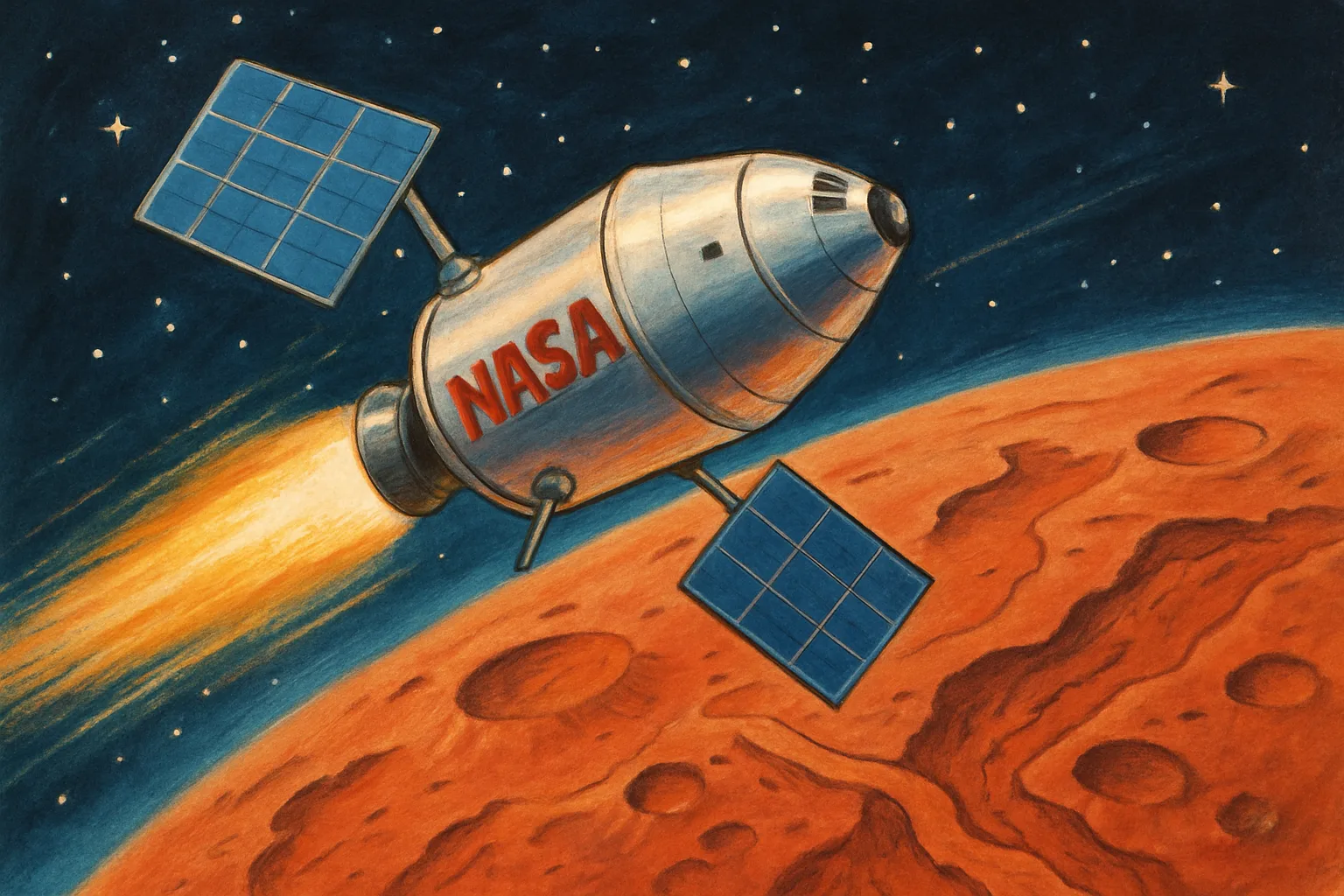
NASA’s Psyche spacecraft swung close past Mars earlier this year and used the planet’s gravity like a slingshot to speed up. The maneuver worked perfectly, and Psyche is now racing toward its target: a mysterious asteroid made mostly of metal. NASA just released a stunning timelapse video of the whole encounter!
What Happened?
On May 15, 2026, the Psyche spacecraft zoomed past Mars, coming within about 2,864 miles of the planet’s surface. That’s about the same distance as flying from New York all the way to Los Angeles — and back. For a spacecraft traveling through deep space, that is a very close approach!
But Psyche wasn’t stopping to visit Mars. Instead, it used Mars’s gravity to perform a clever trick called a gravity assist. Think of it like a ball rolling near a spinning merry-go-round: the spinning merry-go-round grabs the ball and flings it forward faster. Mars’s gravity grabbed Psyche and boosted its speed by about 1,000 miles per hour. It also tilted Psyche’s flight path just slightly — about one degree — to point it precisely at its destination.
NASA recently released a breathtaking timelapse video made from images captured during the flyby. The video shows Mars slowly growing from a tiny crescent, like a sliver of a fingernail, into a full, swirling red globe as Psyche approached. Craters, rust-red deserts, and polar ice caps were all visible.
While flying past Mars, Psyche also turned on its science instruments and tested them out — practicing for the real science work ahead. The mission team confirmed that everything worked beautifully.
Why Does It Matter?
Psyche is now locked on a path toward asteroid 16 Psyche, a giant space rock located in the asteroid belt between Mars and Jupiter. Psyche is expected to arrive at the asteroid in the summer of 2029.
Asteroid 16 Psyche is one of the most unusual objects in our solar system. Scientists believe it is made mostly of metal — perhaps iron and nickel — rather than rock and ice like most asteroids. Some researchers think it could be the leftover core of a small planet that was smashed apart long ago.
Here on Earth, we cannot dig deep enough to study our own planet’s iron core directly. But asteroid 16 Psyche may be sitting right out in space, waiting to be explored. By visiting it, scientists hope to learn how rocky planets like Earth formed in the first place.
The Mars flyby also tested a brand-new communication system called Deep Space Optical Communications, which uses laser light instead of radio waves to send information back to Earth much faster than before.
Big Words
- Gravity assist — a smart space-travel trick where a spacecraft uses a planet’s gravity to gain speed and change direction without burning any extra fuel
- Asteroid — a rocky or metallic object that orbits the Sun; most are found in the asteroid belt between Mars and Jupiter
- Asteroid belt — a wide ring of rocky and metallic objects orbiting the Sun between the planets Mars and Jupiter
- Timelapse — a video created by taking many photos over a long stretch of time and playing them quickly, so hours or days of movement appear in just a few seconds
- Deep Space Optical Communications — a new NASA technology that uses laser beams to send data from spacecraft very far away, much faster than old-fashioned radio signals
Fun Fact
Mars boosted Psyche’s speed by about 1,000 miles per hour — for free! Using a gravity assist instead of firing rocket engines saved a huge amount of fuel. It is like getting a running push from a giant instead of pedaling uphill on your own.
Think About It
Asteroid 16 Psyche might be the exposed iron core of an ancient destroyed planet. If you could bring back a piece of it to study, what do you think scientists might learn about how Earth’s own core was formed?
Sources
- NASA.gov — NASA’s Psyche Mission Aces Mars Flyby, Targets Metal-Rich Asteroid
- NASA Science Blog — NASA’s Psyche Mission Delivers Mars Flyby Data, Time-lapse Video (July 17, 2026)
- ScienceDaily — NASA’s Psyche Spacecraft Aces Mars Flyby Capturing Stunning Timelapse Video (July 28, 2026)
- HotHardware — NASA’s Psyche Spacecraft Captures Breathtaking Mars Flyby (July 22, 2026)