
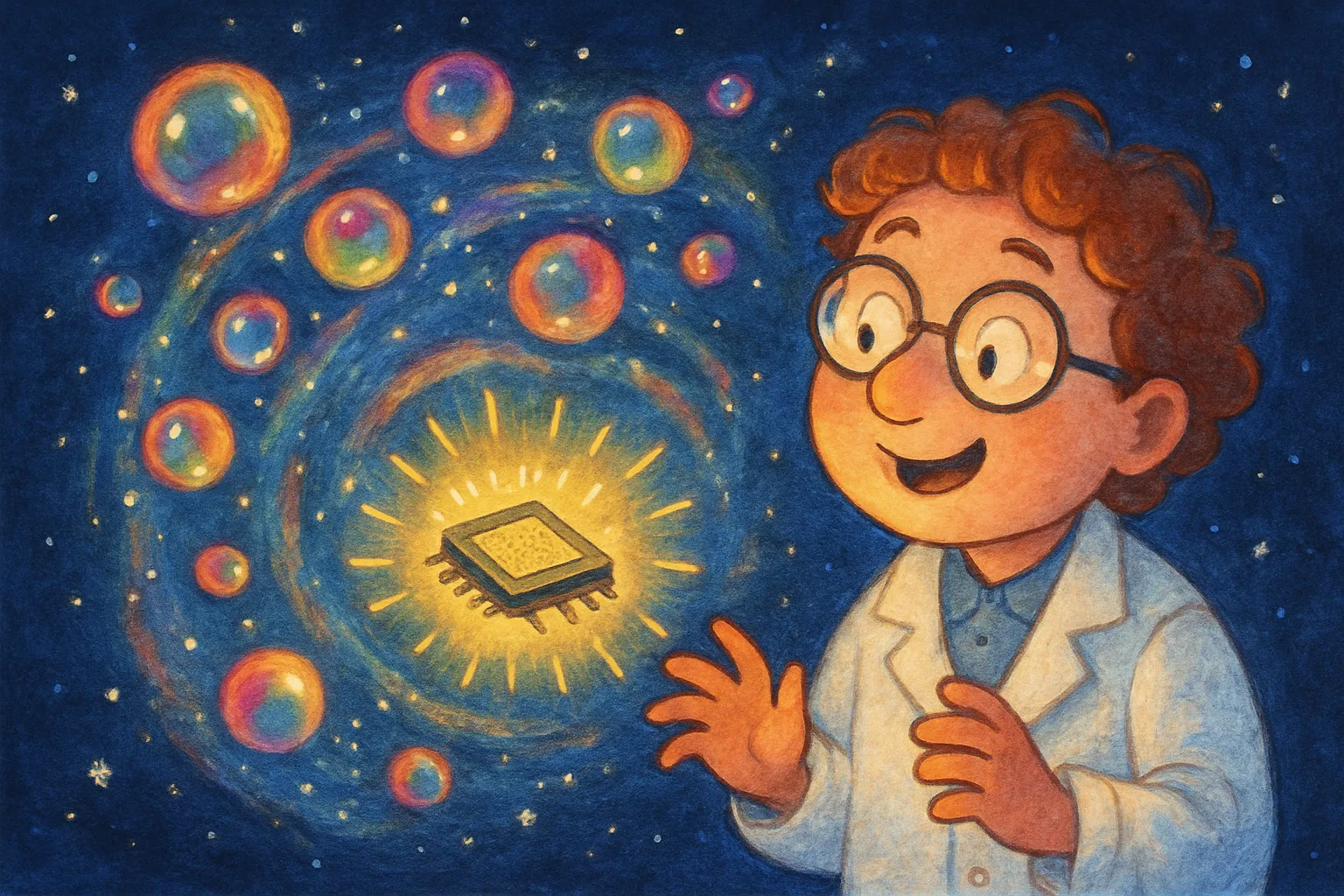
Pop! Scientists Use a Tiny Computer to Replay the Big Bang
Quick Summary
Scientists at Duke University used a special quantum computer to recreate something truly mind-blowing: the moment when brand-new particles “popped into existence” shortly after the Big Bang — the giant explosion that created our universe about 13.8 billion years ago. Their findings were published in the science journal Nature Physics.
What Happened?
Imagine stretching a rubber band so tight that it snaps. When it snaps, the energy stored in the stretch becomes motion — and things fly apart. Physicists have a similar idea about particles — the tiniest building blocks of everything in the universe.
In physics, certain particles are connected by something called a “string” of energy — not a real string you can touch, but a field of force linking them together. If you pull them far enough apart, the string stretches until it has so much energy that it “snaps” — and brand-new particles pop into existence right at the breaking point.
This is thought to be one of the ways matter formed in the very early universe, right after the Big Bang. But it is incredibly hard to study. You cannot exactly rewind the universe by 13.8 billion years!
So researchers at the Duke Quantum Center found a clever workaround. They used a quantum computer made of just 13 trapped ions — atoms that have been modified and held in place with special electric fields. Each ion acts like a tiny bit of the universe. Think of 13 glowing beads on a string, where each bead can store and process information in a totally new way.
By carefully changing the conditions in the simulator, the team watched as new pairs of effective particles appeared — popping into existence, just as physics predicted for the early universe.
One surprise: the new particles appeared at the ends of the “string” first and then spread inward. Scientists had expected them to appear more evenly. That unexpected result is a brand-new discovery.
Why Does It Matter?
Quantum computers work in a completely different way from the laptop or tablet you use at school. They can tackle problems that regular computers find almost impossible — like simulating the crazy physics of the very early universe.
This experiment, published in the journal Nature Physics, shows that quantum computers could one day help answer some of the biggest questions ever asked: How did matter form? Why is there more matter than anti-matter in the universe? What happened in the first split-second after the Big Bang?
We don’t have all the answers yet. But scientists now have a powerful new tool to explore them.
Big Words
- Quantum computer — A type of computer that uses the strange rules of quantum physics to solve problems that normal computers cannot handle
- Ion — An atom that has gained or lost an electron, giving it an electric charge; quantum computers use them like tiny processing units
- Big Bang — The massive explosion of energy about 13.8 billion years ago that scientists believe created our universe
- String breaking — A physics phenomenon where the energy connecting two particles builds up until it “snaps” and creates new particles
- Nature Physics — One of the world’s most respected scientific journals, where important physics discoveries are published
Fun Fact
The quantum simulator used in this experiment holds just 13 ions — each one smaller than a human hair is wide. Yet it can model conditions from the earliest moments of the universe, something no supercomputer on Earth could do as well!
Think About It
Scientists cannot travel back in time to watch the Big Bang, so they build tiny simulations to learn about it. Can you think of other times when people build small models or simulations to understand big, complicated things?
Sources
- Duke University Pratt School of Engineering — Quantum Device Simulates Matter Popping into Existence
- ScienceDaily — Quantum computer simulates matter ‘popping into existence’
- Phys.org — Quantum device simulates matter popping into existence
- Nature Physics — String-breaking dynamics in a quantum simulator (published September 23, 2026)