
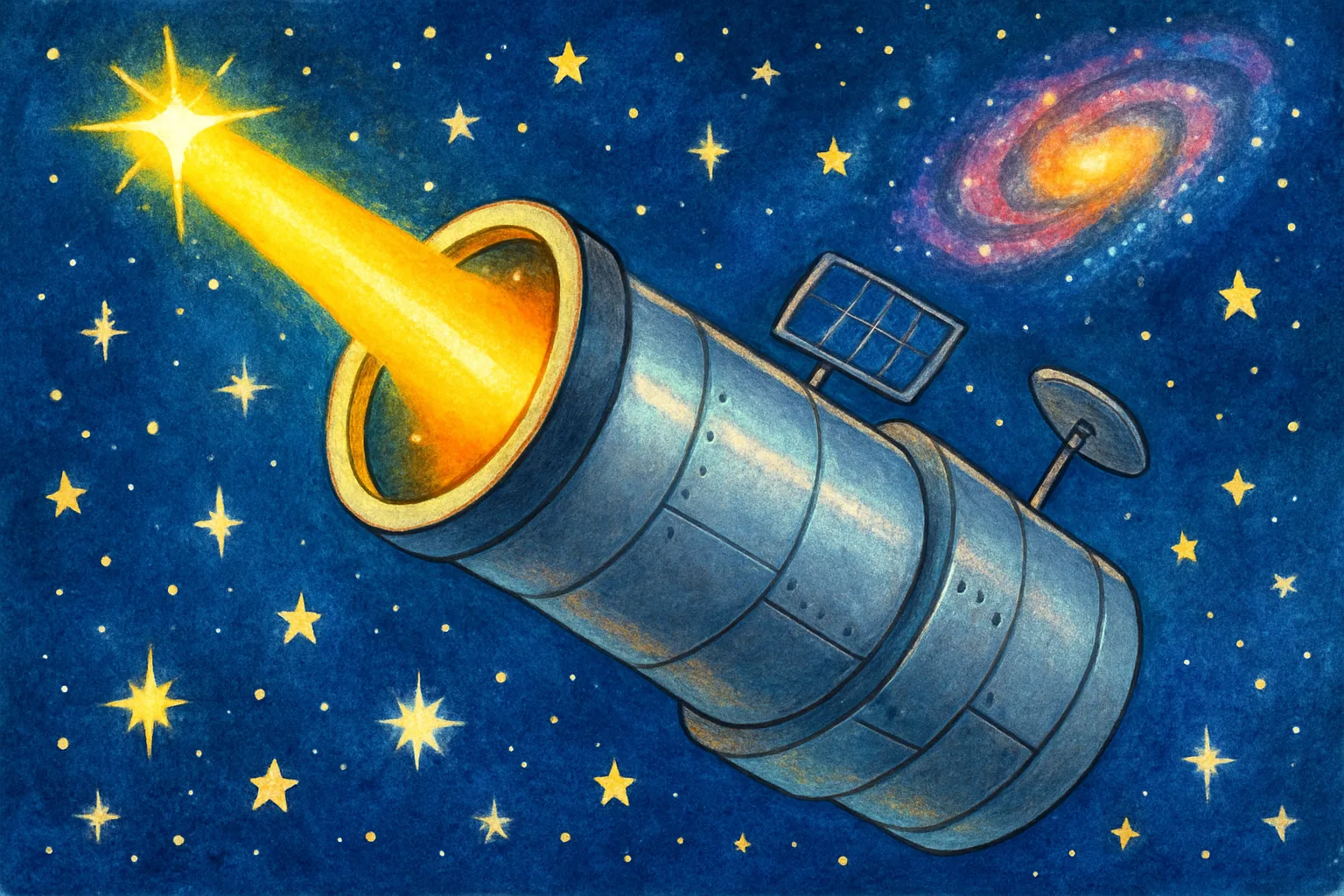
Planet Hunter! NASA’s Newest Telescope Opens Its Eye for the Very First Time
Quick Summary
NASA’s brand-new Roman Space Telescope just switched on a special camera called a coronagraph for the very first time in space. The coronagraph is designed to block starlight so scientists can see planets hiding around other stars. It already captured its first test images — and things look great!
What Happened?
NASA launched the Nancy Grace Roman Space Telescope on August 30, 2026. It rode into space on a SpaceX Falcon Heavy rocket. Now it is traveling toward its home about one million miles from Earth.
On September 22, something exciting happened. A special instrument called the Coronagraph Instrument opened its eye to starlight for the very first time. Think of it like a baby opening its eyes after being born — that first look is a huge moment.
The coronagraph works like a thumb over a flashlight. If you hold your thumb just right, you block the bright bulb. Then you can see the dim light around it. The coronagraph does the same thing with stars. It blocks a star’s blinding glare so scientists can spot the faint glow of planets orbiting around it.
The team then pointed the instrument at a nearby galaxy called the Large Magellanic Cloud. It captured star images — blurry at first, then sharper on a second test on September 27. That is exactly what the scientists expected to see.
The telescope is also incredibly steady. It can stay locked on a target with precision like aiming a laser pointer at a coin from 150 miles away. That steadiness is important, because one tiny wobble would ruin an image.
Why Does It Matter?
Scientists believe there are billions of planets out there orbiting other stars. Most of them are impossible to photograph because the star next to them is so blindingly bright — like trying to see a firefly sitting next to a stadium spotlight.
The Roman coronagraph is a technology test for future planet-hunting telescopes. If it works as planned, future tools could one day photograph Earth-like planets and even look for signs of life in their atmospheres.
Full science observations are expected to begin in early 2027. Scientists around the world are waiting excitedly to see what Roman discovers.
Big Words
- Coronagraph — a special device that blocks the bright light of a star so fainter objects nearby can be seen.
- Large Magellanic Cloud — a small galaxy that travels close to our Milky Way galaxy, visible from Earth’s southern sky.
- Fine-guidance system — the part of the telescope that keeps it perfectly still and pointed at the right spot in space.
- Exoplanet — a planet that orbits a star other than our Sun.
- Commissioning — the process of testing and preparing a new spacecraft or instrument before it begins its real science work.
Fun Fact
The Roman Space Telescope’s main camera is so powerful it could photograph an area of sky the size of about 100 full moons in a single snapshot!
Think About It
If you could photograph any planet around another star, what would you most hope to find there?
Sources
- NASA JPL — NASA’s Roman Team Snaps Test Coronagraph Image
- Caltech IPAC — NASA’s Roman Space Telescope Takes First Coronagraph Instrument Observation
- ScienceDaily — NASA’s Roman telescope just opened its planet-hunting eye
- Time.news — NASA’s Roman Space Telescope Opens Coronagraph Instrument to Cosmic Light