
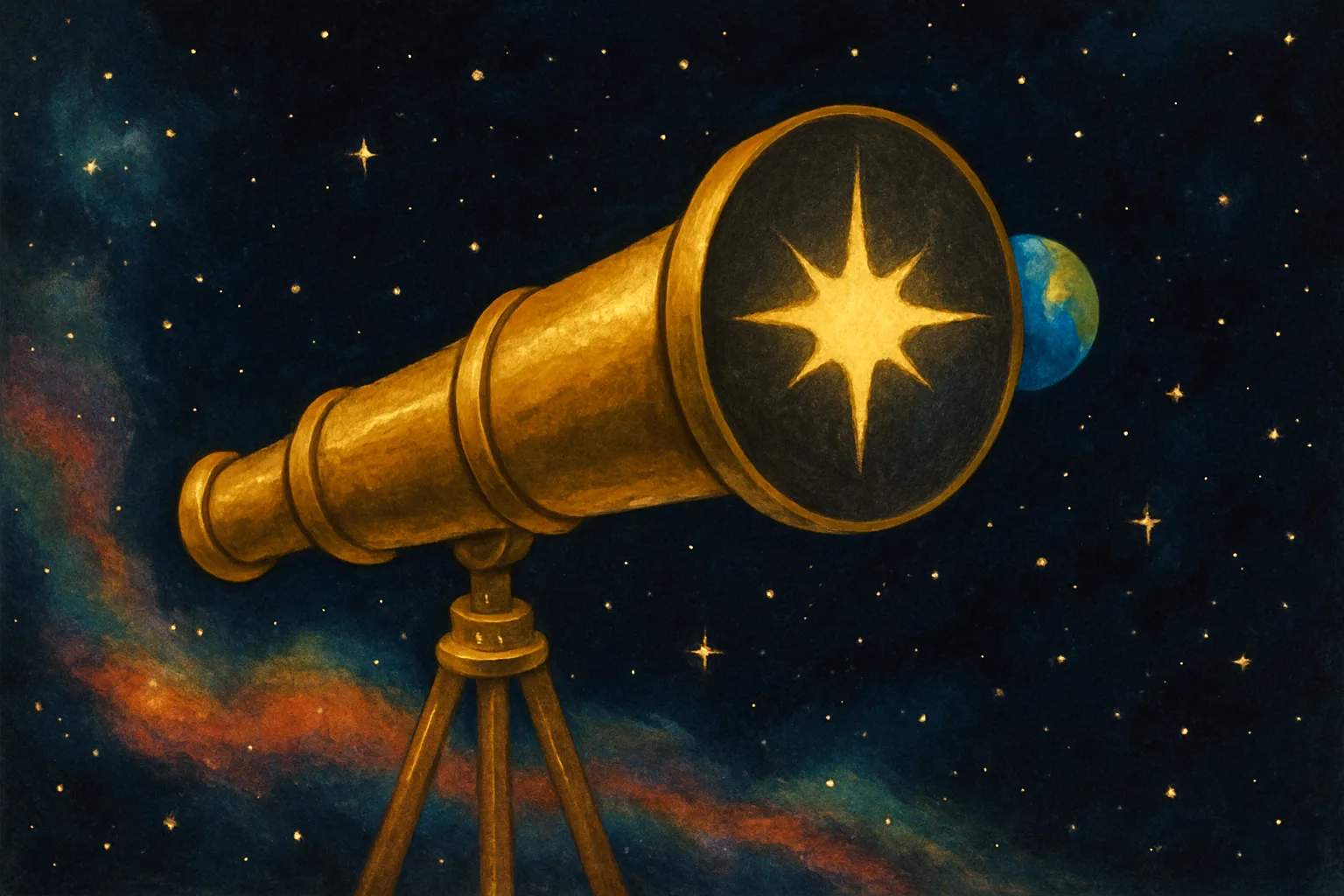
Planet Hunter Wakes Up! NASA’s Roman Telescope Opens Its Special Star-Blocking Eye
Quick Summary
NASA’s Nancy Grace Roman Space Telescope has turned on a special tool called a coronagraph — and it just captured real starlight in space for the very first time. This is the first instrument of its kind ever tested in orbit. Scientists hope it will one day help us find planets that look like Earth.
What Happened?
NASA launched the Roman Space Telescope on August 30, 2026, aboard a SpaceX Falcon Heavy rocket. One month later, engineers began waking up the telescope’s special instruments one by one.
On September 22, something historic happened. Roman switched on a tool called the Coronagraph Instrument. It opened its eye to cosmic light for the very first time while floating in space.
The coronagraph captured a first glimpse of a star in the Large Magellanic Cloud — a small, neighboring galaxy to our Milky Way, located about 160,000 light-years away. Then, on September 27, it captured an even sharper second image.
NASA confirmed both milestones in an official announcement, and science reporters around the world shared the exciting news this week.
But what exactly is a coronagraph? Imagine you are trying to see a tiny firefly sitting right next to a giant spotlight. The spotlight is so bright you cannot see the firefly at all! A coronagraph works like a tiny thumb placed in front of that spotlight — it blocks the blinding light of a star so scientists can spot the much dimmer planets orbiting beside it.
What makes Roman’s coronagraph extra special is that it uses a mirror that can change its shape. This shape-shifting mirror, called a deformable mirror, bends light with extreme precision. It is the first of its kind ever tested in space. Scientists call it a “deformable-mirror coronagraph.”
Roman also proved it can hold incredibly still. Its guidance system was tested from September 15 to 21. The results were stunning. Roman can stay locked on a single target with a precision better than 1/100,000 of a degree — that is like aiming a laser at a coin from 150 miles away and never missing.
As a bonus, engineers discovered that Roman used so little fuel getting to its post in space that the telescope has enough propellant to operate for at least 22 years. It was originally designed for just 5 years!
Why Does It Matter?
One of the biggest questions in all of science is: Are there other planets like Earth? And could any of them support life?
Roman’s coronagraph is designed to help answer that question. By blocking a star’s bright light, it will let scientists take direct photos of planets in other solar systems. Scientists call these distant worlds exoplanets.
Right now, most exoplanets are found by noticing tiny wobbles or brief dips in starlight — indirect clues. Roman’s coronagraph could one day let us actually see these worlds as tiny dots of light. That would be like the difference between hearing that a pizza exists and actually seeing one in front of you.
The technology tested on Roman will also help design NASA’s future Habitable Worlds Observatory — a telescope specifically built to search for planets that might host life.
Big Words
- Coronagraph — A tool on a telescope that blocks the bright light of a star so scientists can see faint objects near it, like planets.
- Deformable mirror — A flexible mirror that can change its shape to help focus light with extreme precision.
- Exoplanet — A planet that orbits a star other than our Sun.
- Lagrange point — A stable spot in space where a spacecraft can “park” near Earth, held steady by the gravity of the Earth and Sun together.
- Light-year — The distance light travels in one year — about 5.88 trillion miles. It is used to measure huge distances in space.
Fun Fact
The Roman telescope’s main camera will be able to survey an area of sky 100 times larger than the Hubble Space Telescope’s camera — in a single snapshot!
Think About It
If scientists found a planet that looked just like Earth around another star, what do you think would be the first question you would want answered about it?
Sources
- NASA Science Blog — NASA Checks Roman Guidance System, Takes First Coronagraph Observation (Sept 30, 2026)
- ScienceDaily / NASA — NASA’s Roman Telescope Just Opened Its Planet-Hunting Eye (Oct 2, 2026)
- TechTimes — NASA Roman Space Telescope Coronagraph Captures First Starlight in Orbit (Sept 30, 2026)
- Scientific American — NASA’s Nancy Grace Roman Telescope Glimpses Its First Cosmic Light