
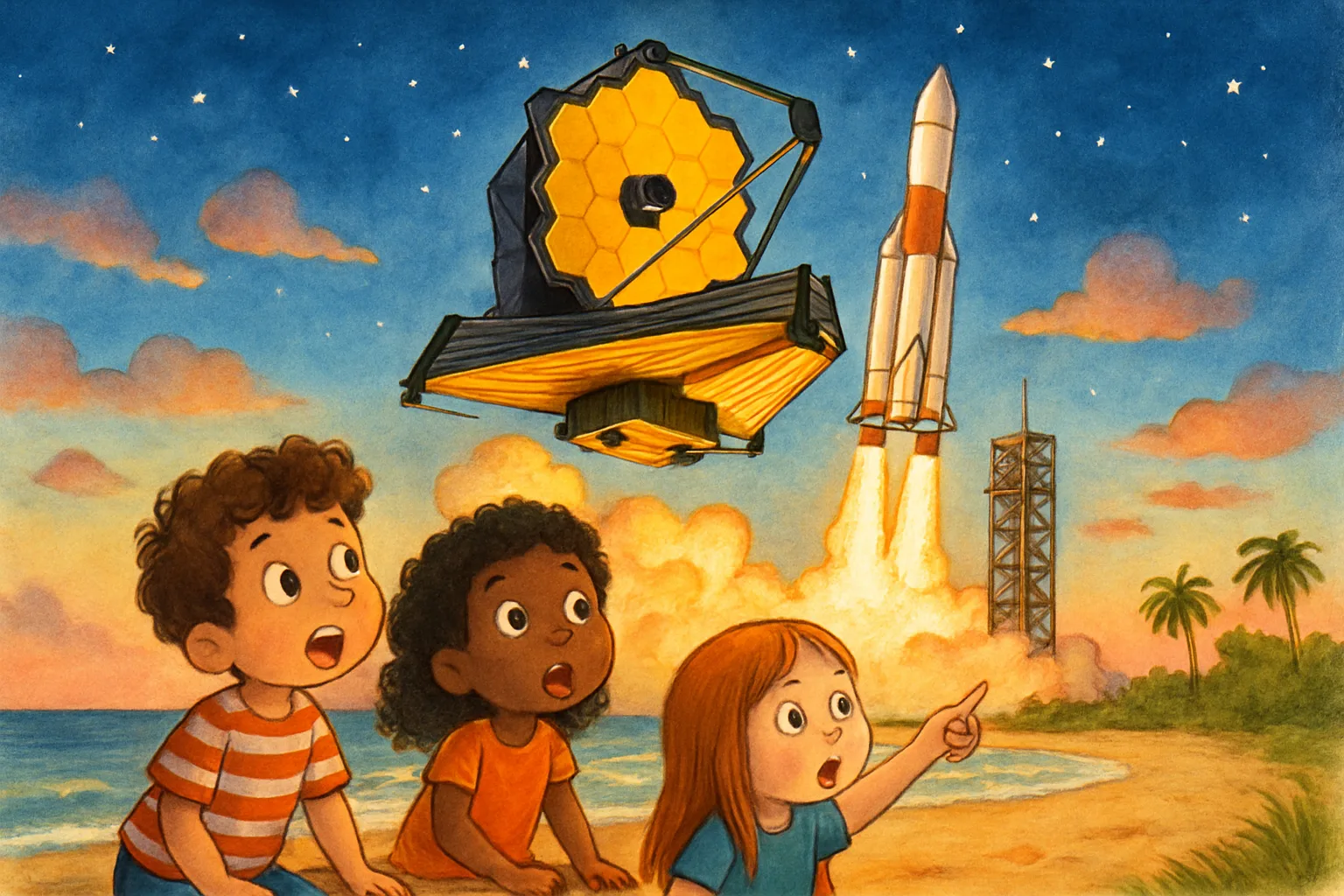
One Sleep Away! NASA’s Mega-Telescope Launches Tomorrow Morning
Quick Summary
NASA’s newest space telescope is ready to fly! The Nancy Grace Roman Space Telescope lifts off Sunday, August 30, at 7:26 a.m. from Florida. It will search for alien worlds and unlock some of the universe’s biggest secrets.
What Happened?
For years, thousands of engineers and scientists have been building a remarkable machine. Tomorrow morning, it finally gets its moment.
NASA’s Nancy Grace Roman Space Telescope — called Roman for short — has officially passed its final launch check. That check is called a Launch Readiness Review. Teams from NASA and SpaceX met Friday to make sure everything was perfectly ready.
Roman will ride to space on a SpaceX Falcon Heavy rocket. The Falcon Heavy is one of the most powerful rockets ever built. It uses three boosters strapped together — like three rocket engines holding hands.
Liftoff is set for 7:26 a.m. EDT from Launch Complex 39A at Kennedy Space Center in Florida. That is the same launchpad that sent Apollo astronauts to the Moon.
Weather forecasters say there is a 60 percent chance of good conditions for launch. The team is ready to go.
Why Does It Matter?
Roman is named after NASA’s very first chief astronomer, Nancy Grace Roman. She helped make the Hubble Space Telescope possible, so scientists sometimes call her the “mother of Hubble.”
Roman has a mirror the same size as Hubble’s. But it has a superpower Hubble does not: a much, much wider view. Imagine Hubble can photograph one postage stamp of the sky at a time. Roman can photograph more than 200 postage stamps — all at once.
Scientists say Roman is more than 1,000 times faster at surveying the sky than Hubble. What would take Hubble 2,000 years to scan, Roman can do in just one year.
So what will Roman look for? A lot!
First, it will hunt for planets outside our solar system — called exoplanets. It will use a special tool called a coronagraph. A coronagraph works like a thumb held up in front of your eyes to block the bright Sun so you can see something dimmer nearby. Roman’s coronagraph blocks the bright light from stars so Roman can spot the dimmer planets circling them.
Roman will also study dark energy — a mysterious force that scientists think is making the universe expand faster and faster. Nobody knows exactly what dark energy is. Roman could help crack that puzzle.
Over its five-year mission, Roman could measure light from up to one billion galaxies. That is a number so big it is hard to imagine — like counting every grain of sand on a very long beach, twice.
Why Does It Matter?
Bigger telescopes mean bigger discoveries. Every time humans have built a more powerful eye on the universe, they have found things nobody expected. Roman could reveal planets we have never dreamed of, or finally explain why the universe is speeding up. The discoveries could change science textbooks for generations.
Big Words
- Exoplanet — a planet that orbits a star other than our Sun, far out in space
- Coronagraph — a tool that blocks starlight so scientists can spot dimmer things hiding nearby, like planets
- Dark energy — a mysterious force that scientists think is pushing the universe to expand faster over time
- Launch Readiness Review — a final check where engineers make sure a rocket and its spacecraft are completely safe and ready to fly
- Field of view — the total area a camera or telescope can see in a single image, like the difference between looking through a straw and looking through a wide-open window
Fun Fact
Roman’s camera is so powerful that if you held a grain of sand at arm’s length, Roman could take a picture sharp enough to show all the tiny scratches on it — from millions of miles away.
Think About It
If Roman discovers a planet that looks a lot like Earth orbiting another star, what question would you most want scientists to ask about it?
Sources
- NASA Science — Roman Launch Countdown
- NPR — NASA is about to launch a space telescope that could change how we see the universe
- Space.com — Nancy Grace Roman Telescope live updates
- ScienceDaily — NASA is about to launch a powerful new eye on the universe
- DogonNews — NASA’s Roman Space Telescope Set To Launch August 30