
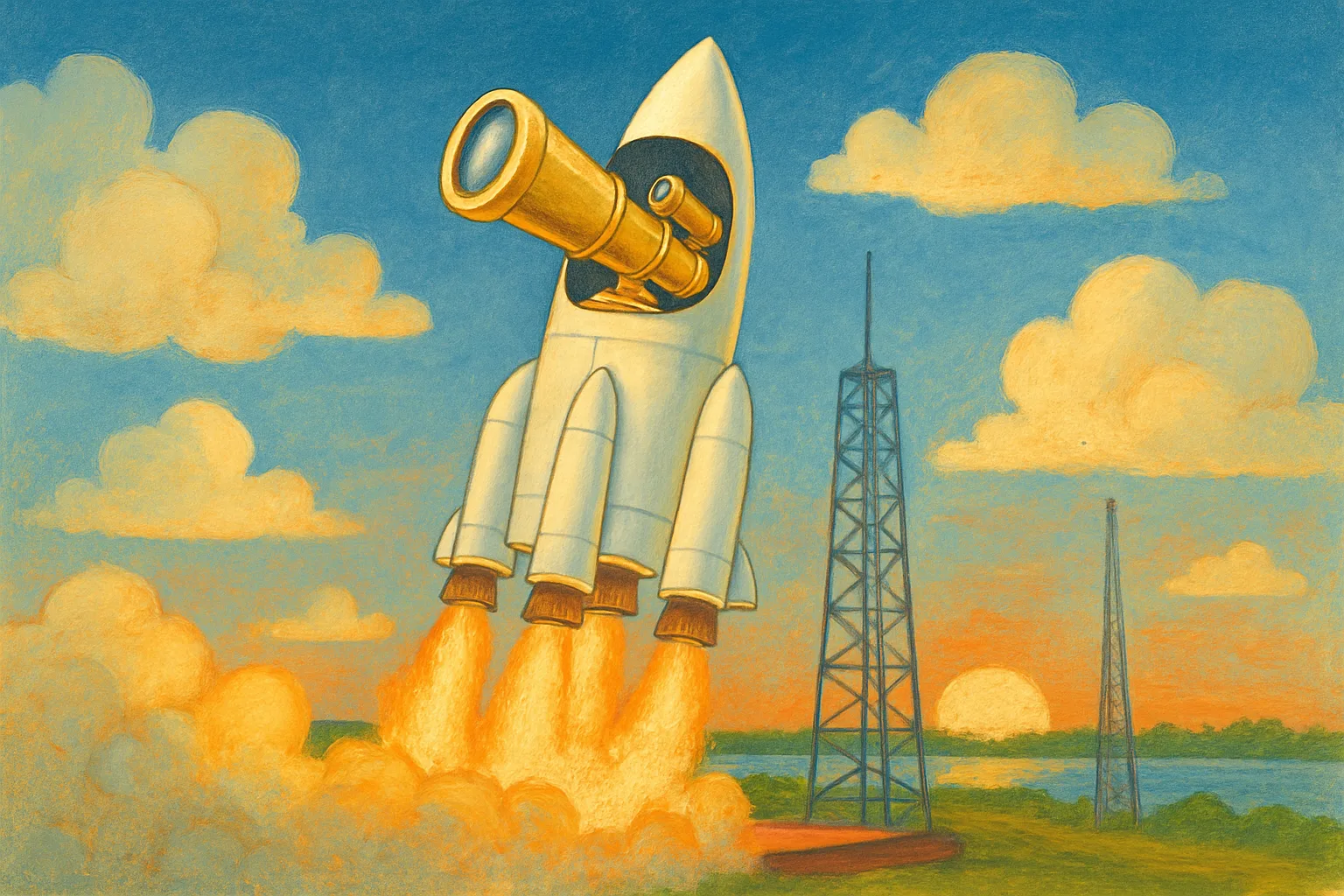
Liftoff! NASA’s Biggest New Telescope Rockets Into Space This Morning
Quick Summary
NASA’s Nancy Grace Roman Space Telescope blasted off this morning from Florida. It rode into space on a powerful SpaceX Falcon Heavy rocket. This is one of the biggest astronomy moments in years!
What Happened?
Early this Sunday morning, the skies over Kennedy Space Center lit up with fire and thunder. A SpaceX Falcon Heavy rocket carrying NASA’s Roman Space Telescope lifted off at 7:26 a.m. Eastern time from Launch Pad 39A in Florida.
The Falcon Heavy is one of the strongest rockets ever built. It uses three Falcon 9 boosters strapped side by side — almost like three rockets in one. After launch, two of those booster rockets separated and flew back to land at Cape Canaveral. The spacecraft carrying Roman then coasted up and away from Earth.
Roman is heading to a special parking spot in space called the L2 point. That spot is about 1.5 million kilometers from Earth — about four times farther than the Moon. From there, Roman will look deep into the universe without Earth’s bright light getting in the way.
The telescope was originally supposed to launch in May 2027. But the team worked so hard that it launched nine months ahead of schedule and even under budget. That almost never happens for a mission this big!
Why Does It Matter?
The Roman Space Telescope is a brand-new set of eyes on the universe. Its camera has 300 megapixels — that’s like 300 million tiny picture squares. Your phone camera probably has about 12. Roman’s view of the sky will be at least 100 times wider than the famous Hubble Space Telescope.
Scientists hope Roman will photograph light from about one billion galaxies during its five-year mission. A billion is one thousand millions — more stars and galaxies than you could count in a thousand lifetimes.
Roman will study two of the universe’s biggest secrets: dark energy and dark matter. These are invisible forces and materials that make up most of everything — but scientists still don’t fully understand them. Roman will also search for planets around other stars and look for worlds where life might someday be found.
NASA named the telescope after Nancy Grace Roman, the agency’s first chief astronomer. She helped make the Hubble Space Telescope possible, which is why people call her the “Mother of Hubble.”
Big Words
- Observatory — a powerful telescope used by scientists to study space
- Dark energy — a mysterious force that is making the universe expand, or stretch out, faster and faster
- Dark matter — invisible material that can’t be seen but has gravity and holds galaxies together
- Lagrange point — a special spot in space where the gravity of the Sun and Earth balance out, making it a steady place to park a spacecraft
- Megapixel — one million tiny picture dots; more megapixels means a sharper, more detailed photo
Fun Fact
The launch pad Roman used — Pad 39A at Kennedy Space Center — is the same pad from which astronauts launched to the Moon during NASA’s Apollo missions in the 1960s and 70s.
Think About It
If Roman takes pictures of one billion galaxies, and each galaxy has billions of stars, how many stars do you think Roman might help scientists study — and do you think any of them might have planets with life?
Sources
- NASA Science — Roman Launch Countdown
- NASA.gov — Nancy Grace Roman Space Telescope Launch Coverage
- NASA+ — Nancy Grace Roman Space Telescope Launch (event has already occurred)
- SpaceNews — Roman Space Telescope ready for Aug. 30 launch
- Space.com — Nancy Grace Roman Telescope live updates
- SpacePolicyOnline.com — What’s Happening in Space Policy August 23–30, 2026