
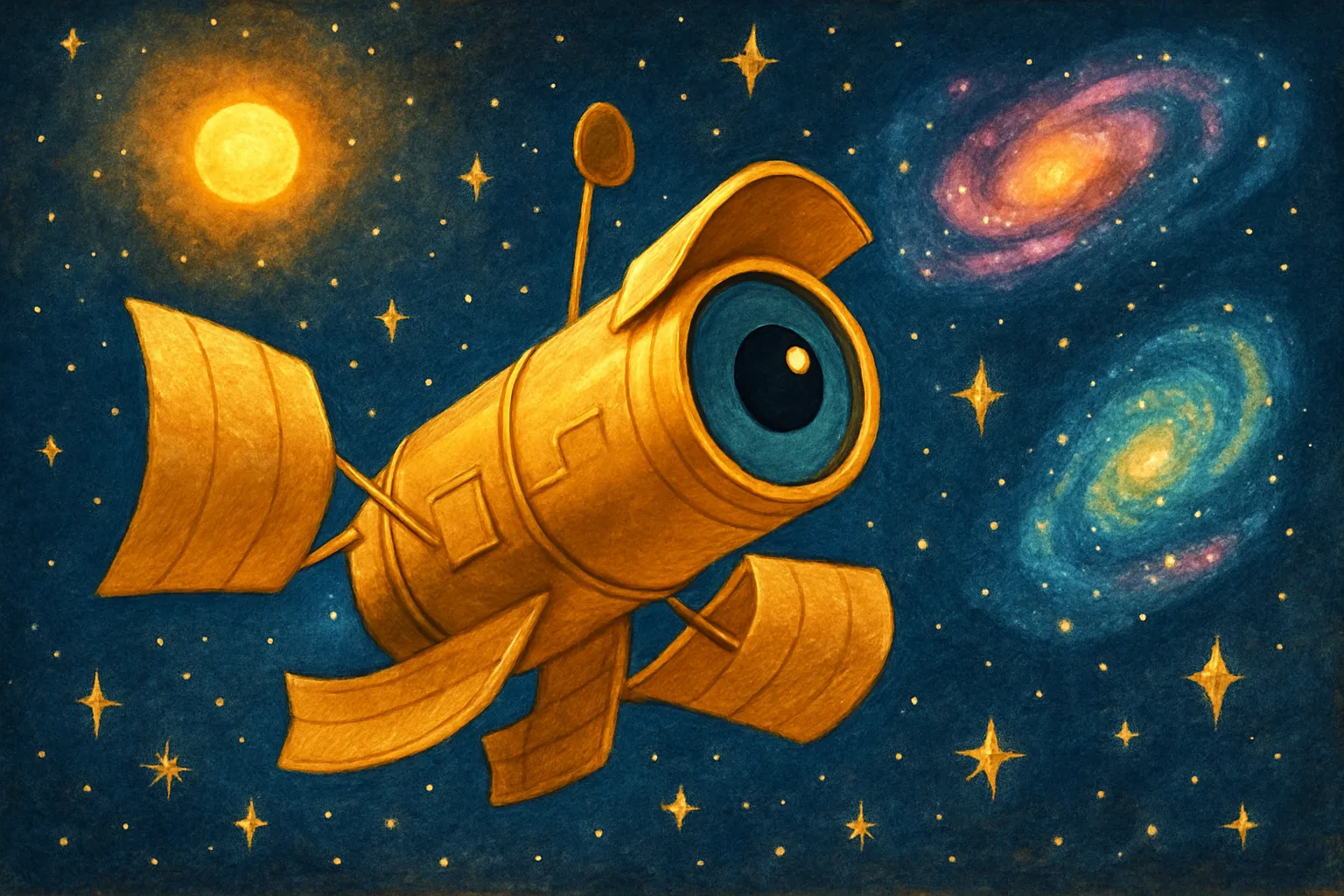
Off to the Stars! NASA’s Roman Telescope Is Now on a Million-Mile Journey
Quick Summary
NASA’s brand-new Roman Space Telescope blasted off yesterday morning. It is now sailing through space on a three-month trip to its final home — about one million miles from Earth. When it arrives, it will help scientists unlock some of the biggest secrets in the universe.
What Happened?
At 7:26 in the morning on Sunday, August 30, a huge SpaceX Falcon Heavy rocket thundered off the launch pad at Kennedy Space Center in Florida. Riding on top was NASA’s Nancy Grace Roman Space Telescope.
The Falcon Heavy is one of the most powerful rockets ever built. Its 27 engines made more than five million pounds of thrust. That is about the same force as 30 jumbo jet planes all pushing at once!
About half an hour after liftoff, the telescope separated from the rocket and began flying on its own. It unfolded its solar panels to soak up sunlight for power. Now it is cruising quietly through space, getting farther from Earth every second.
The Roman Telescope is headed to a special spot called L2. That stands for Lagrange Point 2. It sits about one million miles away — roughly four times the distance from Earth to the Moon. The James Webb Space Telescope already works from that same neighborhood.
The whole trip will take about three months. Scientists and engineers will spend that time checking all of Roman’s systems to make sure everything is working perfectly.
Why Does It Matter?
Roman has a mirror the same size as the famous Hubble Space Telescope’s mirror. But here is the amazing part: Roman can photograph 100 times more sky in one single snapshot than Hubble can. Imagine swapping a regular camera for one that takes photos of the whole neighborhood instead of just one house!
Scientists plan to use Roman to study dark energy — a mysterious force that is making the universe grow bigger and faster. Roman will also search for planets around faraway stars, hunt for exploding stars called supernovas, and photograph billions of galaxies.
NASA named the telescope after Dr. Nancy Grace Roman, who was the agency’s very first chief astronomer. She helped make the Hubble Space Telescope possible. Now her name is on an even more powerful machine, exploring the cosmos she loved.
Big Words
- Lagrange Point — a special spot in space where the gravity of the Sun and Earth balance out perfectly, letting a spacecraft stay in one place without using much fuel.
- Dark energy — a mysterious force scientists believe is causing the universe to expand, or grow bigger, faster and faster over time.
- Supernova — a giant explosion that happens at the end of a massive star’s life; it can briefly shine brighter than an entire galaxy.
- Solar panels — flat panels that turn sunlight into electricity, powering a spacecraft the way a solar-powered calculator uses light to run.
- Exoplanet — a planet that orbits a star other than our Sun, possibly billions of them scattered across the universe.
Fun Fact
The Roman Space Telescope’s main mirror was originally built as part of a secret spy satellite. The government donated it to NASA, saving the agency billions of dollars!
Think About It
If Roman finds a planet that looks a lot like Earth — with the right temperature and signs of water — what questions would you most want scientists to answer about it?
Sources
- NASA Science Blog — NASA’s Roman Space Telescope Launches
- NPR — ‘A glorious dawn launch’: NASA’s newest space telescope has left the Earth
- NASA APOD — APOD: 2026 August 31 – Launch of the Roman Space Telescope
- Space.com — Nancy Grace Roman Telescope live updates