
Saturn’s Force Field Has a Secret Twist — And Scientists Just Figured Out Why!
Quick Summary
Scientists have found something surprising in old data from NASA’s Cassini spacecraft. Saturn’s magnetic shield — the invisible bubble that protects it from the Sun — is twisted and lopsided. Its super-fast spin and one of its moons are responsible for the strange shape.
What Happened?
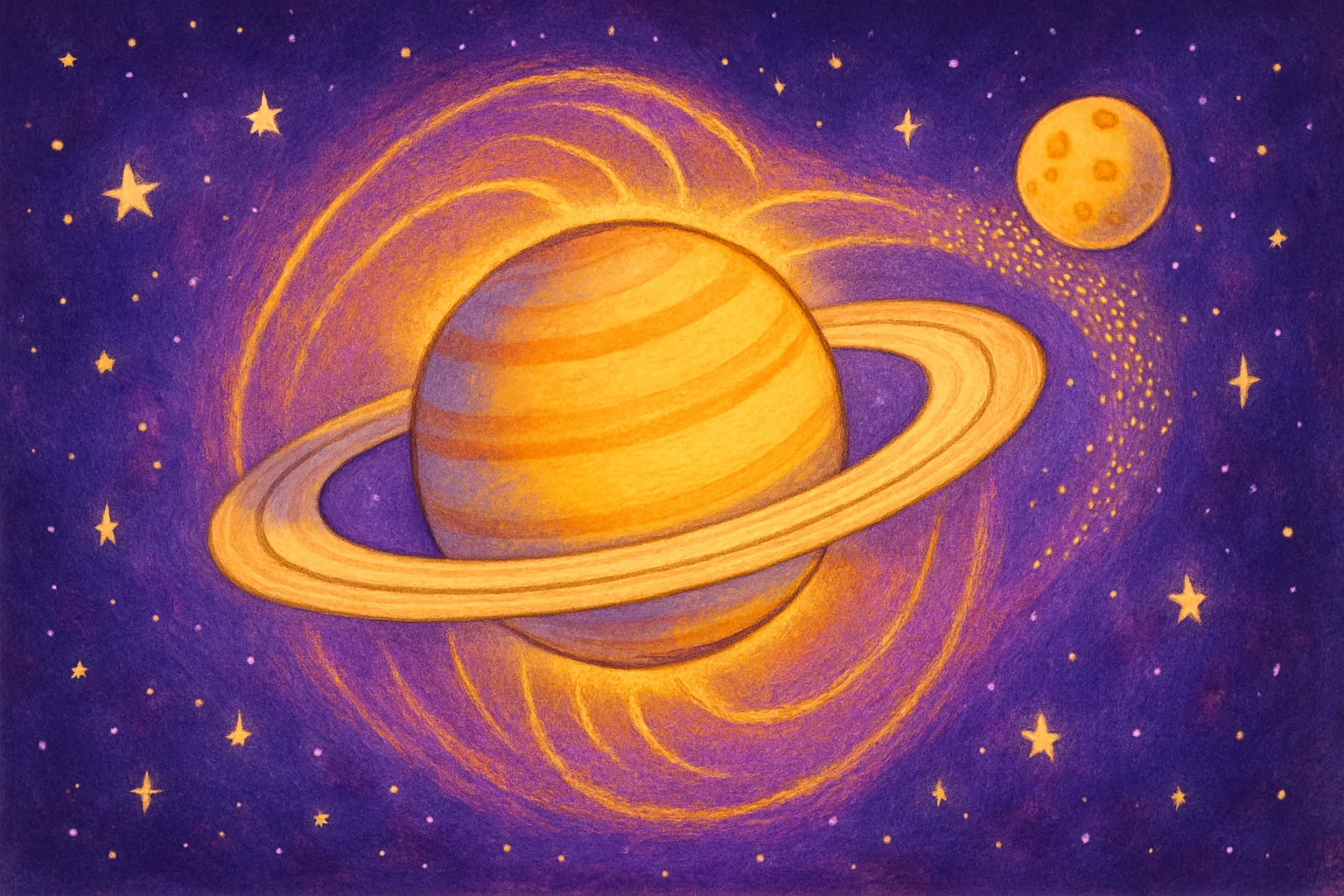
Every planet with a magnetic field has an invisible protective bubble around it called a magnetosphere. Think of it like a force field in a video game — it deflects dangerous particles that stream out from the Sun.
On Earth, this force field has two small funnel-shaped gaps near the poles, where some solar particles can sneak through. These gaps are called cusps, and on Earth they sit roughly at noon on the planet’s dayside — right where you’d expect them.
But Saturn is different. Very different.
Scientists studying years of data from the Cassini spacecraft — which explored Saturn from 2004 to 2017 — have discovered that Saturn’s cusps are dragged far around to the afternoon side of the planet. Instead of sitting at “noon,” they’re pushed all the way to “3 or 4 in the afternoon,” if you imagine the planet as a clock.
The culprit is Saturn’s incredibly fast spin. Saturn rotates once every 10.5 hours — so fast that a full day there is shorter than a school day plus a night of sleep. That rapid spin drags the planet’s whole magnetic structure around with it, pulling the cusps out of place.
There is a second culprit too: Saturn’s moon Enceladus. This icy moon shoots giant geysers of water ice and charged particles into space. Those particles pile up inside Saturn’s magnetic bubble, making it heavy and uneven — like a lopsided backpack.
The research was published in the journal Nature Communications.
Why Does It Matter?
Understanding Saturn’s magnetic shield helps scientists understand Saturn’s bright, colourful auroras — the light shows that appear near its poles, similar to Earth’s Northern Lights.
It also shows us that giant planets like Saturn play by completely different rules than Earth when it comes to magnetic fields. The finding could help scientists better understand other giant planets, including ones orbiting distant stars.
Best of all, it proves that space missions like Cassini keep giving us new discoveries — even years after the spacecraft itself is gone.
Big Words
- Magnetosphere — the invisible bubble of magnetic force around a planet that shields it from harmful particles from the Sun, like a giant invisible helmet.
- Cusp — a funnel-shaped gap near a planet’s poles where solar particles can slip through the magnetic shield, almost like a drain in a bathtub.
- Cassini — a NASA spacecraft that spent 13 years exploring Saturn and its moons before diving into the planet in 2017.
- Enceladus — one of Saturn’s 146 moons, famous for shooting enormous icy water geysers into space from cracks on its surface.
- Aurora — a glowing, colourful light show in a planet’s sky caused by particles interacting with the magnetic field near the poles — Earth’s version is called the Northern Lights.
Fun Fact
Saturn spins so fast that its equator bulges outward! The planet is about 10% wider across its middle than from pole to pole — like a beach ball someone is squishing from above and below.
Think About It
If Cassini ended its mission in 2017 but scientists are still discovering new things from its data in 2026, what does that tell you about how valuable it is to collect and save scientific data?
Sources
- ScienceDaily — ‘Cassini reveals a surprising twist in Saturn’s magnetic shield’ (Aug 10, 2026)
- Lancaster University / Nature Communications — ‘Dawn-dusk Asymmetrical Distribution of Saturn’s Cusp’
- NEWS.am Tech — ‘Cassini reveals unexpected feature of Saturn’s magnetosphere’ (Aug 10, 2026)