
Ring Spotlight! Saturn Will Be at Its Very Best This Weekend
Quick Summary
This weekend is the perfect time to spot Saturn in the night sky! On October 4, the ringed planet reaches a special position called opposition. That makes it the brightest and biggest it will appear all year. You do not need a telescope to see it — just your eyes and a clear sky!
What Happened?
Every year, Earth catches up to Saturn in our race around the Sun. When Earth passes right between the Sun and Saturn, that moment is called opposition. It is like Saturn is standing directly across from the Sun in the sky.
At opposition, Saturn rises in the east just as the Sun sets in the west. It stays up all night long. And because it is on the same side of the Sun as us, it is closer and brighter than at any other time of the year.
Saturn reaches its 2026 opposition on October 4. But the good news is you do not have to wait until exactly that moment. Saturn is already blazing in the night sky right now, and it will remain easy to see for weeks.
Right now, Saturn shines at magnitude 0.3. That means it is brighter than almost every star you can see. It glows with a steady golden-yellow color. Look for it rising in the east after sunset and reaching its highest point in the south around midnight.
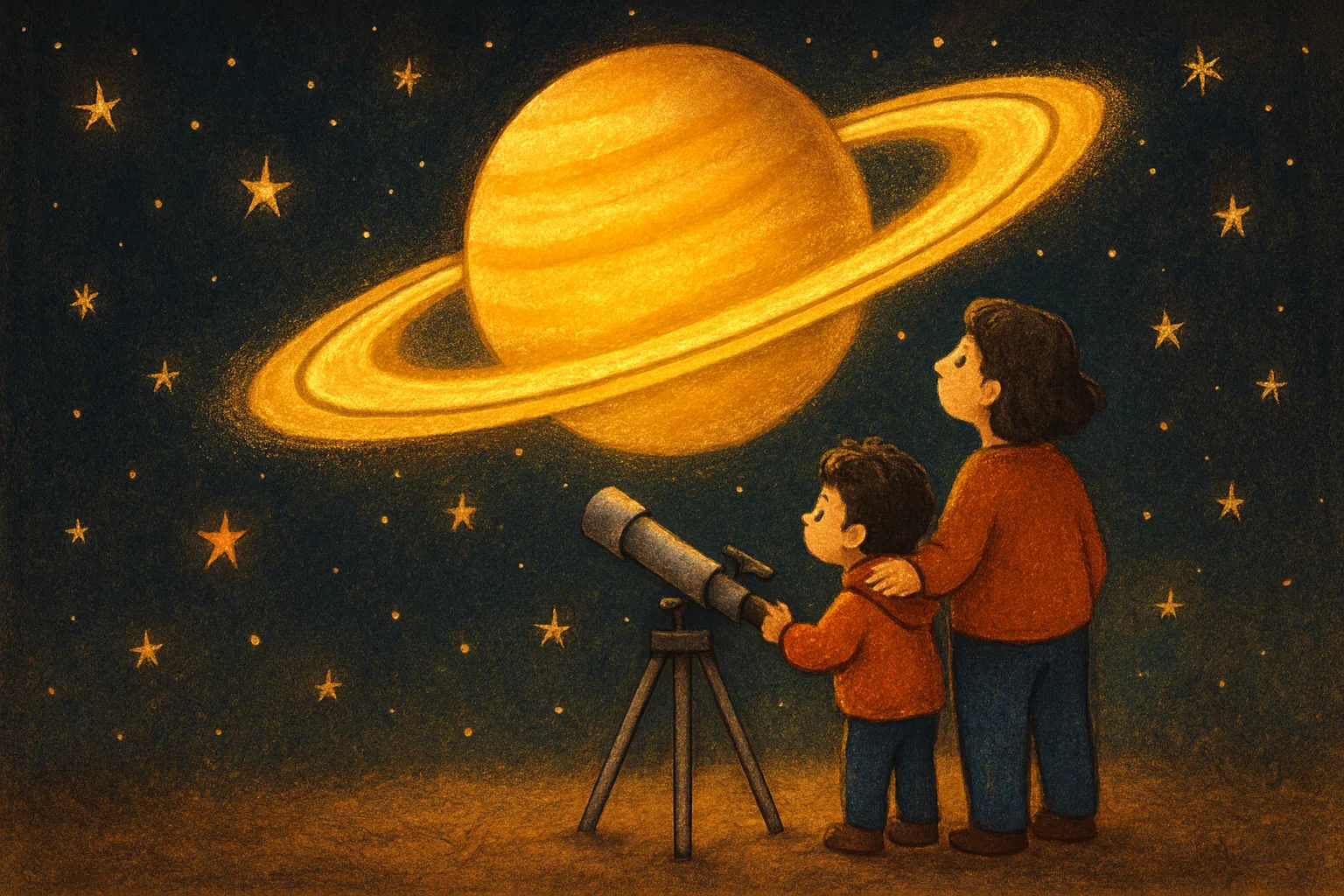
If you have a small telescope — even one about the size of a cardboard tube — you should be able to see Saturn’s famous rings. This year, the rings are tilted at 7.5 degrees toward Earth. That is much better than last year, when the rings were nearly edge-on and looked like a thin line. Imagine a hula hoop — last year it was turned sideways. This year it is tilted just enough to see its shape clearly.
NASA’s Hubble Space Telescope also recently spotted something special on Saturn: a ten-sided wave pattern swirling around the planet’s south pole. Scientists are watching it strengthen — a rare chance to see a giant weather system develop on another world.
Why Does It Matter?
Saturn is one of the most beautiful sights in the night sky. Seeing its rings for the first time through a telescope is something people never forget. Opposition is the best chance all year to have that experience.
Skywatching also helps kids and adults connect with the universe. When you look at Saturn, you are seeing a real planet 1.26 billion kilometers away — that is about 70 light-minutes, meaning the light you see left Saturn over an hour ago!
Big Words
- Opposition — the moment when Earth passes directly between the Sun and an outer planet, making the planet rise at sunset and shine at its brightest.
- Magnitude — a number used by astronomers to measure how bright something looks in the sky; the lower the number, the brighter it appears.
- Ring tilt — the angle at which Saturn’s rings are tilted toward Earth; a bigger tilt means we can see the rings more clearly.
- Atmospheric wave — a giant, repeating pattern in a planet’s atmosphere, like a weather pattern but on a huge scale.
- Opposition surge — the extra boost in brightness a planet gets right at opposition when sunlight hits it directly from behind us.
Fun Fact
Saturn takes about 29.4 Earth years to orbit the Sun — so one Saturn year is almost as long as you will have lived by the time you finish high school, college, and your first real job!
Think About It
If you could travel to Saturn and look back at Earth from there, what do you think our planet would look like?
Sources
- NASA Science — What’s Up: October 2026 Skywatching Tips from NASA
- EarthSky — Saturn at opposition, brightest for 2026, on October 4
- The Almanac — Saturn at Opposition 2026: When and How to See It
- SpaceandTelescope.com — Saturn at opposition 2026: All you need to know