
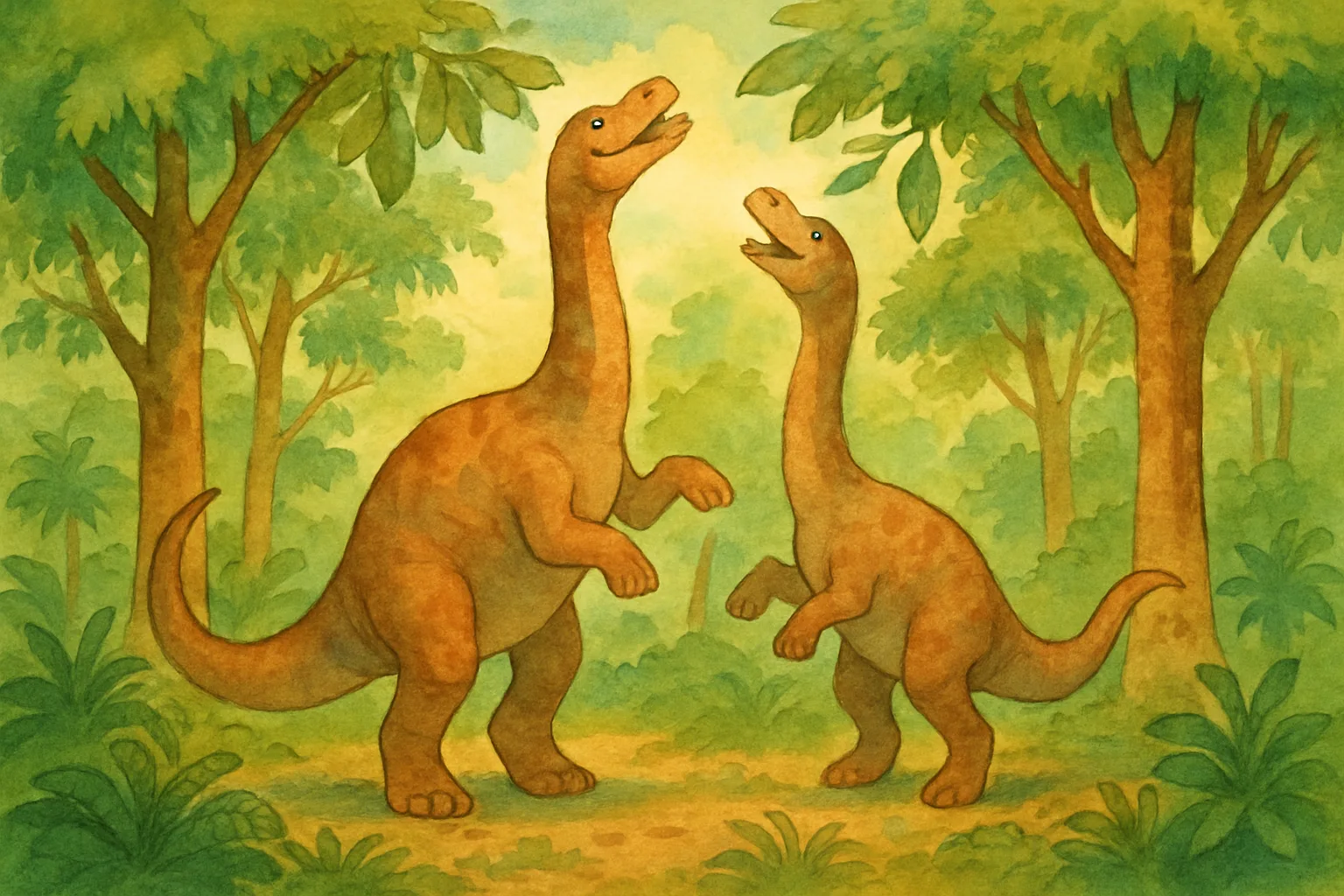
These Giant Dinosaurs Could Stand Up — But Only While They Were Young!
Quick Summary
Scientists have discovered that two kinds of giant plant-eating dinosaurs from South America could actually stand up on their back legs — at least when they were younger. As they grew larger and heavier, it became too difficult. The discovery solves a long-standing mystery about what these enormous animals were doing on two feet.
What Happened?
When you think of giant long-necked dinosaurs — called sauropods — you probably picture enormous four-legged creatures lumbering slowly across a prehistoric plain. And you would mostly be right. Most sauropods were so heavy that rearing up on two legs would have put enormous, bone-breaking stress on their bodies.
But a new study published in the journal Palaeontology found two exceptions.
Two South American titanosaurs — Uberabatitan from Brazil and Neuquensaurus from Argentina — were special. They were about the size of an elephant. That sounds enormous, but in the sauropod world, that is actually on the smaller side. Some of their relatives were as heavy as a dozen elephants stacked together.
A team of scientists from Brazil, Germany, and Argentina wanted to know whether these dinosaurs could really stand on two legs. To find out, they used a computer method called finite element analysis. Engineers use this same method to test bridges and buildings — they simulate how forces and weight act on a structure to see if it will hold up.
The researchers created detailed digital models of the dinosaurs’ thigh bones, called femurs, based on real fossils from museum collections around the world. Then they ran simulations to see how much stress the bones could handle when the animal reared up.
The result? The bones handled it just fine — when the dinosaurs were young and smaller. Standing on two legs likely helped them reach leaves high up in trees, look bigger to scare off predators, or show off to attract a mate.
But as the dinosaurs grew older and heavier, their bones could no longer handle the strain as easily. The ability faded as they aged — like growing too big for a favorite childhood trick.
Why Does It Matter?
This discovery gives us a much richer picture of how these ancient giants actually lived. Dinosaurs were not just slow, plodding creatures. Even the biggest plant eaters had clever strategies for survival.
It also shows how scientists today can use computer tools designed for engineers to answer questions about animals that lived 66 million years ago. The same software used to test skyscraper designs helped solve a dinosaur mystery!
For scientists, each new detail about sauropod behavior adds to the story of how life evolved on Earth over hundreds of millions of years.
Big Words
- Sauropod — a group of giant, long-necked, plant-eating dinosaurs that walked on four legs; they were the largest land animals ever to live
- Titanosaur — a type of sauropod that lived during the Cretaceous period; some were enormous, others were elephant-sized
- Femur — the thigh bone; in humans and many animals, it is the longest and strongest bone in the body
- Finite element analysis — a computer method that tests how forces and weight affect structures, used by both engineers and scientists
- Rearing — when an animal rises up on its back legs while lifting its front legs off the ground
Fun Fact
Neuquensaurus, one of the rearing dinosaurs in this study, lived about 66 million years ago in what is now Argentina — right around the same time as the asteroid that wiped out non-bird dinosaurs. These animals were still alive until almost the very end of the dinosaur age!
Think About It
If you were a giant plant-eating dinosaur and you could only stand on two legs when you were young, how would you use that ability? What would be the most useful thing to do with it before you got too big?
Sources
- ScienceDaily — Some dinosaurs could rise like giants until they grew too big (July 20, 2026)
- Earth.com — Some giant dinosaurs in South America could stand on two legs (July 2026)
- SciTechDaily — These Giant Long-Necked Dinosaurs Could Stand Upright and Scientists Finally Figured Out Why (July 2026)
- Indian Defence Review — These Dinosaurs Could Stand Like Giants, Until Their Bodies Betrayed Them (July 22, 2026)