
Cracking the Flu’s Secret Code! Scientists Map How It Hijacks Your Cells
Quick Summary
Scientists have made a big breakthrough in understanding the flu virus. They created the very first detailed map showing exactly how the flu sneaks into your cells and takes them over. The discovery could lead to much better flu medicines and vaccines.
What Happened?
Every year, the flu makes millions of people sick. You probably know the feeling — a sore throat, a fever, aching muscles. But here is something wild: the flu virus is so tiny that billions of them could fit on the period at the end of this sentence. And yet, it is surprisingly sneaky.
Researchers at EMBL Hamburg in Germany, working with scientists at other labs, published a groundbreaking study today in the science journal Nature Microbiology. They created what they called a molecular map — think of it like a detailed blueprint — showing exactly how the influenza A virus takes control of a human cell.
Using special technology, the scientists could watch protein-protein interactions happening inside living, infected cells. That is like watching a thief pick a lock from inside the building, instead of guessing what happened afterward.
They found two major tricks the flu uses.
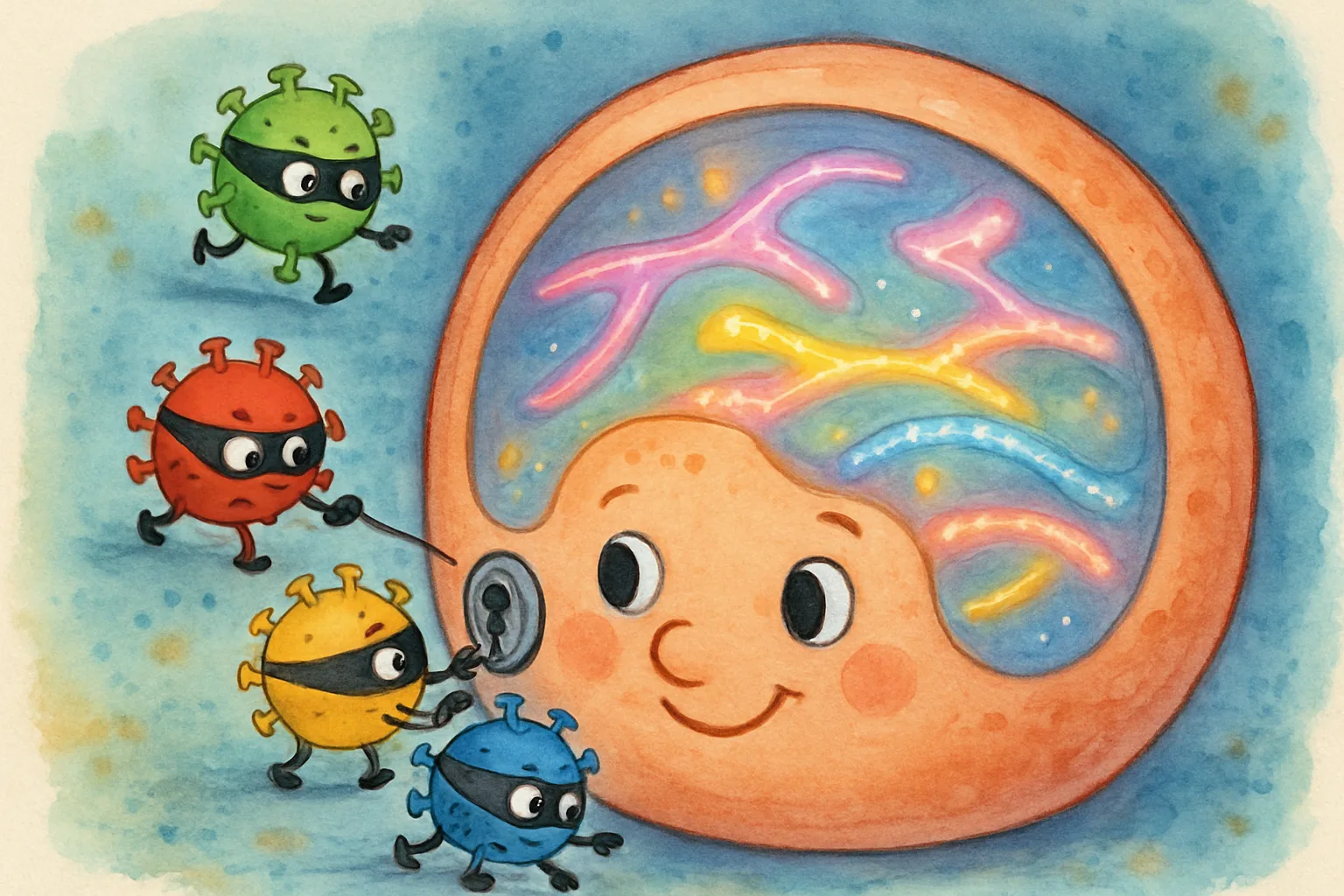
First, the virus uses a protein on its surface — like a key — to latch onto the cell and get inside. Once in, the cell’s own machinery helps the virus build more copies of itself, almost like the cell becomes the virus’s factory without knowing it.
Second, the flu dissolves tiny structures inside the cell’s nucleus called paraspeckles. Think of paraspeckles like a locked storage room inside the cell. When the virus dissolves them, it releases special proteins it can then use to make even more copies of itself.
According to researchers, this is the first large-scale map showing how the flu virus connects with its host directly inside intact, living cells.
Why Does It Matter?
Seasonal flu causes serious illness in three to five million people worldwide every year. Understanding exactly how the flu hijacks cells could help scientists design much smarter medicines — ones that block the virus at the exact steps scientists just discovered.
The new approach could also be used to study other dangerous viruses beyond the flu, making this discovery a powerful tool for future medicine.
Big Words
- Influenza A — a type of flu virus that infects people, birds, and other animals; it has caused major outbreaks throughout history
- Protein — a tiny molecule that does jobs inside your body, like building tissue, fighting germs, or carrying oxygen
- Nucleus — the control center of a cell, like the cell’s brain, where DNA is stored
- Paraspeckles — small droplet-like compartments inside a cell’s nucleus that store special proteins
- Molecular map — a detailed diagram showing how tiny molecules inside a living thing connect and interact with each other
Fun Fact
The influenza A virus is so small that about 10,000 of them lined up side by side would only stretch across the width of a single human hair!
Think About It
The flu virus is able to “trick” the cell into helping it make copies of itself. Can you think of another example — in nature or in everyday life — where something gets what it wants by fooling its host?
Sources
- ScienceDaily — New Molecular Map Reveals How the Flu Virus Hijacks Human Cells (July 21, 2026)
- EurekAlert / European Molecular Biology Laboratory — Scientists map how the flu virus rewires the human cell from the inside
- Nature Microbiology — Mapping in-cell protein contact sites reveals hijacking of paraspeckles during influenza A virus infection (DOI: 10.1038/s41564-026-02416-1)
- News-Medical.net — Mapping how influenza virus rewires human host cells