
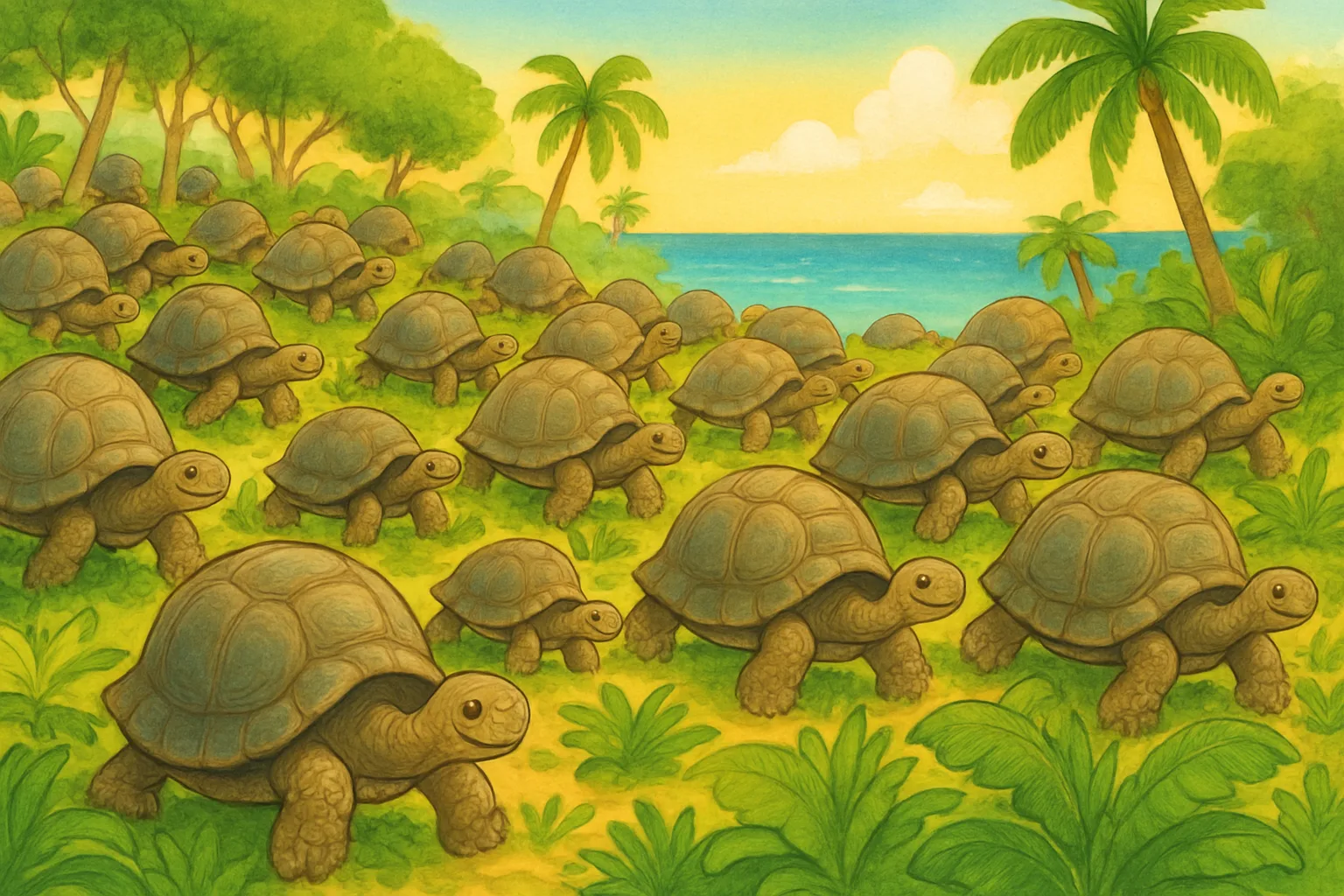
Tortoise Triumph! 180,000 Giant Tortoises Are Thriving on a Tiny Island
Quick Summary
Scientists just published a brand-new count of the giant tortoises living on Aldabra Atoll, a remote island in the Indian Ocean. They found around 180,000 of the slow-moving giants. That is more than the total number of people living in the entire country of Seychelles!
What Happened?
A team from the Seychelles Islands Foundation and the University of Exeter in the United Kingdom spent five years carefully counting tortoises. They watched, recorded, and used math to estimate how many tortoises were hiding in places too thick with plants to see into. When all the numbers came together, the result was remarkable: about 180,000 Aldabra giant tortoises roaming freely on the atoll.
Aldabra Atoll is a chain of tiny coral islands sitting in the Indian Ocean, off the eastern coast of Africa. It is one of the most remote and protected places on Earth. Very few people live there. The tortoises, however, love it.
The Aldabra giant tortoise is the second-largest tortoise species in the world. Full-grown adults can weigh as much as 550 pounds — heavier than a large motorcycle. They lumber along slowly, munching on plants, and they can live for more than 100 years.
This new count is the highest ever recorded for the species. The last major count, done in the late 1990s, put the number at about 100,000. So the population has nearly doubled since then.
Why Does It Matter?
This story is really a comeback story. In the 1800s, sailors and traders hunted Aldabra tortoises for food. By the end of the century, there were fewer than 1,000 left on the whole island. The species was almost gone forever.
Then people decided to help. The atoll became a strict nature reserve in 1981. A year later, it was named a UNESCO World Heritage Site — one of Earth’s most special protected places. With hunting stopped and the habitat kept safe, the tortoises slowly bounced back.
Now they are thriving. Scientists say the population has been stable and healthy throughout the five-year study. It is proof that when humans stop harming animals and protect their homes, nature can heal itself.
Although the numbers are wonderful, scientists warn that the tortoises are not completely safe. Climate change, rising seas, and other threats still need to be watched. But for now, this is one of the biggest conservation success stories on Earth.
Big Words
- Aldabra Atoll — a group of small coral islands in the Indian Ocean that is one of only two places on Earth where giant tortoises live wild and free
- Conservation — protecting animals, plants, and nature to keep them from disappearing
- Population — the total number of a particular animal living in one place
- UNESCO World Heritage Site — a place that the United Nations has decided is so special and important that it must be protected for all of humanity
- Species — a group of living things that share the same features and can have babies together
Fun Fact
A giant tortoise named Jonathan, who lives on the island of Saint Helena, is estimated to be around 194 years old — making him the oldest known land animal alive today!
Think About It
If tortoises can make such a huge comeback when we protect their home, what other animals do you think could recover if people gave them better protection?
Sources
- CNN / ABC17 News — Once near extinction, these giant tortoises now outnumber people in the Seychelles, survey finds (Oct 8, 2026)
- University of Exeter — New study reports largest-ever population estimate for Seychelles’ giant tortoises (Oct 7, 2026)
- ColombiaOne — Scientists Find 180,000 Giant Tortoises in Seychelles (Oct 9, 2026)
- OrissaPost — Scientists discover 1,80,000 giant tortoises on one island (Oct 10, 2026)
- Earth.com — Thousands of giant tortoises have been overlooked in the Seychelles (Oct 15, 2026)