
One Tiny Cell, Enormous Power! Scientists Discover Your Brain Cells Are Way Smarter Than We Knew
Quick Summary
Scientists have just discovered something remarkable about the cells inside your brain. A single brain cell can do many complicated things at once — far more than anyone realized. This discovery could change how we understand human intelligence.
What Happened?
Your brain contains about 86 billion cells called neurons. Until now, scientists thought each neuron worked like a simple light switch — either ON or OFF, sending a signal or not.
But a new study published in a top science journal called the Proceedings of the National Academy of Sciences reveals something amazing. Each neuron is more like a tiny computer than a simple switch. One brain cell can actually carry out many complex calculations all by itself.
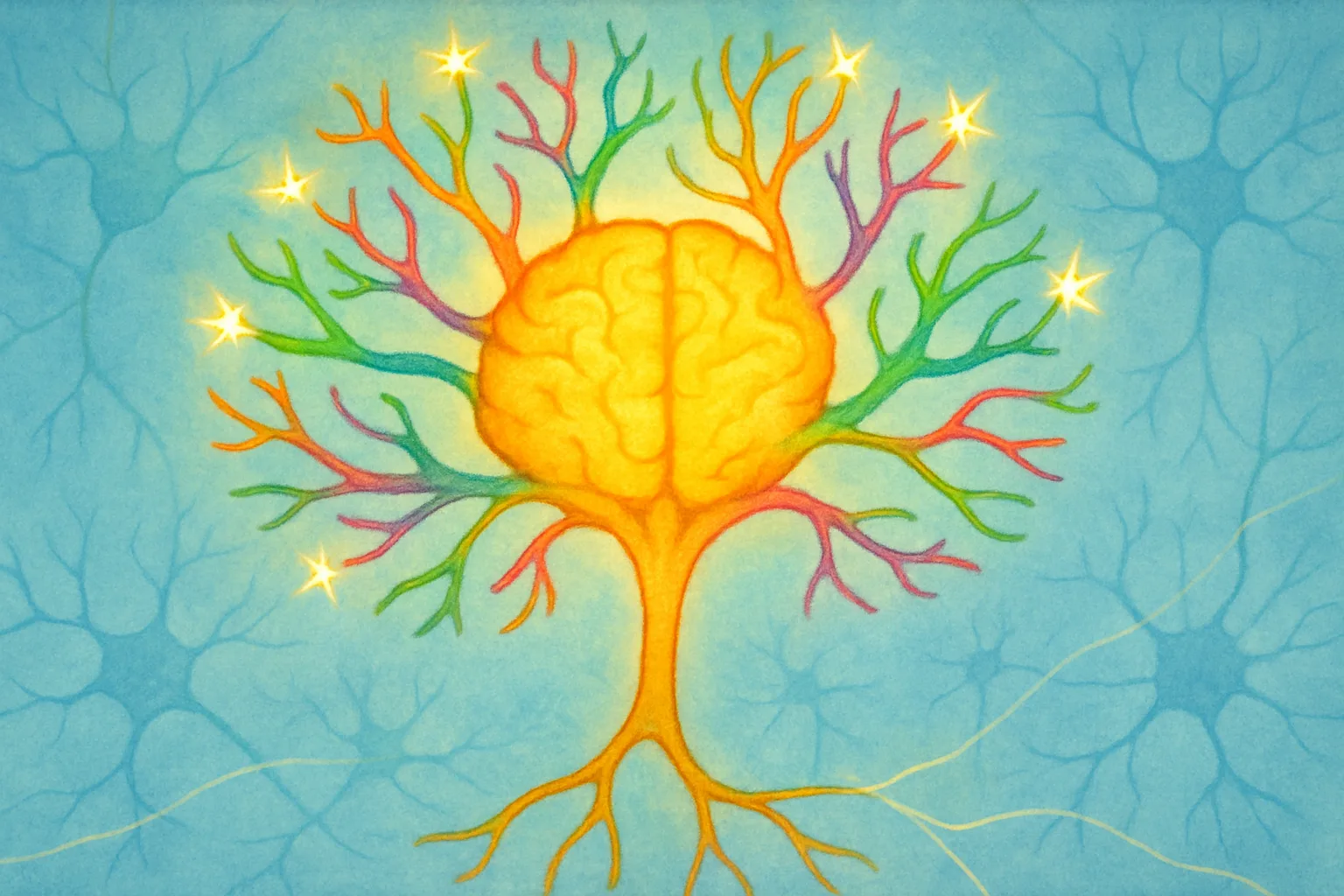
How? Neurons have hundreds of branching arms called dendrites. Picture a tree. The trunk is the main body of the cell. The branches are the dendrites. Scientists found that each branch can process information on its own — independently — before the result ever reaches the trunk.
Imagine if each branch of a tree could solve a math problem on its own, and then all the answers got combined at the trunk. That is roughly what is happening in your brain — all the time, trillions of times per second.
The researchers used artificial intelligence to figure this out. They built a computer model that tried to copy what a single neuron does. To imitate just one human brain cell, their AI model needed many, many layers of computing power — about as much as a whole deep artificial neural network.
Human neurons turned out to be uniquely powerful compared to brain cells from mice and other animals.
Why Does It Matter?
This discovery helps explain something scientists have always wondered: why are humans so good at language, imagination, and math? The answer might be partly in the power of each individual cell.
It also gives engineers new ideas for building smarter artificial intelligence. Today’s AI systems are built from very simple units. Future AI might instead use units that are as powerful and complex as real brain cells.
As one researcher put it, a single human neuron is not just a switch — it is an extraordinarily sophisticated computing device all on its own.
Big Words
- Neuron — a brain cell that sends and receives signals; your brain has about 86 billion of them.
- Dendrites — the branching arms of a neuron that collect incoming signals, like the branches of a tree collecting sunlight.
- Computation — a calculation or a step in solving a problem; computers and brains both perform computations.
- Cortex — the outer layer of the brain, where much of our thinking, language, and decision-making happens.
- Artificial neural network — a type of computer program inspired by the brain, used in AI systems to recognize patterns and solve problems.
Fun Fact
Your brain uses about as much energy as a dim 20-watt light bulb — and yet it can outperform the world’s most powerful supercomputers at certain tasks. Now we know one reason why: each cell is doing way more work than we ever guessed!
Think About It
If one brain cell is already as powerful as a whole computer program, what do you think 86 billion brain cells working together are capable of that we haven’t discovered yet?
Sources
- Scientific American — Neuroscientists have vastly underestimated brain cells’ computing power (Aug. 13, 2026)
- SciTechDaily — A Single Human Neuron Is Far More Powerful Than Scientists Thought
- ScienceDaily — Human brain cells are far more powerful than scientists thought
- Proceedings of the National Academy of Sciences — Dendritic morphology and synaptic nonlinearities enhance functional complexity in human cortical neurons (2026)