
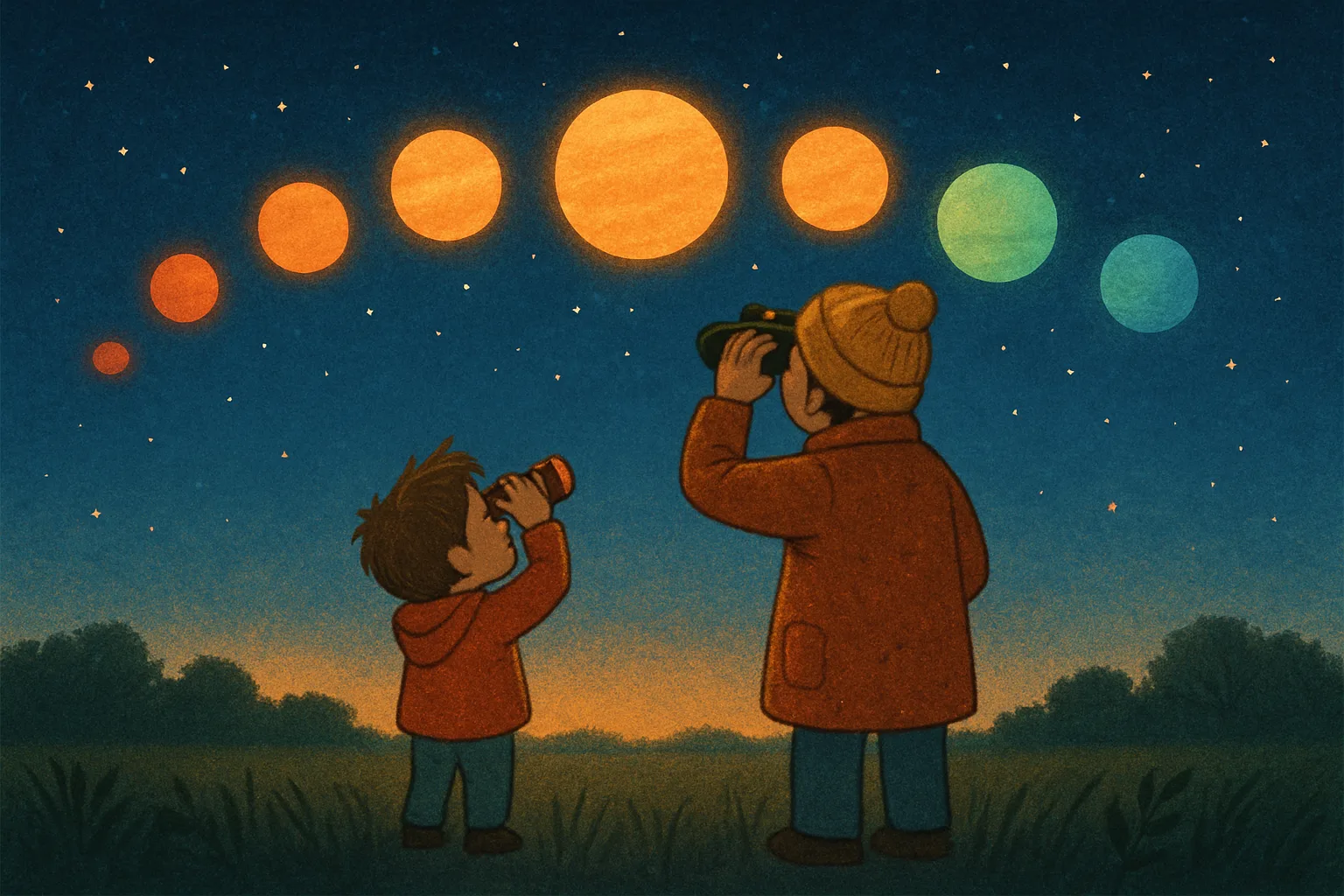
Six Planets, One Sky! Wake Up Early and Catch the Planet Parade This Week
Quick Summary
Right now, six planets are stretched across the sky all at once — and you might be able to see some of them with just your eyes! Today, August 15, is a special moment: Jupiter and Mercury are appearing almost perfectly side by side. Set your alarm and look east before sunrise!
What Happened?
Our solar system is putting on a show! For the past several nights — and for a few more nights to come — six planets are visible in the pre-dawn sky at the same time. The planets taking part are Jupiter, Mercury, Mars, Saturn, Uranus, and Neptune.
This kind of event is called a planet parade or planetary alignment. It happens when several planets end up on the same side of the Sun at once, so from Earth we can see them all lined up across the sky like a giant curved banner.
Tonight, August 15, is an especially cool moment. Jupiter and Mercury are appearing almost perfectly side by side, very close together near the eastern horizon. They are like two bright friends standing shoulder to shoulder.
Here is the best part of the parade to know: four of the six planets — Jupiter, Mercury, Mars, and Saturn — are bright enough to see with just your naked eyes. You do not need a telescope! Jupiter is the brightest of the bunch, shining like a very steady, bright star. Mars has a warm reddish glow, and Saturn looks yellowish.
To spot Uranus and Neptune, you will need a pair of binoculars or a telescope. They are too faint for human eyes alone.
To get the best view, head outside about 45 minutes before sunrise and look toward the east. Find a spot with a clear flat horizon — no trees or tall buildings in the way. Let your eyes adjust to the darkness for about 10 minutes before looking up.
The parade will be most visible between now and around August 18, so this week is your best chance!
Why Does It Matter?
Seeing six planets at once is a rare treat. Events like this remind us that we live inside a solar system — a family of worlds all orbiting the same star. Most nights, you might spot one or two planets without trying. Seeing six at once is like finding out all your cousins showed up for the same surprise visit.
Astronomy has no age limit. You do not need any special training to enjoy a planet parade. All you need is a clear sky, a little patience, and the curiosity to look up.
Big Words
- Planet parade — When multiple planets line up on the same side of the Sun and can be seen stretched across the sky at the same time.
- Pre-dawn — The time just before the Sun rises. The sky starts to glow, but it is still dark enough to see stars and planets.
- Naked eye — Looking at something with just your eyes, without binoculars or a telescope.
- Ecliptic — The invisible path in the sky that the Sun, Moon, and planets all travel along. It’s why the planets appear in a curved line, not a perfectly straight one.
Fun Fact
On a very clear night, the planet Saturn is so bright you can sometimes spot it with your bare eyes and still see that something looks a tiny bit different about it — ancient astronomers noticed it looked “fuzzy” compared to other stars, long before they knew it had rings!
Think About It
If you could travel to any one of the six planets in the parade — Jupiter, Mercury, Mars, Saturn, Uranus, or Neptune — which would you choose to visit, and what do you think you would find there?
Sources
- The Planetary Society — What’s up in the night sky: August 2026
- Space & Telescope — Planet parade August 2026: All you need to know
- StarWalk — How to See the Planetary Alignment in August 2026
- Outer Space Trip — How to See a Planet Parade: The August 2026 Six-Planet Dawn Lineup