
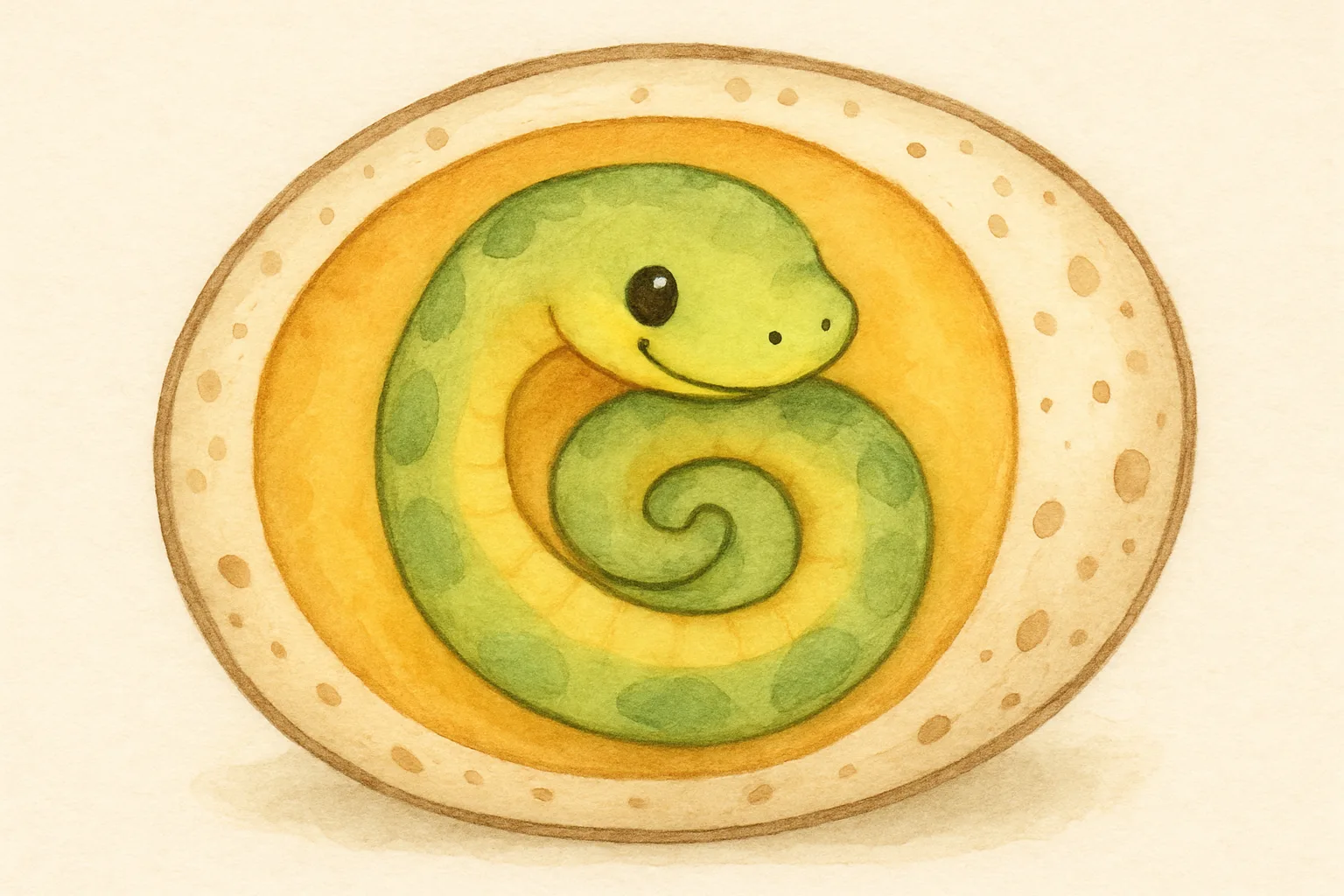
Curling Into a Coil! Scientists Finally Solved Why Baby Snakes Spiral to the Right
Quick Summary
Before a snake hatches, it curls into a tight spiral inside its egg. Scientists have always wondered: why does it almost always coil to the right? A new study just figured out the answer — and it’s a surprising tug-of-war between the snake’s body and its gut!
What Happened?
Researchers at the Canadian Museum of Nature led a team that studied more than 900 snake embryos from 39 different species. They used detailed 3D scans to peek inside eggs without breaking them. What they found was published this week in the journal Current Biology.
Here is the puzzle they solved: when a snake is developing inside an egg, its body grows much faster than its gut (the tube that digests food). The gut can’t keep up. It stays shorter, like a rope tied to both ends of a too-long loop.
Because the body is getting longer and longer but the gut is holding it back, the body has to buckle and twist — just like when you squeeze a long noodle between your fingers and it bends into a curve.
There is one more ingredient that controls which way the spiral goes. A big blob of yolk sits on the left side of the embryo. That pushes the growing body toward the right. So the coil almost always goes clockwise — to the right — during the early stages of development.
Here is the fun twist at the end: as the embryo gets bigger, the yolk shrinks. The young snake starts to wiggle and can reposition itself. By the time it is nearly ready to hatch, about half the embryos are coiled to the right and half to the left. So snakes are not permanently “right-handed” — the rightward preference only lasts for a while!
The team also discovered a brand-new structure they called the “visceral pillar” — a column of gut tissue stretching through the center of the spiral like a pole in the middle of a coiled spring. This has never been described in snakes before.
Why Does It Matter?
Snakes have more vertebrae — backbone bones — than any other living animal with a backbone. Scientists have long wondered how such a long body fits inside such a small, round egg. This study explains it beautifully: the coiling is not something the embryo chooses. It is a physical result of how fast different body parts grow.
The discovery could also help scientists understand other spirals in nature. Your intestines coil inside your belly. Snail shells twist in one direction. Even some climbing plant vines spiral as they grow. The same physical rules might explain all of them.
Big Words
- Embryo — a baby animal in the very early stages of growing, before it is born or hatches
- Vertebrae — the small linked bones that make up a backbone; snakes have more of these than any other animal with a spine
- Yolk — the yellow, nutrient-rich part of an egg that feeds a growing embryo as it develops
- Dextral — a science word meaning curling or spiraling to the right, the same direction clock hands move
- Visceral pillar — a newly discovered column of gut tissue inside a snake embryo that acts like a tether, causing the body to buckle and coil
Fun Fact
Snakes hold the world record for the most vertebrae of any animal with a backbone. Some species have more than 400 individual backbone bones — humans only have 33!
Think About It
The snake’s body grows faster than its gut, so the body is forced to buckle into a coil. Can you think of another time in everyday life when something that is too long for its space is forced to bend or twist? What everyday object behaves like that?
Sources
- ScienceDaily / Canadian Museum of Nature — Scientists discover why snake embryos twist into spirals (September 1, 2026)
- Current Biology — How snake embryos coil (Weber et al., DOI: 10.1016/j.cub.2026.07.078)
- Discover Magazine — The Mystery of Why Snake Embryos Curl To The Right Could Lie In Their Digestive Tract
- ZME Science — Snake Embryos Almost Always Twist the Same Way Inside the Egg, and Scientists Think They Know Why