
Four Days to Go! A Rare Total Solar Eclipse Is Almost Here
Quick Summary
On Wednesday, August 12, the Moon will pass directly in front of the Sun and block its light completely. This rare event is called a total solar eclipse. It will be visible across parts of Greenland, Iceland, and Spain — and it is the first total solar eclipse over mainland Europe in 27 years!
What Happened?
The countdown is on! In just four days, on the morning of August 12, the Moon will line up perfectly between Earth and the Sun. For people in just the right places, the sky will go dark in the middle of the day. Stars will appear. The temperature will drop. And a glowing ring of light — called the corona — will burst into view around the edges of the Moon.
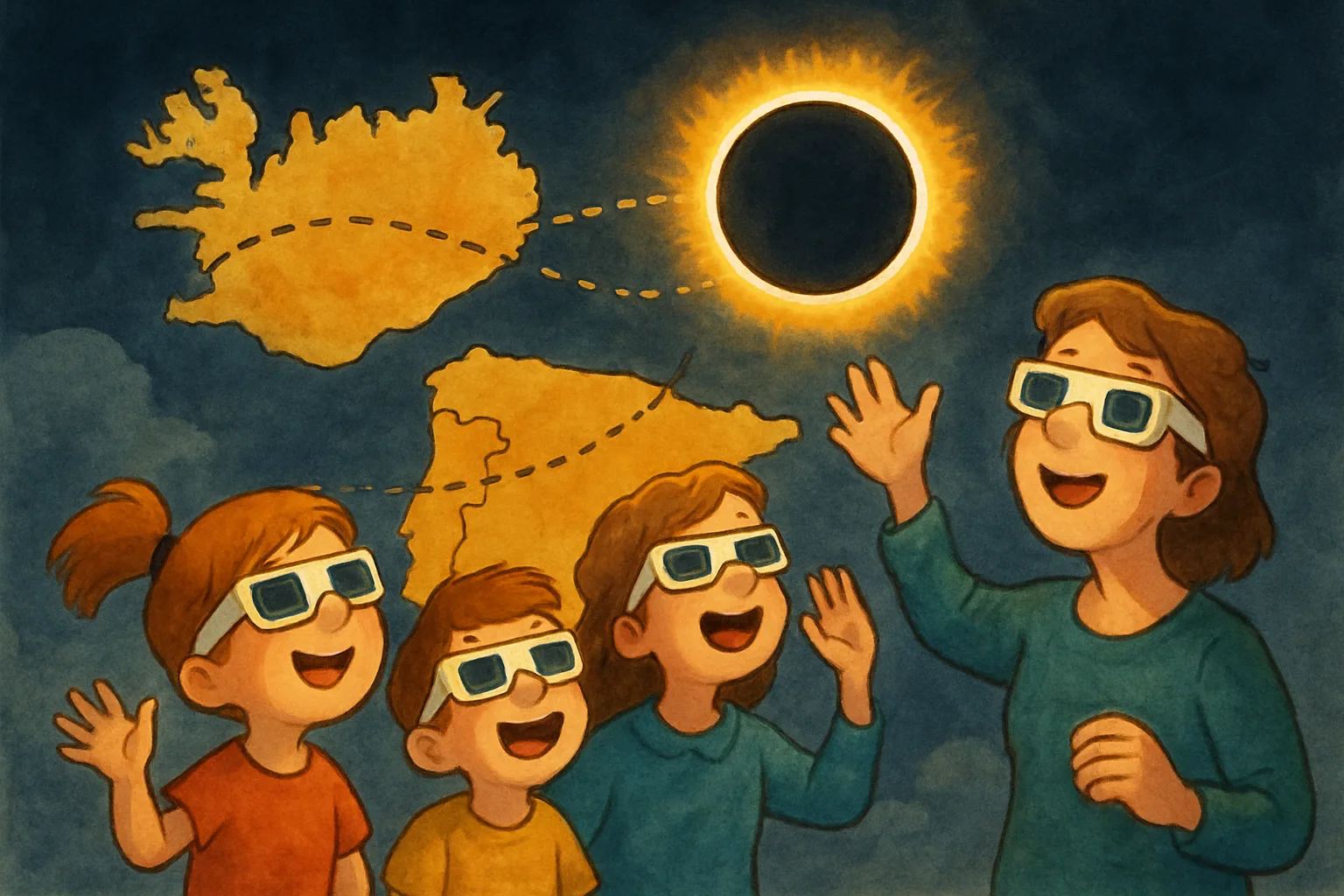
This “path of totality” — the narrow strip of Earth where the eclipse is total — runs from northern Russia and the Arctic, then passes over Greenland, Iceland, and northern Spain and Portugal. The best spot on the planet to watch? The coast just west of Iceland, where totality will last 2 minutes and 18 seconds.
Two minutes and 18 seconds might not sound long. But watching the Moon perfectly cover the Sun is one of the most breathtaking things a person can ever see. It only happens along a very narrow path — think of it like a shadow the size of a large city being dragged across Earth’s surface.
Outside the path of totality, hundreds of millions of people across Europe, the UK, Ireland, and even northeastern North America will see a partial eclipse. In some parts of the UK and Ireland, over 90% of the Sun will be blocked — almost enough to turn daytime into dusk.
Europe has not seen a total solar eclipse since August 11, 1999. For many adults, watching the 2026 eclipse will be the first total solar eclipse of their lives.
Here is one extra special thing: the eclipse is happening when the Moon is near its closest point to Earth in its orbit. That makes the Moon appear slightly larger than usual — which is exactly why it can cover the Sun so completely and give us such a long totality.
Why Does It Matter?
Total solar eclipses are rare and exciting, but they are also great moments for science. Astronomers and scientists from around the world travel to the path of totality to study the Sun’s outer atmosphere. This glow, called the corona, is normally invisible because the Sun’s bright surface drowns it out. During totality, with the Sun blocked, scientists can study how the corona behaves.
Eclipses also get millions of people excited about astronomy. If you are lucky enough to be near the path, make sure to get eclipse glasses that are certified safe (look for ISO 12312-2 on the label). Never look at the Sun without them!
Big Words
- Total solar eclipse — when the Moon moves exactly between Earth and the Sun, completely blocking the Sun’s bright face
- Path of totality — the narrow strip of Earth where the Moon’s shadow falls and a total eclipse is visible
- Corona — the Sun’s outer atmosphere, which looks like a glowing halo and is only visible during a total eclipse
- Partial eclipse — when the Moon covers only part of the Sun, visible from a much wider area around the path of totality
- Perigee — the point in the Moon’s orbit when it is closest to Earth, making the Moon appear slightly bigger in the sky
Fun Fact
The Moon is about 400 times smaller than the Sun — but it is also about 400 times closer to Earth. This lucky coincidence is the only reason a total solar eclipse is possible. If the Moon were just a little smaller or farther away, it could never cover the Sun completely!
Think About It
If you could travel anywhere in the world to watch the August 12 eclipse, where would you go — and who would you bring with you?
Sources
- NASA Science — Total Solar Eclipse on August 12, 2026
- Space.com — Total solar eclipse Aug. 12, 2026 live updates — 5 days to totality
- National Solar Observatory — August 12, 2026 Solar Eclipse Map
- BBC Sky at Night Magazine — August 2026 solar eclipse guide
- ESA — Total solar eclipse 12 August 2026 Global map
- National Eclipse — 2026 Total Solar Eclipse Maps