
How Big Is Our Solar System? Scientists Say We Need a Bigger Ruler!
Quick Summary
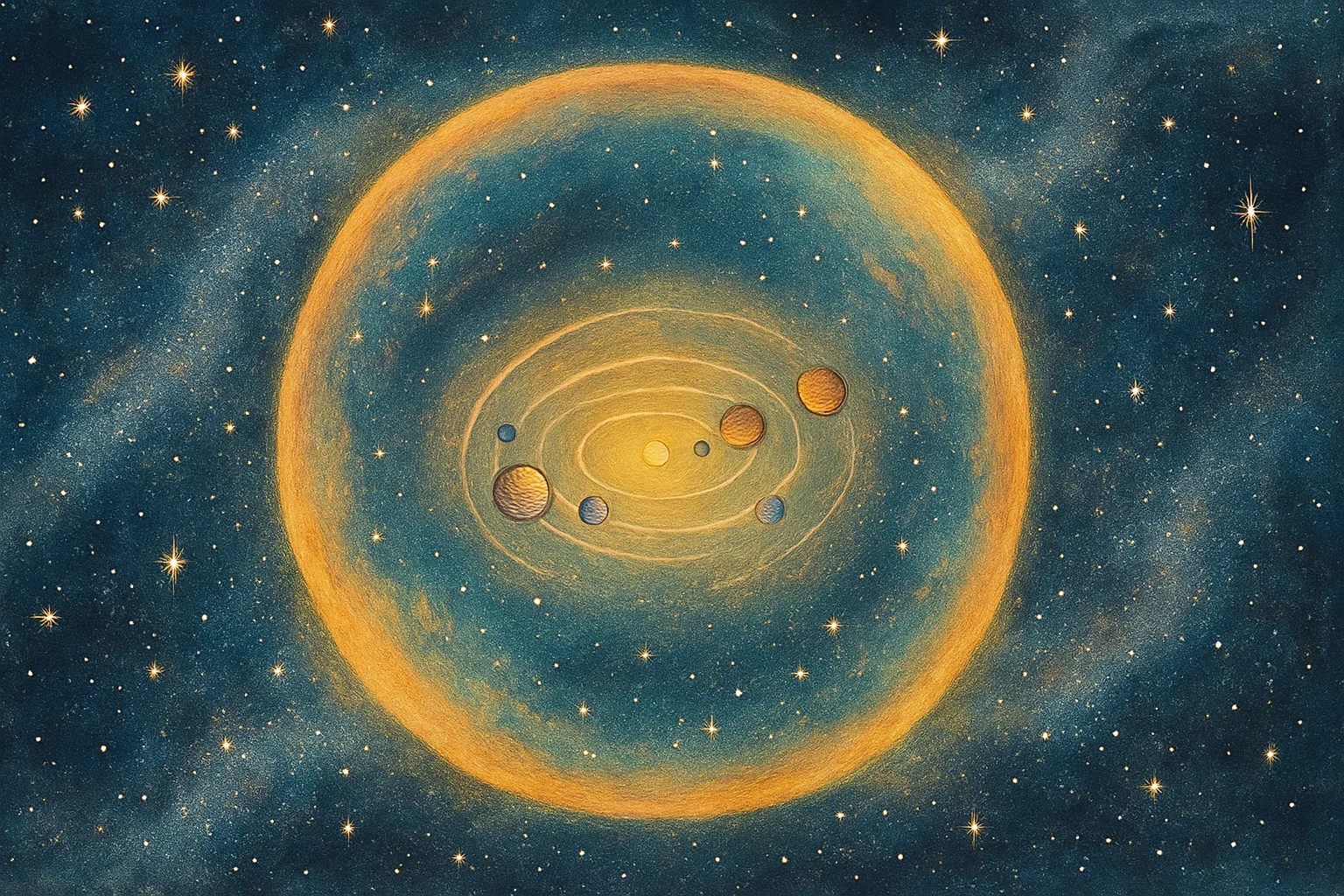
For a long time, scientists said our solar system ended at a distant bubble called the heliosphere, far beyond Neptune and Pluto. Now two space scientists say the true edge might be almost 100 times farther out than that. Their new ideas are turning heads across the astronomy world.
What Happened?
Jim Green, a former NASA chief scientist, and Ed Belbruno, a math professor at Yeshiva University, published a bold new idea this week. They say the real “edge” of our solar system does not end where the Sun’s solar wind fades. Instead, it stretches all the way out to where the Milky Way’s own gravity — including something mysterious called dark matter — finally takes over from the Sun’s pull.
Using careful calculations, they figured out this new boundary sits about 3.8 light-years from the Sun. A light-year is the distance light travels in one year, which is about 6 trillion miles. That means our solar system’s true gravitational reach stretches roughly 22 trillion miles in every direction. To put that in perspective, the nearest star system to our Sun (Alpha Centauri) is about 4.2 light-years away. Our solar system might nearly reach all the way there!
The scientists say there is no sharp wall at the edge — more like a slow, blurry handoff between the Sun’s gravity and the galaxy’s gravity. It is a bit like a tug-of-war between two giants, and the rope between them is very, very long.
This idea is still a theory, and other scientists will test it. The researchers hope the New Horizons spacecraft — which flew past Pluto in 2015 and is now sailing into the outer solar system — might one day help prove or disprove their calculations.
Why Does It Matter?
If the solar system’s true gravitational zone is this enormous, it could mean that distant, slow-moving objects like rogue planets — planets that drift alone through space without a star — might sometimes wander into the Sun’s grip and join our solar system. That is an exciting idea! It also helps scientists understand how gravity and dark matter shape everything around us.
Big Words
- Solar system — the Sun and everything that orbits around it, including planets, moons, asteroids, and comets
- Heliosphere — a giant bubble of particles and magnetic forces that the Sun pushes out into space; once thought to mark the solar system’s edge
- Light-year — the distance light travels in one year, about 6 trillion miles (9.5 trillion kilometers)
- Dark matter — a mysterious invisible substance that makes up most of the mass of the universe; scientists know it exists because of how it bends gravity
- Rogue planet — a planet that travels through space alone, not orbiting any star
Fun Fact
New Horizons, the spacecraft that snapped the first-ever close-up photos of Pluto in 2015, is now billions of miles from Earth — still zooming outward through the very region these scientists are studying!
Think About It
If the solar system is much bigger than we thought, does that change how you imagine our place in the universe? Could there be undiscovered objects drifting at the very edge, waiting to be found?
Sources
- Space.com — It’s time to reassess the size of our solar system, scientists say (Oct. 16, 2026)
- NewsBytesApp — Jim Green and Ed Belbruno propose 3.8 light-year solar boundary (Oct. 16, 2026)
- ArchyNewsy — New Solar System Edge Redefined by Gravity and Dark Matter Theory (Oct. 16, 2026)
- ROOM – The Space Journal of Asgardia — Green & Belbruno paper (August 2026)