
Space Junk Alert! An Old Soviet Satellite Just Broke Into Pieces in Orbit
Quick Summary
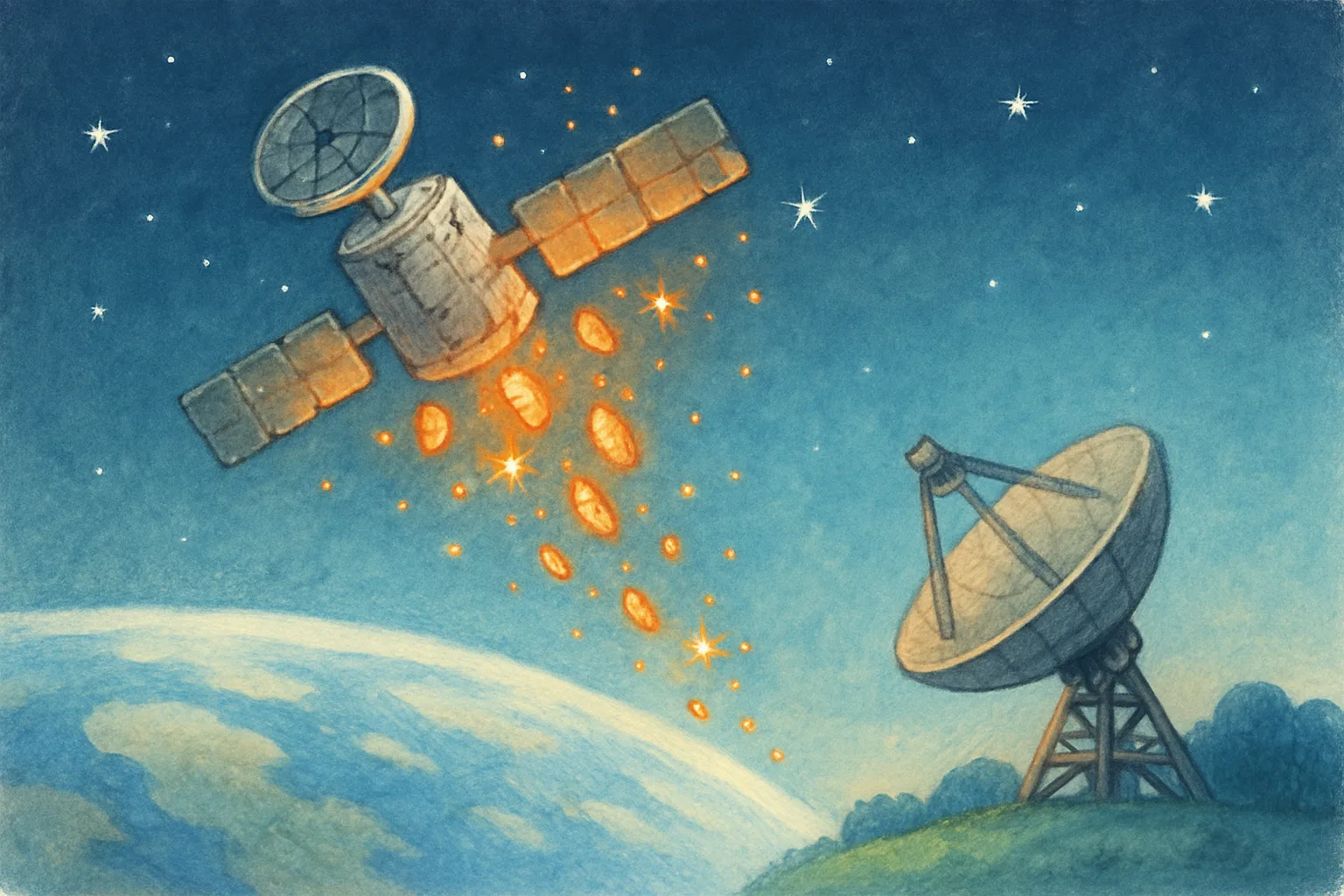
An old Soviet weather satellite has broken apart in space, creating dozens of flying fragments high above Earth. Scientists are calling it part of a “worrying trend” as more and more old spacecraft fall to pieces in orbit. Understanding and solving the space junk problem is becoming one of the most important challenges in space science.
What Happened?
A company called LeoLabs — which tracks objects flying around Earth — spotted something alarming on October 5. As an old Soviet satellite named Meteor 2-7 passed over their radar station in Western Australia, the sensors detected dozens of new fragments flying near it.
Meteor 2-7 is a weather satellite that launched all the way back in 1981 — that is 45 years ago! It stopped working long ago, but it has been circling Earth ever since, about 530 miles above the ground. That is higher than the International Space Station.
Nobody yet knows exactly why it broke apart. It could have been hit by another piece of space debris, or old parts inside may have finally given way. Scientists are still investigating.
This is not the first time this particular satellite has caused problems — it previously fell apart in 2004 too. And it is not alone. Several other old satellites have also broken up in recent months, including an old American spy satellite in September 2026.
Today, the European Space Agency tracks more than 44,000 pieces of space junk orbiting Earth. That is almost three times more than the 16,000 pieces tracked in 2005. Even a tiny fragment the size of a marble can cause serious damage to a working spacecraft because everything in orbit moves at thousands of miles per hour.
Why Does It Matter?
Earth’s orbit is getting crowded. Every time an old satellite or rocket breaks apart, it creates new fragments that can put other spacecraft — including ones that give us weather forecasts, GPS directions, and TV signals — in danger.
Scientists and space agencies around the world are working on ideas to clean up space junk. Some propose special nets or magnets to grab old satellites. Others want new rules that require all new spacecraft to safely fall back into Earth’s atmosphere when they are done.
Keeping space clean and safe is important for everyone on Earth who depends on satellites every single day.
Big Words
- Orbit — the curved path a satellite or spacecraft follows around Earth, like a ball on a string spinning in circles
- Space debris — broken pieces of old rockets and satellites left floating in orbit; sometimes called space junk
- Fragmentation — when something breaks apart into many smaller pieces
- LeoLabs — a company that uses ground-based radar to track thousands of objects flying in low Earth orbit
- Low Earth orbit — a zone of space roughly 100 to 1,200 miles above Earth’s surface where most satellites travel
Fun Fact
At the speed that objects travel in low Earth orbit — about 17,500 miles per hour — even a fleck of paint can punch a small hole in a spacecraft’s window. That is why space agencies take even tiny debris very seriously!
Think About It
If you were in charge of cleaning up space junk, what kind of invention would you design to safely remove old satellites from orbit?
Sources
- Space.com — A dead Soviet satellite just broke apart in orbit (again). Experts say it’s part of a ‘worrying trend’ (Oct. 8, 2026)
- SpaceWatch.Global — LeoLabs Detects New Fragment Creation Event Involving Soviet-Era Meteor 2-7 (Oct. 7, 2026)
- NewsBytesApp — Soviet-era Meteor 2-7 fragments scatter over Western Australia, raising risks (Oct. 9, 2026)