
100 and Counting! SpaceX Just Had Its 100th Launch of the Year
Quick Summary
Early on the morning of August 19, SpaceX launched its 100th mission of 2026 — a truly wild number for a single year! The rocket carried 24 Starlink satellites into orbit and then landed its booster safely in the Pacific Ocean.
What Happened?
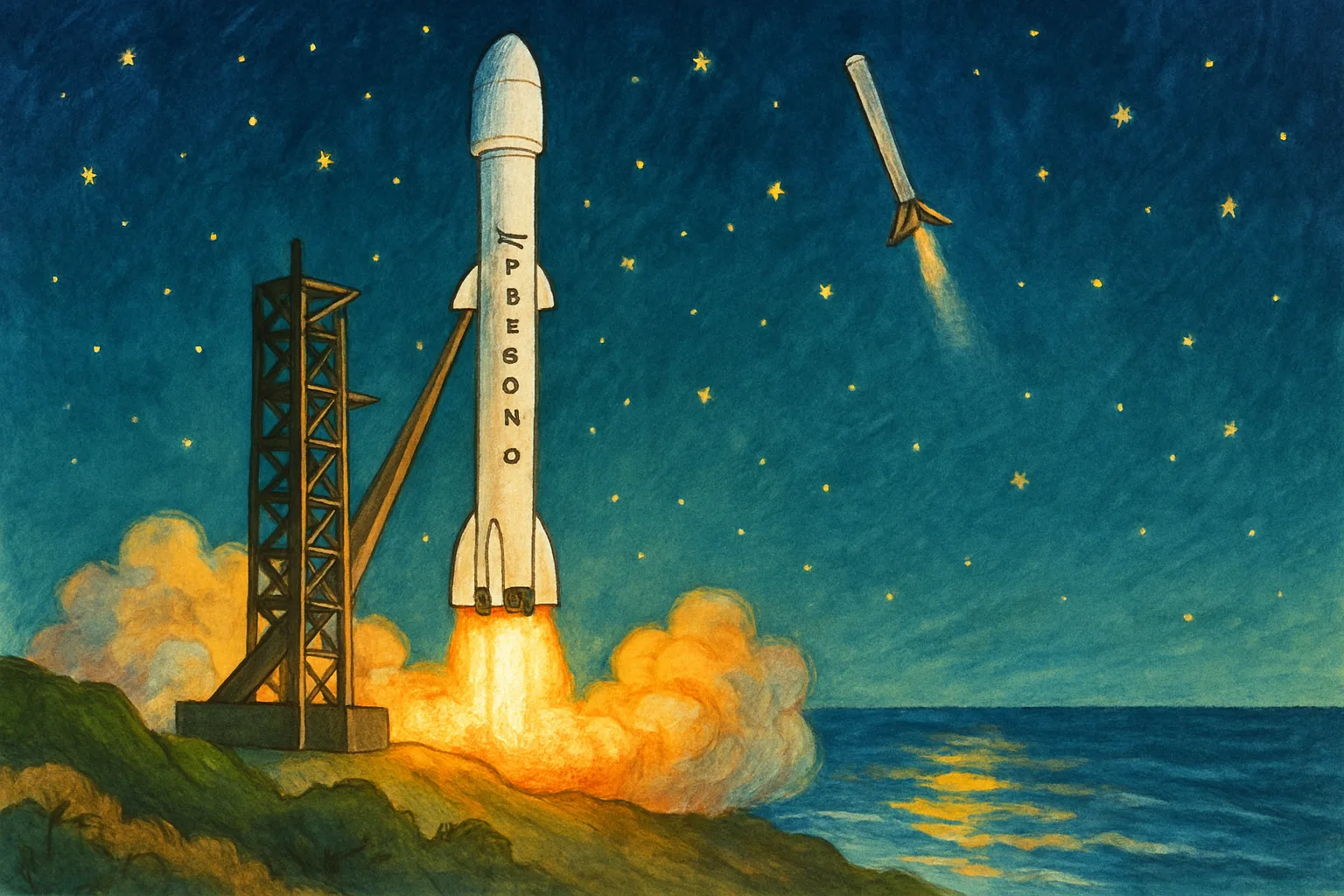
SpaceX launched a Falcon 9 rocket from Vandenberg Space Force Base in California. The rocket blasted off in the middle of the night, lighting up the sky over the Pacific Coast.
About an hour after liftoff, the rocket’s upper stage released 24 Starlink satellites into low Earth orbit. Starlink is SpaceX’s network of internet satellites that beams high-speed internet down to people all over the world — even in very remote places without cables or phone towers.
About 8.5 minutes after launch, the rocket’s first stage flew itself back down and landed on a drone ship in the Pacific Ocean. The drone ship — a robotic floating platform — was waiting right where the rocket expected it. Landing on a moving ship in the middle of the ocean is about as tricky as tossing a pencil off a building and having it land perfectly upright on a skateboard!
This booster — called B1097 — had flown 12 times before this mission. That means SpaceX is using the same rocket engine section over and over again, like a very powerful, very expensive reusable toy.
Why Does It Matter?
100 launches in less than eight months is a breathtaking pace. That averages out to more than one rocket launch every two and a half days!
Just ten years ago, the idea of launching that many rockets in a single year would have seemed impossible for one company. It shows how fast the space industry is moving.
All those Starlink satellites are adding up too. SpaceX has now launched well over 10,000 Starlink satellites since the program began. They beam fast internet to ships, planes, farms, schools, and homes that couldn’t get reliable internet any other way.
A busier rocket schedule also means the cost of getting things into space keeps going down — which opens the door for more science missions, more exploration, and maybe, one day, more people traveling to space.
Big Words
- Drone ship — a large robotic ship with no crew that floats in the ocean and catches returning rocket boosters
- Low Earth orbit — a region of space very close to Earth, roughly 200–2,000 kilometers up, where most satellites live
- Constellation — a large group of satellites that all work together, just like how a sports team has many players working toward one goal
- Booster — the main engine section of the rocket that does the heavy lifting at launch and then returns to land
- Megaconstellation — an extremely large satellite network with thousands of satellites working together
Fun Fact
If you laid 100 Falcon 9 rockets end to end, they would stretch about 7 kilometers — longer than 70 soccer fields in a row!
Think About It
With thousands of internet satellites in orbit, nearly everyone on Earth could eventually connect to the internet. What’s one thing you’d share with someone in a remote part of the world if you could message them right now?
Sources
- Space.com — SpaceX launches its 100th mission of the year, sends Starlink satellites to orbit
- Spaceflight Now — Live coverage: SpaceX to send Starlink satellites to orbit with Tuesday night launch from California