
Space Delivery Day! A Dragon Brings Power and Science to the Station
Quick Summary
A SpaceX rocket blasted off from Florida early this morning. It was carrying more than 6,300 pounds of supplies and cool science experiments to the International Space Station. This is SpaceX’s 35th cargo delivery to the station!
What Happened?
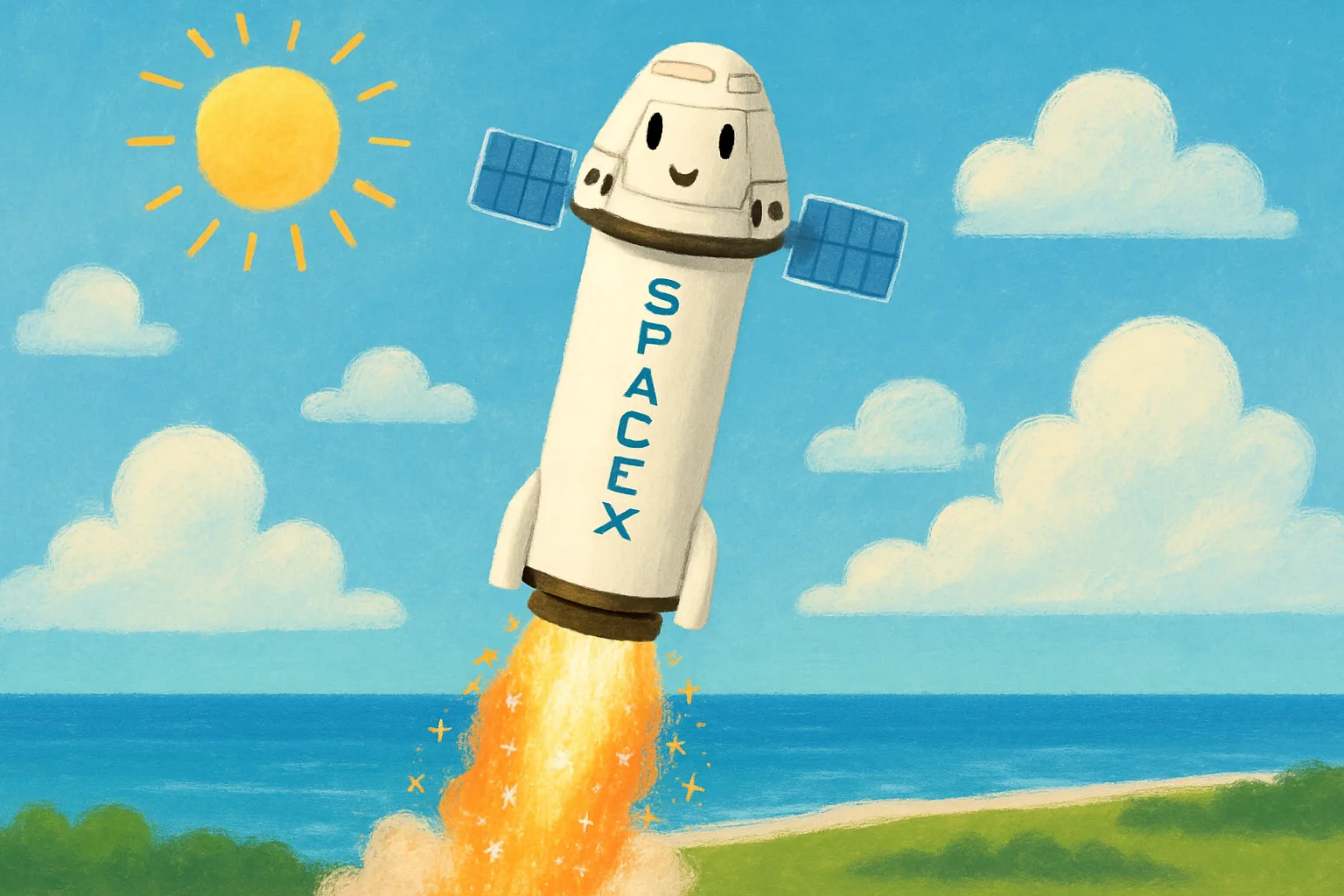
At 6:33 in the morning, a Falcon 9 rocket lifted off from Cape Canaveral Space Force Station in Florida. On top sat a robotic spacecraft called Dragon — packed full of goodies for the astronauts living on the International Space Station (ISS).
The most important item on board is a set of new solar panels. These are special roll-out solar panels that unfurl in space like a window shade. They are the very last set needed to finish a big upgrade to the station’s power system. Once astronauts install them, the space station will be more powerful than ever — able to run more science experiments and equipment.
But the solar panels aren’t the only exciting cargo. Dragon is also carrying experiments that scientists hope could one day help people on Earth. Researchers sent up brain organoids — tiny blobs of cells that act like a mini brain. Scientists will study them in space to look for clues about diseases like Alzheimer’s and Parkinson’s. The station also received materials to test how a special kind of glass forms when there is no gravity. And Dragon brought hardware to help make artificial retinas — tiny devices that could one day restore lost eyesight.
Why do scientists do these experiments in space? Because the lack of gravity — called microgravity — lets things grow and form in ways that are impossible on Earth. Think of it like baking a cake: changing just one ingredient changes the whole result.
Dragon will stay docked at the station for about a month. Then it will undock, splash down in the Pacific Ocean off the coast of California, and bring back finished experiments for scientists to study.
Why Does It Matter?
The new solar panels will complete a years-long project to give the space station a major power boost. More power means scientists can run bigger and better experiments in space. The medical experiments riding along could lead to future treatments for some of the most serious diseases that affect the brain and eyes. Space is not just about exploration — it is also a laboratory that helps people here on Earth.
Big Words
- Microgravity — the condition of very weak gravity in space, where things feel nearly weightless
- Organoid — a tiny cluster of cells grown in a lab that acts like a mini version of an organ, such as a brain
- Retina — the layer at the back of your eye that senses light and sends signals to your brain so you can see
- Solar array — a group of solar panels that turn sunlight into electricity
- Cargo — goods and supplies carried by a vehicle, like a truck, ship, or rocket
Fun Fact
The Dragon capsule can carry cargo both up to the station AND bring things back down to Earth — it is the only spacecraft currently working that can do both!
Think About It
If you could send one experiment to the space station to study in microgravity, what would you choose to learn about?
Sources
- NASA — SpaceX CRS-35 Launch Preview (nasa.gov)
- Space.com — SpaceX launching 6,300 pounds of cargo to the ISS on Oct. 13
- NASASpaceFlight.com — CRS-35 set to launch to ISS with final iROSA arrays, experiments, and other items
- TeslaNorth.com — SpaceX’s Next Cargo Dragon Launches Oct. 13 With the ISS’s Final Roll-Out Solar Arrays