
Moon Selfie! A Korean Spacecraft Just Photographed a Brand-New Crater
Quick Summary
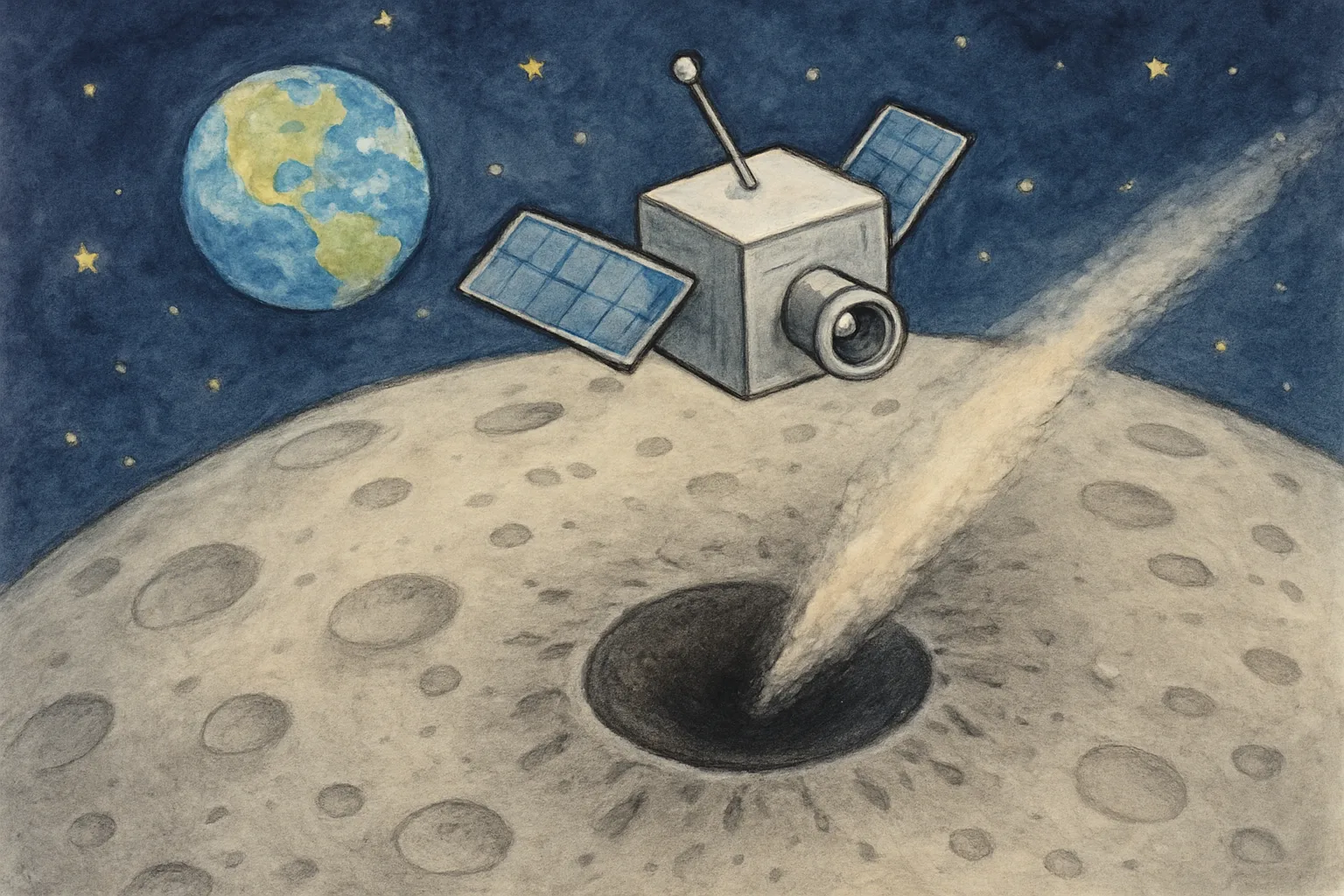
A piece of a SpaceX rocket crashed into the Moon on Wednesday, August 5. A South Korean spacecraft called Danuri was already orbiting the Moon and caught the whole thing on camera. Scientists are now using those images to study the brand-new crater.
What Happened?
Back in January 2025, a SpaceX Falcon 9 rocket launched two robotic moon landers into space. The landers went on their way, but the upper stage — the top part of the rocket that pushes things into deep space — was left drifting. It slowly followed a looping path through space for about 18 months.
Scientists calculated that the piece of rocket was on a collision course with the Moon. They knew roughly when and where it would hit. On August 5, at 2:35 in the morning Eastern time, it slammed into the lunar surface near a region called the Einstein Crater at about seven times the speed of sound. That is roughly five miles per second — fast enough to cross the United States in under ten minutes!
Danuri, South Korea’s first Moon orbiter, had a front-row seat. It began photographing the area 30 minutes before the crash. Then it flew over the site eight times, snapping pictures before and after. The images show a new dark splotch on the Moon’s gray surface, surrounded by material that splashed outward from the impact.
Scientists at NASA’s Lunar Reconnaissance Orbiter will also study the site to measure the crater’s size and understand what the Moon’s surface is made of.
Why Does It Matter?
Moon craters are usually millions of years old. Scientists almost never get to watch one form in real time. This is like seeing a dinosaur footprint being made right in front of you.
The before-and-after photos from Danuri give researchers something incredibly rare: a chance to compare exactly what changed. They can study how fast dust spreads after an impact, what the insides of the Moon’s surface look like, and how to predict future crashes more accurately.
Scientists also say the crash posed no danger to Earth. The Moon is roughly 240,000 miles away — almost 30 Earths lined up in a row.
Big Words
- Lunar orbiter — a spacecraft that travels in a circle around the Moon, studying the surface from above
- Upper stage — the top section of a rocket that keeps burning after the bottom falls away, pushing the spacecraft into its final position
- Ejecta — the rock, dust, and material that gets blasted outward when something crashes into a planet or moon
- Impact crater — a bowl-shaped hole in the ground made when a rock or other object slams into a surface at high speed
- Tidal disruption — when gravity pulls something apart because one side is being pulled much harder than the other
Fun Fact
Danuri’s name is a combination of two Korean words: “dal,” meaning Moon, and “nuriда,” meaning to enjoy. So its name basically means “Enjoy the Moon!” — which it certainly did this week.
Think About It
If you were a scientist with photos of a fresh crater, what questions would you most want to answer about it? What would you look for in the before-and-after pictures?
Sources
- ABC News (AP) — ‘South Korean satellite captures before and after views of SpaceX rocket’s moon crash’ (Aug 6, 2026)
- Space.com — ‘SpaceX rocket’s impact crater on the moon spied by Korean lunar orbiter (photos)’ (Aug 6, 2026)
- Korea Herald — ‘S. Korea’s Danuri captures rare images of SpaceX rocket crashing into moon’ (Aug 6, 2026)
- CNN — ‘New crater likely to form after SpaceX rocket slams into the moon’ (Aug 5-6, 2026)