
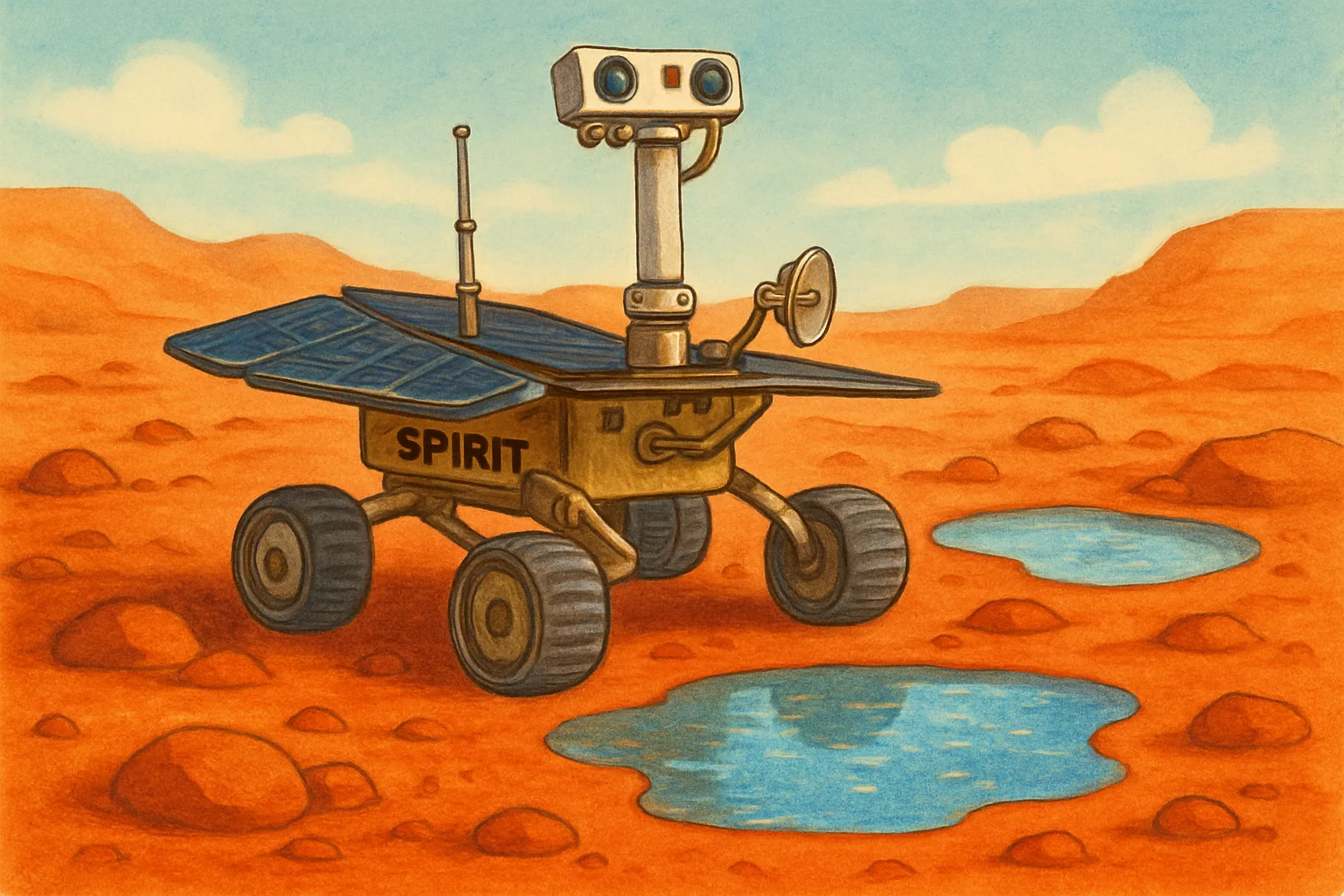
Old Robot, New Secret! NASA’s Spirit Rover Data Reveals Ancient Water on Mars
Quick Summary
NASA’s Spirit rover stopped working back in 2010. But scientists are still finding surprises hidden in the data it collected! A researcher just discovered mineral clues buried in Spirit’s old readings — and they suggest that water once covered large parts of Mars.
What Happened?
Imagine putting away a box of old homework, and then a friend finds a hidden clue in it twenty years later. That is almost exactly what happened with NASA’s Spirit rover.
Spirit landed on Mars way back in January 2004. It drove around the red planet for about six years, collecting all kinds of data with its science instruments. In 2010, it stopped responding and NASA officially ended the mission. But all that data was carefully saved — billions of bits of information, just sitting in storage.
Now, a scientist named Professor Paulo de Souza from Edith Cowan University in Australia has gone back and looked at those old readings very carefully. He combined measurements from 32 different soil spots that Spirit visited inside a giant bowl-shaped area called Gusev Crater.
By adding all those small measurements together — like stacking up puzzle pieces — Professor de Souza found something that nobody noticed before. The Martian soil contained traces of two minerals called hematite and altered magnetite. These are important because they usually form when rocks and soil are touched by water over a long time.
Think of hematite like this: it is the same rust-red mineral that gives Mars its famous reddish color — and on Earth, it often forms at the bottom of ancient lakes and rivers.
The minerals were so faint that the original scientists couldn’t detect them with individual readings. It took combining thousands of measurements into one big picture — like turning up the volume to hear a very quiet sound — before the clue finally appeared.
Why Does It Matter?
Scientists have long wondered if Mars was ever wet enough to support life. Finding these water-linked minerals in ordinary Martian topsoil is a big deal. It suggests that the ground across wide areas of Mars was once soaked by liquid water — not just in a few special spots, but perhaps across huge regions of the planet.
This also shows something exciting: old data from old robots can still produce brand-new discoveries! Scientists don’t always need a new mission to learn something new. Sometimes, smarter tools and smarter techniques can unlock secrets hiding right in front of us.
Spirit itself was an extraordinary robot. It was only designed to last 90 days. Instead, it kept going for over six years — 25 times longer than planned! Even asleep, it is still teaching us.
Big Words
- Rover — a robot vehicle that drives around on a planet’s surface to study it
- Hematite — a reddish mineral that often forms when rocks are in contact with water for a long time
- Magnetite — a dark, magnetic mineral that can change form when it reacts with water
- Gusev Crater — a large, ancient bowl-shaped impact crater on Mars that Spirit explored
- Mineral — a natural solid substance found in rocks and soil, like iron, salt, or quartz
Fun Fact
Gusev Crater is about 100 miles (160 km) across — big enough to hold the entire city of Los Angeles several times over. Scientists think it may once have been a giant lake!
Think About It
If Mars once had lots of water, what do you think it might have looked like millions of years ago? Could anything have ever lived there?
Sources
- Phys.org — More evidence Mars once had water emerges from old Spirit rover data (July 28, 2026)
- Sci.News — Hidden Clues in Spirit Rover Data Suggest Mars Once Had Far More Water than Scientists Realized (July 29, 2026)
- TechTimes — Hematite Hidden for Decades in Spirit’s Archive Rewrites Mars Water History (July 31, 2026)
- Scimex — More evidence Mars once had water — New ECU discovery (July 2026)
- NASA Science — Spirit mission page