
Scientists Found a Secret Off-Switch Inside the Sun — and It Could Save Satellites!
Quick Summary
Scientists have found a hidden signal in the Sun’s activity cycle. It acts like a built-in off-switch that could warn us about dangerous space weather up to seven years before it happens. This discovery could help protect satellites, power grids, and GPS systems all over the world.
What Happened?
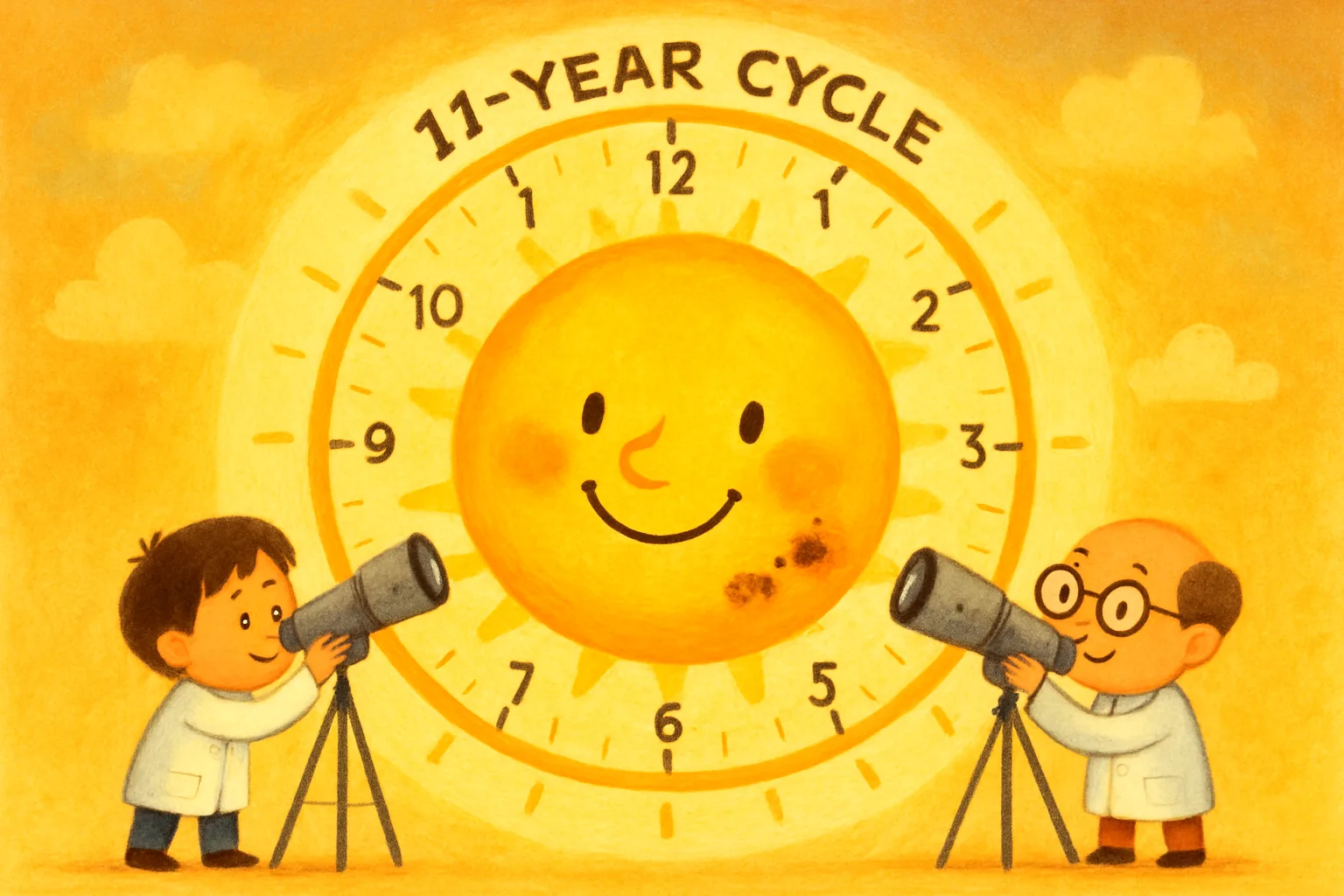
The Sun does not just shine steadily. It goes through a slow rhythm that lasts about 11 years. During that time, it gets more active, fires off lots of solar flares, and then gradually quiets back down. This is called the solar cycle.
Think of it like the Sun taking a long, slow deep breath. It breathes in over about 11 years, reaching its most active point at the middle — called solar maximum — then it exhales and grows quieter.
The tricky part is that every solar cycle is a little different. Some are strong, some are weak, and scientists have never had a good way to predict how powerful the next one will be until it is almost already here.
Now, researchers at the Royal Astronomical Society have found something exciting. They discovered that every cycle has a hidden moment they call a “switch-off” point. At this moment, the most violent space weather suddenly stops. The number of sunspots remaining at that moment acts like a clue. It tells scientists how strong the very next cycle will be.
Using this method, scientists can make a prediction up to seven years before the Sun reaches its next peak of activity. Seven years is a long time — that is almost as long as going from first grade all the way through middle school!
The team has already taken an early peek at the next cycle, called Solar Cycle 26. Their best guess is that it will be a moderate cycle, similar to or a bit weaker than the current one. They will know more precisely in about two more years.
Why Does It Matter?
Space weather is not just a cool science topic. It is a real-world concern. Powerful solar storms can disrupt GPS signals, knock out radio communications, damage satellites, and even affect power grids on the ground.
With seven years of warning, engineers and space agencies could better prepare satellites and power systems before a strong solar cycle arrives. It is a bit like getting a weather forecast a week ahead — except the forecast is for space, and it is seven years ahead.
This discovery gives scientists their best-ever tool for planning ahead. And planning ahead means fewer surprises from our nearest star.
Big Words
- Solar cycle — the roughly 11-year pattern of the Sun’s activity, from quiet to stormy and back again
- Solar maximum — the peak point in the solar cycle when the Sun is most active and has the most sunspots
- Switch-off point — the newly discovered moment when the Sun’s most violent activity suddenly stops within a cycle
- Space weather — the changing conditions in space caused by activity on the Sun, which can affect Earth’s satellites and technology
- Solar Cycle 26 — the next 11-year solar cycle, which scientists are already beginning to study and predict
Fun Fact
Astronomers have been counting sunspots since 1755 — that is over 270 years of data! All those records helped scientists find this hidden off-switch pattern hiding in plain sight.
Think About It
If you could predict one big event seven years in the future — like a huge storm or a technology failure — how would you use that time to get ready? What would you do first?
Sources
- Royal Astronomical Society — NAM 2026: How the Sun goes to ‘sleep’ could reveal future space weather when it wakes (July 20, 2026)
- ScienceDaily — A hidden ‘switch-off’ signal could predict solar storms seven years early (July 21, 2026)
- EurekAlert — How the Sun goes to ‘sleep’ could reveal future space weather when it wakes (July 2026)
- Phys.org — How the sun goes to ‘sleep’ could reveal future space weather when it wakes (July 2026)