
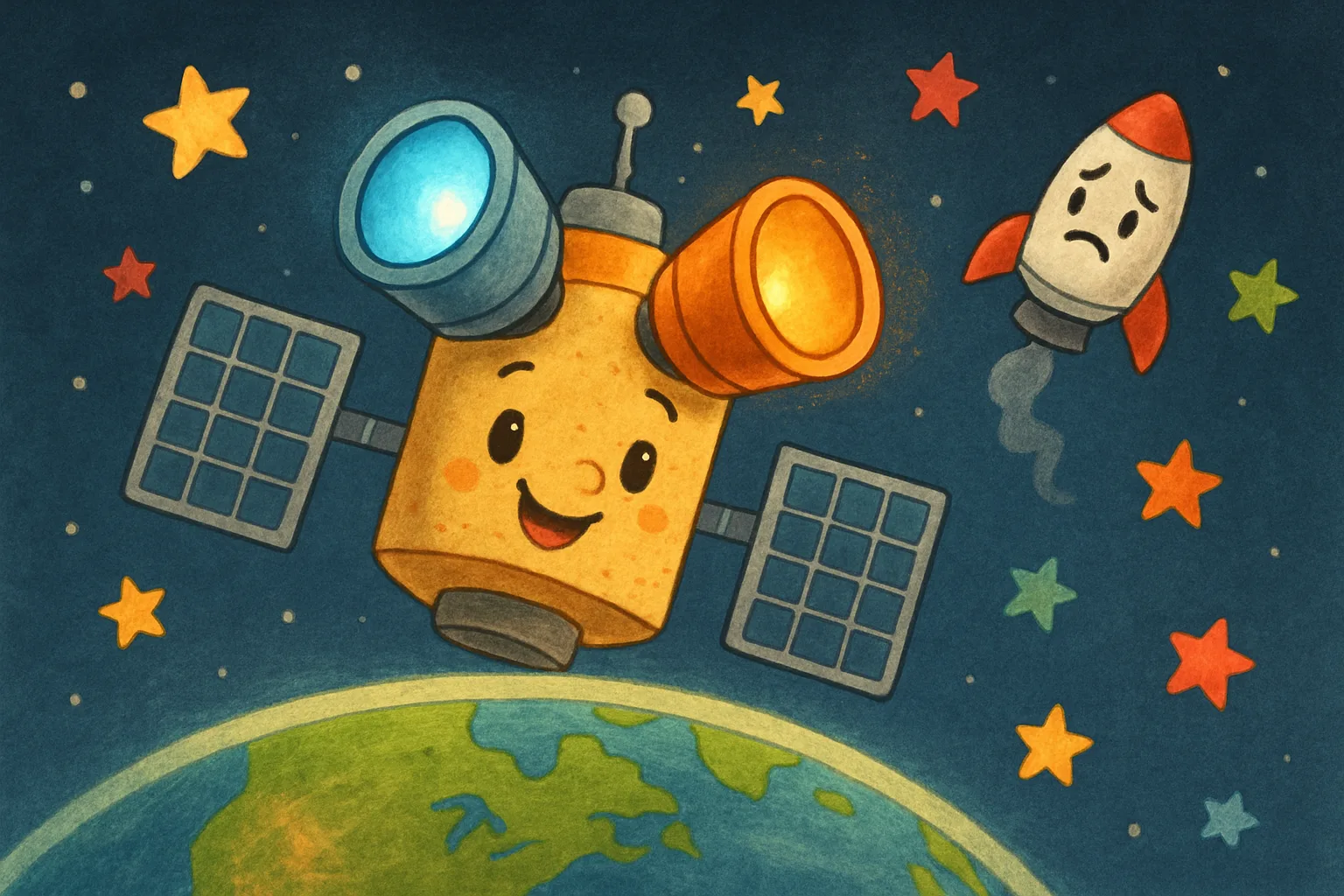
Still Fighting! NASA’s Swift Telescope Is Back at Work After a Daring Rescue Attempt
Quick Summary
NASA’s Swift space telescope is back to scanning the sky — even though a daring rescue mission failed to save it. The brave old telescope is making the most of whatever time it has left. Scientists are calling it an incredible final act.
What Happened?
NASA’s Neil Gehrels Swift Observatory has been circling Earth since November 2004. That is nearly 22 years! It was built to do just one job: spot enormous explosions in deep space called gamma-ray bursts. Gamma-ray bursts are the most powerful blasts in the entire universe. Imagine the biggest firework you’ve ever seen — then imagine something a trillion times more powerful. That’s a gamma-ray burst.
Over the years, Swift became much more than a one-trick spacecraft. It used three different telescopes to study everything from exploding stars to distant galaxies. NASA scientists called it their “multitool for studying the cosmos.”
But there was a problem. Earth’s thin upper atmosphere slowly drags satellites downward. Swift was sinking. NASA worried it would fall back to Earth and burn up in the atmosphere later this year.
So NASA hired a company called Katalyst Space Technologies to build a space robot named LINK. The plan was brave and bold. LINK would fly up, grab Swift like a space crane, and push it to a higher, safer orbit. The company built and launched LINK in just nine months — an amazing feat.
Sadly, things went wrong. In July, two of LINK’s spinning wheels stopped working. The little robot started tumbling and used up too much fuel trying to stabilize itself. It could no longer reach Swift. The rescue mission was officially over.
But Swift’s team refused to give up. In late August, engineers switched two of Swift’s three science instruments back on. Within hours, the old telescope was photographing the universe again — including a beautiful X-ray image of the glowing remains of a star that exploded 13,000 light-years away.
Scientists say Swift may have only a month or two of science time left before it drops too low to operate. But it is going to use every last minute.
Why Does It Matter?
Swift taught us enormous amounts about the universe’s most violent events. Over 21 years, it spotted more than 1,000 gamma-ray bursts. In 2008, it detected one so bright it could briefly be seen with the naked eye — even though it happened 7.5 billion light-years away. That is halfway across the entire observable universe!
When Swift finally does reenter Earth’s atmosphere, it will break apart safely and mostly burn up. Scientists are already planning what comes next. But Swift’s legacy — over two decades of discovery — is permanent.
Big Words
- Gamma-ray burst — An enormous explosion in deep space that releases more energy in a few seconds than our Sun will in its entire lifetime.
- Observatory — A special place or spacecraft designed to study space using powerful instruments.
- Orbit — The curved path a spacecraft takes as it travels around Earth or another object in space.
- Atmospheric drag — The way Earth’s thin upper air slowly pulls satellites downward, like friction slowing a sled.
- Reentry — When a spacecraft falls back into Earth’s atmosphere, usually burning up due to extreme heat.
Fun Fact
Swift was designed to last just two years. It ended up working for nearly 22 — more than ten times longer than planned! That is like being asked to run one lap and then running eleven marathons instead.
Think About It
If you were building a space telescope, what would YOU want it to study — and what would you name it?
Sources
- NASA Science Blog — NASA’s Swift Restarts Science Observations (Aug 28, 2026)
- Space.com — NASA’s doomed Swift space telescope restarts science work after rescue mission fails
- ScienceDaily — NASA’s Swift telescope is back, but time is running out (Sep 1, 2026)
- NBC News — NASA mission to save its sinking space telescope fails