
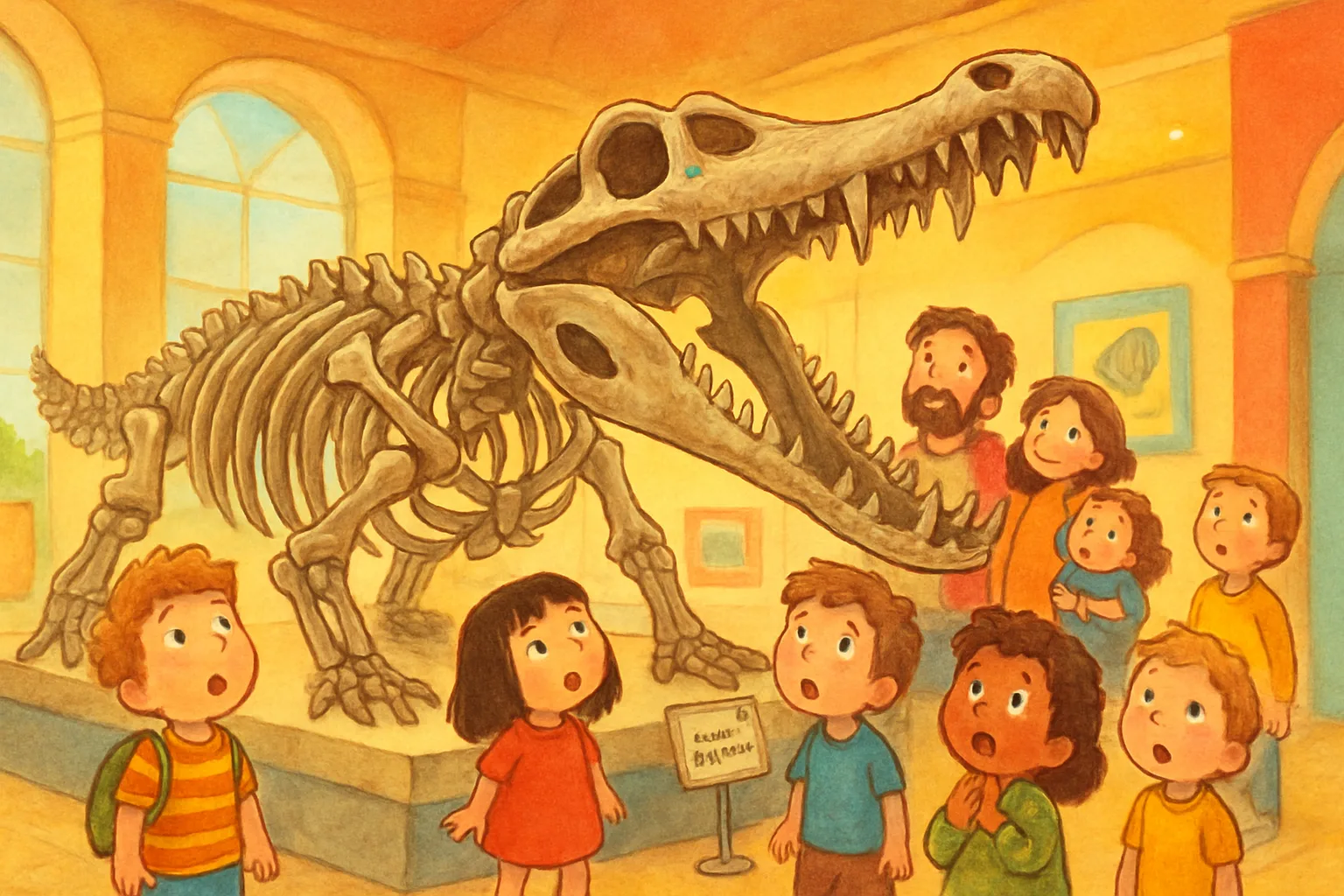
Dino-Chomper Is Back! The World’s First Accurate Terror Croc Skeleton Is on Display
Quick Summary
About 75 million years ago, a massive crocodile-like creature called Deinosuchus lurked in the rivers and swamps of what is now the southeastern United States. It was big enough to eat dinosaurs for breakfast. Now, for the very first time, anyone can see a scientifically accurate, life-size skeleton of this legendary beast at a museum in Georgia.
What Happened?
The Tellus Science Museum in Cartersville, Georgia, has just put up the world’s first fully accurate mounted skeleton of Deinosuchus schwimmeri. The replica stretches 31 feet from snout to tail — about as long as a school bus.
Building it took decades of hard work. Paleontologist Dr. David Schwimmer began finding Deinosuchus fossil remains in 1979. He spent more than 40 years studying those bones, measuring them, scanning them with computers, and publishing research. Scientists even named the species after him.
To build the skeleton, teams used detailed 3D scans of real fossil bones. Every tooth, every rib, and every joint was shaped to match the actual fossils as closely as possible. No other museum in the world has anything like it.
Deinosuchus looked a lot like a modern crocodile, but much, much bigger. Its jaws were enormous. Scientists have found bite marks on dinosaur bones that match Deinosuchus teeth perfectly — proof that this animal really did hunt and eat dinosaurs.
Why Does It Matter?
For most of history, people only knew about Deinosuchus from scattered broken fossils. No one had ever seen the whole animal put together in an accurate way. This skeleton finally shows the world what this ancient giant truly looked like.
It also helps scientists better understand the ancient ecosystems of North America. When Deinosuchus was alive, much of the southeastern United States was a warm, shallow sea with swampy shores. Dinosaurs roamed the land nearby, and this giant croc waited in the water.
Museums like this help everyone — kids and adults — connect with animals that lived millions of years before humans. Seeing a life-size skeleton makes ancient life feel real in a way that a picture in a book simply cannot.
Big Words
- Paleontologist — a scientist who studies ancient life by examining fossils, bones, and rocks
- Fossil — the preserved remains or traces of a living thing from long ago, turned into rock over millions of years
- Apex predator — an animal at the very top of the food chain that no other animal hunts
- Replica — a carefully made copy of something; in this case, a copy of a skeleton built to match the exact measurements of real fossils
- Cretaceous period — a span of time from about 145 million to 66 million years ago, when dinosaurs ruled the Earth and Deinosuchus was alive
Fun Fact
Deinosuchus had teeth described by scientists as being about the size of bananas. A modern saltwater crocodile — already considered one of the most powerful biters alive today — would look almost small standing next to one!
Think About It
If you could go back in time to the Cretaceous period and safely watch one animal from a distance, would you choose Deinosuchus, a T. rex, or something else entirely — and why?
Sources
- ScienceDaily / Columbus State University — ‘This school-bus-sized terror croc ate dinosaurs. Now it’s back.’ (Aug 5, 2026)
- Columbus State University News — ‘Schwimmer’s decades-long quest leads to first scholarly accurate replica of dinosaur-killer croc’ (Dec 2025 / Aug 2026 re-report)
- Phys.org — ‘Decades-long quest leads to first scholarly accurate fossil replica of dinosaur-killer croc’ (Dec 2025)