
China Sends a Spacecraft to Earth’s Tiny ‘Shadow Moon’ — and It Might Be a Chunk of Our Moon!
Quick Summary
China’s spacecraft Tianwen-2 has finally arrived at a strange little asteroid called Kamoʻoalewa. It traveled about one billion kilometers to get there. Scientists are thrilled because this space rock may actually be a piece of our own Moon!
What Happened?
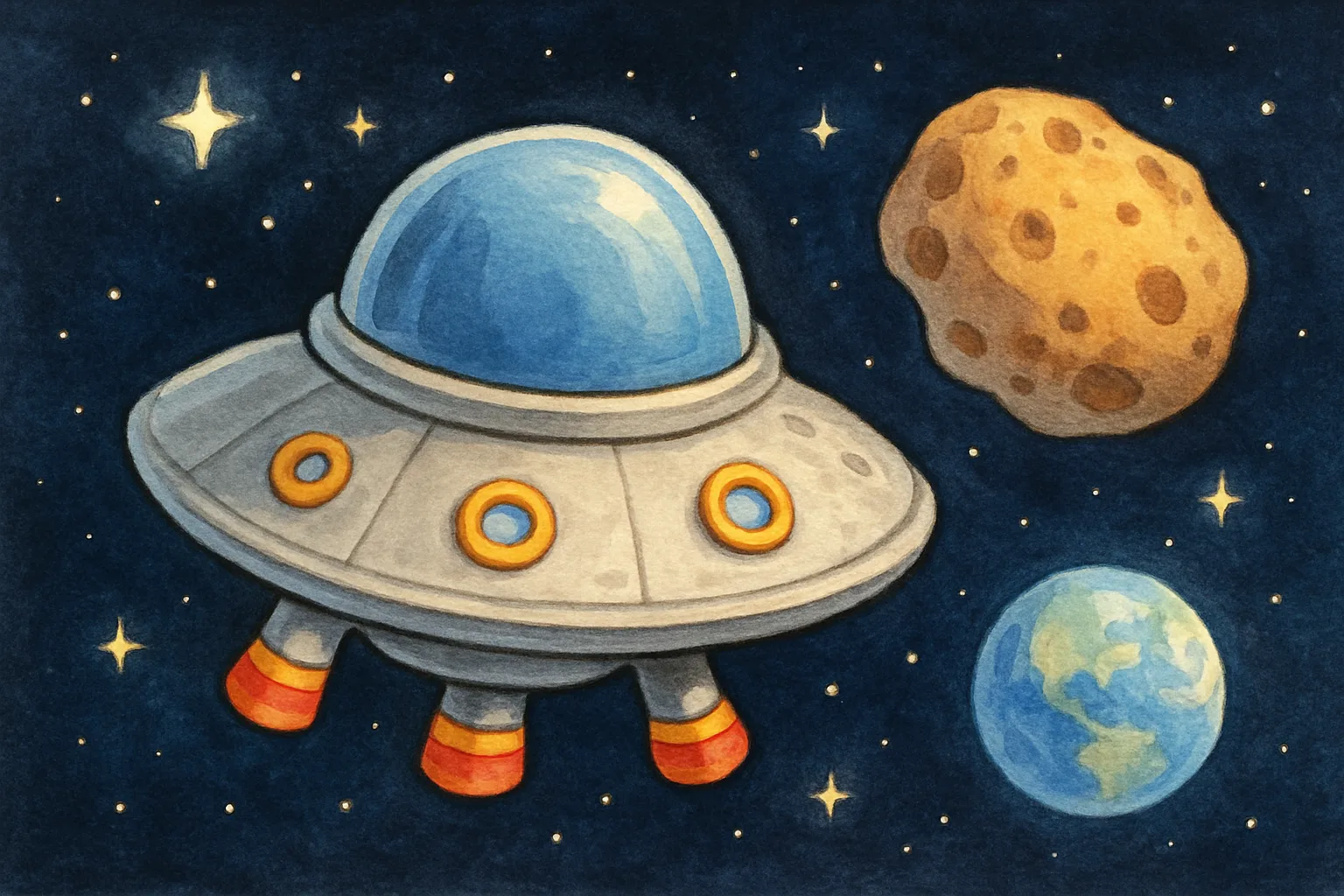
Deep in space, something amazing happened today. China’s space agency announced that its Tianwen-2 spacecraft successfully reached a small asteroid called Kamoʻoalewa (say it like: kah-moh-oh-ah-LAY-wah).
The journey took about 400 days and covered roughly one billion kilometers. To put that in perspective, that’s like traveling from Earth to the Sun — and then all the way back — more than three times.
Tianwen-2 launched in May 2025. It quietly cruised through deep space. China’s space team said almost nothing about the mission until today. Then, on July 6, they released the first close-up image of the asteroid. It looks like a small, lumpy potato.
The spacecraft is now hovering about 20 kilometers away from the asteroid. Twenty kilometers is roughly the distance across a medium-sized city. From that distance, it is already studying the rock’s surface.
Over the coming months, Tianwen-2 will get even closer. It will try to land briefly and scoop up rock samples. Then it will carry those samples all the way back to Earth, arriving in 2027.
Why Does It Matter?
Kamoʻoalewa is one of the most mysterious space rocks near Earth. It is only about 20 to 100 meters wide — smaller than a football field. It travels around the Sun in almost the same path as Earth, like a shadow following you on a sunny day. Scientists call it a “quasi-moon” or “quasi-satellite.”
Here is the really exciting part: when scientists study Kamoʻoalewa from Earth, it looks a lot like rocks from our Moon. Some scientists think a giant space rock crashed into the Moon millions of years ago and sent a chunk flying into space. That chunk became Kamoʻoalewa!
But other scientists are not so sure. They think it might just be an ordinary asteroid from the asteroid belt between Mars and Jupiter.
There is only one way to know for certain: collect actual pieces of it. That is exactly what Tianwen-2 is going to do.
When the samples arrive on Earth in 2027, scientists can compare them with Moon rocks brought back by the Apollo astronauts. If the chemistry matches, the mystery will be solved!
Big Words
- Quasi-satellite — a space rock that travels around the Sun in an orbit very close to Earth’s, so it looks almost like a moon but is not truly held by Earth’s gravity.
- Asteroid — a rocky or metallic object in space, smaller than a planet, that travels around the Sun.
- Sample return mission — a spacecraft journey designed to collect material from another world and bring it back to Earth for scientists to study.
- Orbit — the curved path an object takes as it travels around a planet, moon, or star because of gravity.
- Lunar ejecta — pieces of rock that were blasted off the Moon when another object smashed into it long ago.
Fun Fact
Kamoʻoalewa spins very fast — it completes one full rotation every 28 minutes. That means if you were standing on it, you would see a full “day” and “night” in less time than a school lunch break!
Think About It
If scientists confirm that Kamoʻoalewa is truly a chunk of the Moon, what other surprising places in our solar system might have pieces of the Moon hiding in them?
Sources
- SpaceNews — ‘Tianwen-2 arrives at asteroid Kamo’oalewa, first image revealed’
- Global Times — ‘China’s Tianwen-2 reaches asteroid Kamoʻoalewa, starting scientific exploration after 1 bln kilometers journey’
- Wikipedia — ‘2026 in spaceflight’ (citing SpaceNews, July 6, 2026)
- The Planetary Society — ‘Tianwen-2: China closes in on Kamoʻoalewa’
- Scientific American — ‘China’s Tianwen-2 spacecraft arrives at one of Earth’s mysterious quasi-moons’