
She’s Back! A Tiger Named ‘Hope’ Roams Wild in Kazakhstan for the First Time in 70 Years
Quick Summary
A female Amur tiger named Umit — which means “hope” in the Kazakh language — has been released into the wild in Kazakhstan. It is the first time a tiger has roamed that land in more than 70 years. Scientists call it one of the most exciting conservation moments in recent history.
What Happened?
More than 70 years ago, tigers vanished from Kazakhstan completely. These were a type called the Caspian tiger, also known as the Turan tiger. They once roamed the rivers and reed beds of Central Asia. But hunting and habitat loss wiped them out by the mid-1900s. For decades, Kazakhstan had no wild tigers at all.
Then, scientists made a remarkable discovery: the Amur tiger — which lives in far eastern Russia — is genetically almost identical to the lost Caspian tiger. They are like cousins so close they are practically twins. That meant Amur tigers could be used to bring tigers back to Kazakhstan.
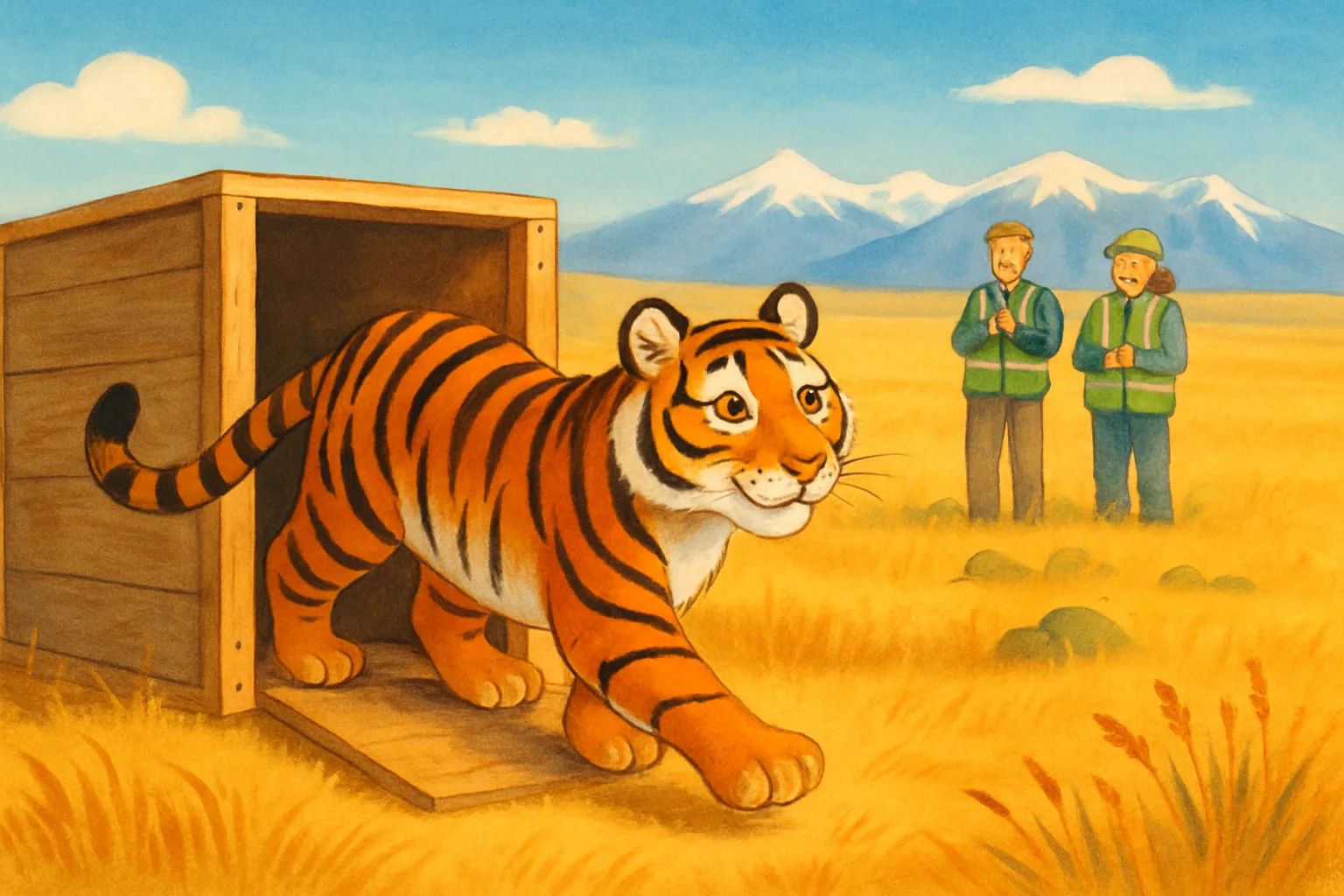
On July 31, 2026, something incredible happened. A wooden crate on the back of a pickup truck swung open in the Ile-Balkhash State Nature Reserve in southeastern Kazakhstan. Out leaped Umit — a healthy adult female Amur tiger — and she bounded off into the open steppe.
But this moment did not happen overnight. It took more than ten years of hard work to prepare. Scientists needed to make sure the reserve had enough prey for a hungry tiger. An adult tiger needs to hunt roughly 50 to 70 large animals every year — imagine eating a full-grown deer every week! So since 2018, conservationists carefully reintroduced Bukhara deer and other animals into the reserve to build up a food supply.
Umit herself went through months of careful health checks and behavior assessments before her release. Vets confirmed she was healthy and that her hunting skills were sharp. She is now fitted with a satellite tracking collar the size of a thick collar necklace. Scientists can watch her movements on a screen in real time, like a GPS dot moving across a map.
Three more tigers are waiting in special enclosures inside the reserve. The adult male, named Amur, is still being evaluated. Two young cubs named Turan and Ussuri are growing up and learning. They were all brought from Russia as part of an international agreement to restore tigers to Kazakhstan’s wild places.
Why Does It Matter?
Tigers are what scientists call a “keystone species.” That means they help hold an entire ecosystem together. When tigers are present, they keep populations of deer and wild boar from growing too large. That stops those animals from overgrazing plants. Healthy plants protect riverbanks and provide food for birds and insects. In this way, bringing back one tiger helps hundreds of other species, too.
Kazakhstan’s tiger project is also a model for countries around the world that want to restore animals that have been lost. It shows that with patience, science, and teamwork across countries, it is possible to bring a species back from the edge.
Big Words
- Reintroduction — the process of bringing a species back to a place where it once lived but disappeared
- Keystone species — an animal that plays such an important role in its ecosystem that removing it causes big changes for many other plants and animals
- Habitat — the natural environment where an animal lives, finds food, and raises its young
- Satellite tracking collar — a device an animal wears that sends location signals to scientists via satellites in space
- Ecosystem — a community of plants, animals, and the environment they all share and depend on
Fun Fact
The Ile-Balkhash Nature Reserve where Umit now roams is about 450,000 hectares — that is roughly the same size as the entire country of Luxembourg!
Think About It
If scientists can bring tigers back to Kazakhstan after 70 years, what other animals that have disappeared from a place do you think could be restored — and what would need to happen first?
Sources
- Mongabay — ‘Kazakhstan releases first tiger into the wild in 70 years’
- Euronews — ‘First tiger released into the wild in Kazakhstan 70 years after Turan tiger extinction’
- The Astana Times — ‘Kazakhstan Releases First Tiger Into Wild in More Than 70 Years’
- NBSAP Accelerator Partnership — ‘Restoring a tiger landscape: Kazakhstan advances long-term tiger recovery in Ile-Balkhash’